Who are the teachers who protest in front of the Ministry of Education: “After 20 years of work, my salary will fall by 1,000 lei” / “the ministry paid me 54 lei for one hour, from now on I will receive about 30 lei”


“The 20-hour norm throws the system in a chaos that no one wants,” says a teacher, who has been teaching for 28 years, for HotNews. It has already protested for more than two weeks in front of the Ministry of Education, along with other teachers, who demand the changes made in education, by Law 141/2025. Hotnews wanted to find out from the teachers who are their main dissatisfaction, before the new school year, which will start on September 8th.
Since the adoption of Law 141/2025, several teachers protest daily before the Ministry of Education. The first rally took place on July 30, and, since then, every day, teachers and teachers come to show their dissatisfaction with the changes made.
“The resignation, Daniel David. Down, down, false minister!”, The approximately 150 people came, on Thursday, in front of the building.
According to the calendar announced by the trade union leaders, the protests will continue every day of the week, until the beginning of the school year, on May 8. Then, “a rally and a protest march is scheduled on the Victoriei Square route – Cotroceni Palace, between 1100 and 1600”.
The main dissatisfaction aims to increase the didactic norm, to combine the classes and to reduce the number of positions, to decrease the scholarship fund and to cut some rights for students, as well as to reduce the payments by the time.
“It is essential to be solidarity and not accept that the future of children are sacrificed in the name of austerity,” the teachers' representatives transmit.
Beyond the banners and slogans, behind each protest are teachers with personal stories.
HotNews spoke with some of them, to understand how the new law affects the government.
Gina Mitriu, teacher with 20 years old: “My salary will fall by 1,000 lei”
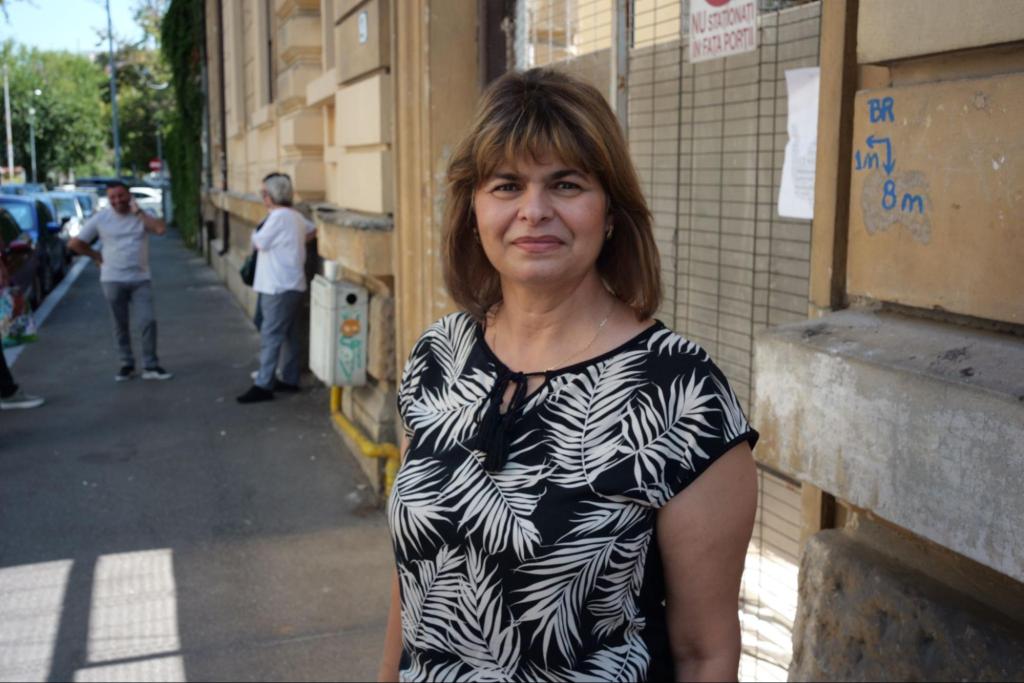
Gina Mitriu, a teacher for primary education at the “Nicolae Bălcescu” School in Tecuci, Galati County, says that her future and the children she teaches is questioned.
He has 20 years of experience in the chair, but “the amount he will take from now will be diminished by 1,000 lei, the decrease coming from meal vouchers and overtime,” explains the teacher.
The unit where it teaches will be “absorbed” by a high school on the other side of the city, “where the older children are, that is, it is about high school children”.
With this reorganization, Gina will have to look for another job, but says she does not know what life will look like in the fall. However, the greatest concern is not related to his job, but to the students.
“The relocation of the school risks losing Roma children, due to transport difficulties,” she warns.
The mayor “promised a minibus”, but the solution is far from guaranteeing the presence at the courses. “We do not know if they will have a 100%presence. We do not know if they will come under these conditions. But let's hope that another better solution will be found so that we will not lose our children.”
The teacher says he proposed several variants to avoid abandonment: “Either we stay in place, inside the kindergarten. We even asked for containers to be able to do the hours there, but we were told that it costs a lot and the town hall has no money. Another variant would be to relocate us in a school closer to our school.”
Ignat Ionel, teacher of Romanian language, 23 years old at the chair: “The effect is devastating”
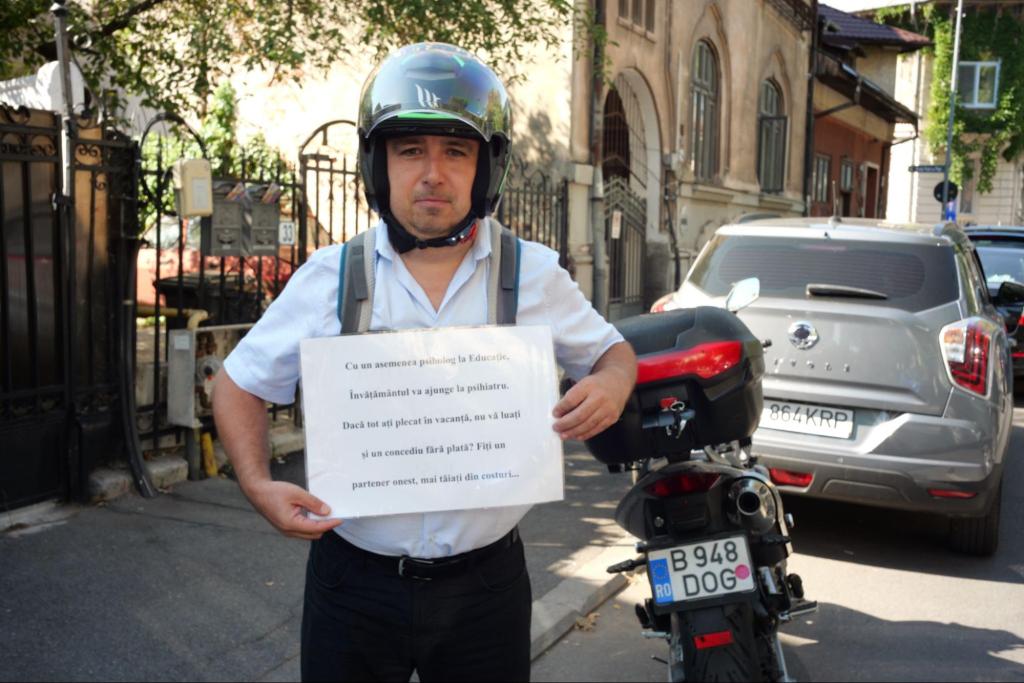
On the engine and with protest messages, Ignat Ionel, professor of Romanian language and literature at the “Decebal” Theoretical High School in Sector 3 of the Capital, joined his colleagues on the street. He has been teaching for 23 years. The changes in the new year hit the teachers directly, he says.
“If until now the ministry paid me 54 lei for one hour, from now on I will receive about 30 lei, after 23 years of experience,” he says. The situation of the younger colleagues is even more difficult: “a debutant teacher will reach 22 lei per hour. With the payment by 45%, the effect is devastating.”
Ignat points out that it is not just about money, but also people who risk disappearing from the system. “A simple calculation: at 18 hours as I had before, now we will have 20 hours. At every 9 teachers who are in the system, the 10th will disappear.”
“School dropout will increase”
The teacher also talks about the consequences of school merits. “” It does not mean only the release of a place in the chair and some money saved to the budget. The real effects will be seen in the school dropout, which will increase. There are not enough means of transport, minibuses that will lead to the last relocated child to another they will no longer be able to reach the school of residence. ”
In his opinion, the reform only forces the teachers to work harder for less money. “Increasing the norm to 20 hours a week is, as Prime Minister Bolojan says,” more work on less money. “But my colleagues are shouting in the street:” Down, down, minister! “. Minister David does not say that teachers will disappear from the system.”
Cătălin Gheorghe, five -year -old teacher: “I was subjected every time to humiliation”

Cătălin Gheorghe is 35 years old and has been teaching plastic education for almost five years at the Gymnasium School no. 27 of Sector 2, Bucharest. He is not a full teacher and says that, although he takes the title exam annually, places for his discipline “no longer exists”.
“It is an I do not know the year in which I give the degree almost without any chance. Because there are no title,” he explains.
His greatest dissatisfaction is about how the teachers were treated. “We were subjected every time to humiliations, not only now, but also in previous years. First there were rumors, then we were told that nothing happened, after which the information on the market appeared and we were asked not to take us after sources.
The teacher believes that these changes will strongly affect the quality of education. “This will affect almost one third of the teachers, even more, because it will mean the increase of the classes with about 25% students. Automatically decreases the quality of the educational act. And now, with a maximum of 26 students in the classroom, the educational process is on the ground,” says Gheorghe.
He points out that the substitutes will be the most vulnerable. “Those who lived from broken rules, a few hours around, a few beyond, will be the most affected. These norms will disappear and no one will come for an remaining hour, especially if they are in the middle of the day.”
In the five years in the chair, Gheorghe says he saw how the prestige of the profession decreases. “The teachers have lost their authority, the discipline levers, and the parents and students received all kinds of interpretable legal tools. In front of the children, the teacher's performance has disappeared. Today, the school is no longer regarded as the first formative institution. For many parents only matter the exam subjects, the rest are treated as”, “
“I, as a final teacher with almost 5 years old, I have between 4,000 and 5,000 lei”
Gheorghe recognizes that many colleagues are thinking of leaving the system. “I am afraid that we will arrive again as in the years 1999-2000, when the chair were brought substitutes with notes of 1 and 2 for exams, which will collapse even more.”
The financial situation does not give him reasons for optimism. “We have been promised increases, but the last 20% tranche was not respected. Salaries do not reach, and not only to teachers, but to over 60-70% of the jobs in the country, where not even the average salary is paid, considered minimal for a decent living.
“We ask for repealing the law, the minister's resignation does not solve anything”
For Gheorghe, the solution is clear: “First of all we ask for the repeal of the law. The resignation would not solve anything. If this law remains, the education will reach a difficult situation to imagine. They will be somewhere at 15-20 thousand students who will no longer take place in the classes. Many will be pushed to private schools, but they have no money,”
The teacher is preparing, along with colleagues, for the boycott announced by unions on September 8th. “But we need solidarity, because in the game it is the future of the children. We also need the support of the parents. Maybe I do not realize it.”

Elena Silvia Țerfan, Romanian teacher, with 28 years experience: “The 20-hour norm throws the system in chaos”
Elena Silvia Ţerfan is a Romanian language and literature teacher at the “Nicolae Iorga” National College in Brăila and has 28 years of experience at the chair. He came to protest with his colleagues and says that the situation in education has reached a critical point.
“We are on the 15th day of protest. It is our assumption of the changes that are now wanted and, at the same time, the desire to support our claims, to avoid unemployment in education and to fight for our cause. The 20-hour didactic norm throws a chaos that no one wants,” she explains.
“You cannot build on instability”
Although she does not lose her job, being a four -year -old at the “Nicolae Iorga” National College, in Braila, says that restructuring already affects colleagues from other schools. “A colleague of mine, with the teaching degree I, very well prepared and with many years of work, remains without a job because of the merits. She is also sick, has an incurable disease, and yet she has worked enormously. Now she is in a situation to run between two, three, four schools.”
For her, the substantive problem is the “instability” that “produces disorder and lack of performance”. “You cannot build on instability. No one refuses to change, but the reform must take into account the reality and the voice of those who are daily at the chair.”
Adrian Cosu, mathematics teacher, 27 years old: “Colleagues are already looking for positions in other schools”
Adrian Cosu teaches mathematics at the “Ferdinand” National College in Bacău. He is 27 years old in the chair, all didactic degrees and says that the negative effects of the changes made are already seen.
“Already things are happening, the evil has been done. These days, people are looking for positions in other schools. Norms have been reduced, the stations have been reduced because of this increase of hours. To me, personally, it did not happen, but in my school the norms were stretched to the maximum.
The teacher makes a simple calculation: “At seven people, or two hours, it means 14 hours. That means almost a norm. I mean a man, or three quarters of the time, he has to leave. Or to look for other schools. And this is what happens now, these days. He must come to the norm or in the rest and look for the post.”
Cosu points out that many colleagues have invested years of work and exams to become teachers, and now they feel forced to look for alternatives. “A man who learned to be a teacher, gave exams, title exams … We are 27 years old in education. That's what we wanted to do and that's what we hope to do, until you can.”