Interview with “Banksy de Romania”, the anonymous artist who filled Bucharest with drawings with a strong social impact: “Any artist has the obligation to tell the truth”

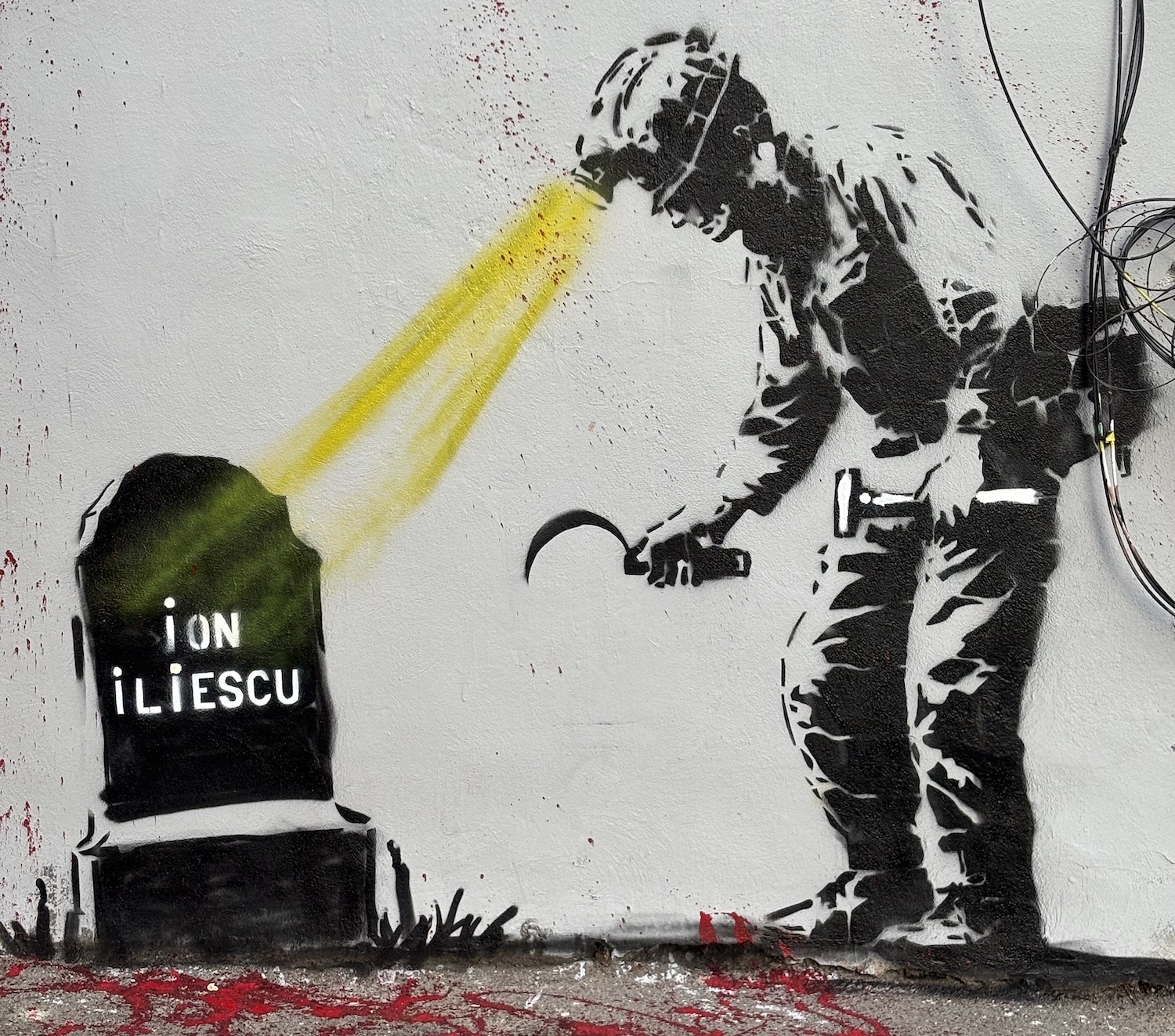
On an advertising panel in the center of Bucharest, a mannequin full of syringes hangs inert, under the message “Stop Drugs”. On another street, a miner illuminates with the grave of Ion Iliescu, in time on the floor are blood spots. These are just two of the works of anonymous artist who tells themselves Orhan -a fictional name chosen to protect its identity. Hotnews spoke with the artist who is also called “Banksy de Romania”, about the messages he wants to convey, but also about the interactions with the citizens and the authorities.
- Banksy is the pseudonym of an artist and director in the UK, known for his satirical drawings, some with a strong political message, on the streets of big cities. Banksy started his activity in the 90's, but to this day his identity has remained unknown.
In a country where graffiti is still regarded as a vandalism, and corruption is only a statistics in the news, Orhan has built a silent-standing voice. O you call it The Blood Stained Hand And it uses it to say things by name, on walls that reach the photos of passers-by, to viralize on the walls of social networks.
In the interview with Hotnews, Orhan talks about truth and frustration, how “blood stain” became his visual signature and the reasons he chose the street instead of the galleries.
He remembers the first contacts with urban art in adolescence, the meeting with Thierry “Mr. Brainwash” (a French artist established in Los Angeles, who became famous after the documentary “Exit Through the Gift Shop” in Banksy) in London and the moment he understood that the message must be said without filters, even if it disturbs.
For him, the anonymity is not a marketing strategy, but a way to maintain his freedom. And, although he does not believe that street art can radically change mentality in such a pessimistic society, he is convinced that he can force people to look at reality-at least for a few seconds, as they stand in front of a wall.
“I am not interested in doing beautiful works, but rather to send a direct message to people.”
– What does “Truth” mean to you in the context of the works The Blood Stained Hand? How did this project start and what was the moment, the first intervention in the public space in this series?
– Orhan: For me, the “truth” in the context of the works The Blood Stained Hand It means to show, without filters, the reality as I live and feel it. I am not interested in doing beautiful works in the classic sense, but rather to convey a message that will come directly to people, even if sometimes, some bothers them or do not want to see this “truth”.
I have been attracted to urban art since I was a teenager. Then, in Romania, the graffiti movement was very strong. I am fascinated by the idea that you can put a name, a character, on a wall and see everyone.
I felt I had to say something important and real, but only later, when I met Thierry (Mr. Brainwash) in London, following the discussion I had with him, the need to create art woke up.
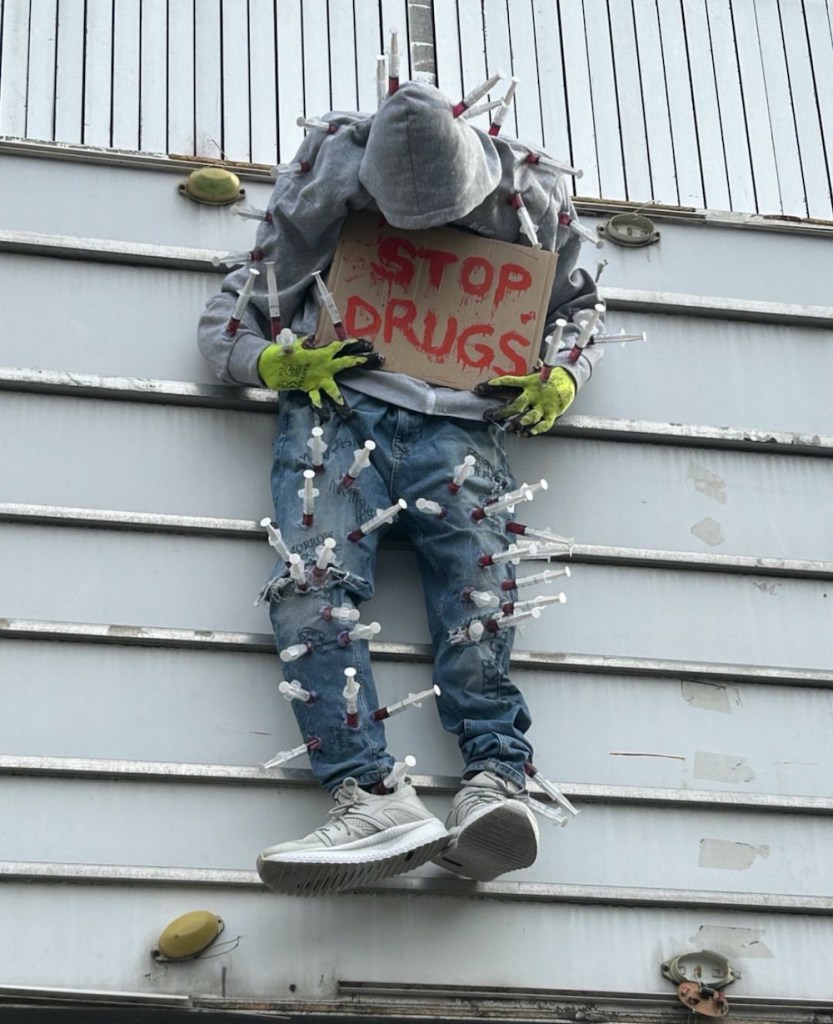
That's how it started The Blood Stained Hand: From the desire to use art as a voice for my story. The first intervention in this series was a dummy hanging on the advertising panel at Cinema Patria. The dummy was full of syringes and had a banner with the message “Stop Drugs”. It was the first time I tried seriously to draw attention to a negative phenomenon that was spreading around us.
– You chose to stay anonymous. What does anonymity offer you and what does it take you?
– I can't say I chose to stay anonymous. In the urban culture of graffiti, this comes in the pack. In this world, every tag or character is an alter ego. I do not feel that he takes something, on the contrary, anonymity gives me the freedom to tell the truth as I see it. And, for me, that matters most.
– Your works are dominated by the red blood stain. At what time did you decide that this symbolism is the most suitable tool for your message?
-Although, from the first work, my messages were written in red, going on the idea of blood stained, corruption that kills, I realized, over time, that the red attracts attention immediately, and the moment I really understood was when I saw the reactions of people in front of a work …
Then I realized that the red is the most suitable color to enhance my message and, at present, I use it as a signature.
– Your interventions are a form of harsh and full of subtlety to a dysfunctional society, where corruption and criminals escape unpunished. Do you think that street art does it still have the power to change mentality in such a pessimistic environment?
– It is difficult to say whether street art can change mentalities, especially in such a pessimistic society and full of false information. But I think it can help bring the truth in front of people and make them see things differently, even when the official media or social networks spread misinformation. And I also think that if artists, journalists and people in society put a topic on the table, the truth becomes more difficult to ignore.
– You were sometimes called “Banksy de Romania”. Do you feel the burden of comparison or give you legitimacy?
– I have noticed, lately, this comparison, I am glad, although I do not want and I cannot compare it. When you say Banksy, you say Street Art, he is the man who took Street Art to another level. Over time, I feel that I have overcome this standard, although visually it seems the same technique, a stencil. I think we have different styles, each artist puts his own fingerprint. I am a little more dark, I take the reality as it is.
“The galleries in Romania are not yet as open at Street Art as abroad”
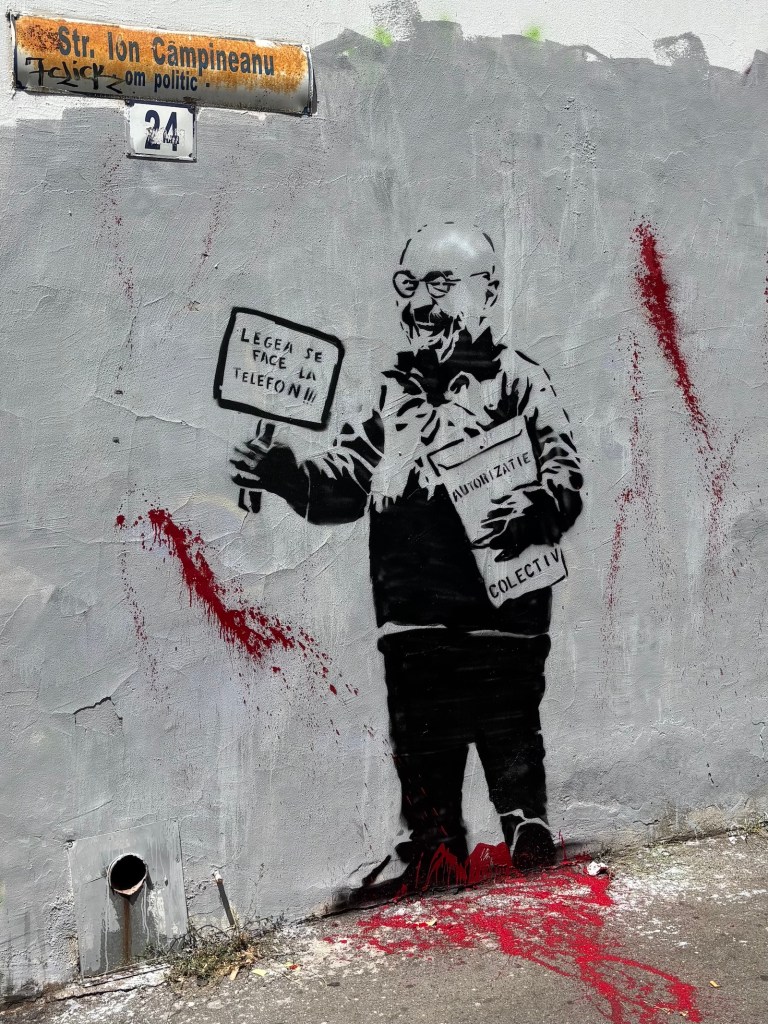
-What causes you to choose a wall from a public space instead of a gallery? Are you attracted to the freedom of anonymity or the unpredictable street?
– I could say that I am attracted by both the freedom of anonymity and the unpredictable street, because both offer you opportunities that you do not find in a gallery. Although I had two exhibitions, the galleries in Romania are not yet open at Street Art as abroad, so my art will remain, for now, in the street. I believe that art must be for everyone and I want to reach people who are usually not interested in art.
– How do you choose your next topic? And, in an ideal Romania, The Blood Stained Hand Would there be? Or would they lose its meaning?
– There are a few factors that make me choose a topic: how divided the society is around it, if it has an old negative historian and if it personally arouses a strong feeling. Even if that seemed against the ideology behind The Blood Stained HandI think in an ideal Romania there would be such topics. From all my experience so far I have learned that a new topic appears, no matter how ideal the Romanian society could be. After all, I think that The Blood Stained Hand It's not just about reacting to a particular subject, but about being always present and saying things by name.
“The most unexpected feedback was a comment in which I was made Satanist”
-What would you like to happen to a work of yours: to get to be put in the museum or to be taken down by the authorities in 24 hours?
– I think I would like to be put in a museum, although its place is on the street, for people. I already know the feeling in which the authorities give me a work even in less than 24 hours, or in which certain citizens destroy the image of the work because they do not agree with what they do. From what I have noticed, others simply “buffers”, I think, for fear of not being accused of supporting the work by keeping it on the facade of the building.
-What was the most unexpected feedback received from someone who saw your work on the street?
– Due to the anonymity I cannot interact directly with the public, but I could say, from what I have noticed, that most people, when I see the work, amuses; Some take pictures of her. I see the biggest feedback online – most seem to open the idea and support this movement. I think the most unexpected feedback was a comment in which I was made “Satanist”.
– How do you see the artist's role as a change agent in the coming years? What do you expect from the public?
– I believe that any artist, regardless of the artistic area of which he is a part, has the obligation to expose the truth and make his public think more rationally, to be more attentive to the information in the public space. I think the public should be more open and support his favorite artist, involving himself directly or indirectly. The change comes when we care and we all get involved.
– Your art is a mirror for society, but what do you think Romanians see when they “look into it”?
-If I were to describe in one word, I would say that I look at the current situation. However, I believe that the majority, unfortunately and with great opinion, look at her with indifference, careless about what happens around them or maybe even comfortable and reconciled with the situation.