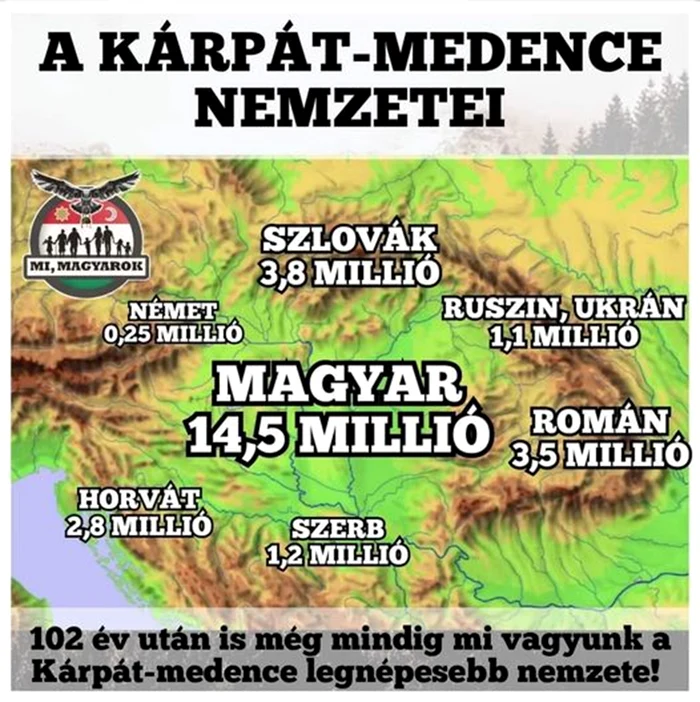
Photo: Contemporary Hungarian propaganda poster: In Romania it would be 3.5 million Hungarians (!)although at the Romanian census of 2021 were registered 1.002.151 Hungarian ethnic (!). Source here.
We continue today the analysis of the influence of what we called in the first episode the true pro-Russian propaganda in Romania, respectively the decoupling of the Hungarian community in Romania and its orientation towards Budapest.
Compared to the two propaganda categories already discussed, we can introduce even a third category of propaganda, where Viktor Orban undertakes a mixed propaganda, addressed especially to the European and Hungarian public, but founded on Cultural approach (Approach = “To be a (foreign) thing” Cf. DEX) and historical at the expense of Romania. Here we refer in particular to a very recent and highly mediated historical series funded by Viktor Orban and focused on Iancu de Hunedoara's personality.
appropriation Cultural in the detriment of Romania appears in the series by the fact that Iancu de Hunedoara is presented as having Hungarian mother tongue, although he was raised in a Romanian family and could not have the Romanian language as a mother tongue. Even his son, the great king of Hungary, Matia Corvin, seems to speak Romanian. In addition, Iancu de Hunedoara is also presented as a “Hungarian Military Leader”, although, according to all the documents of the time, Iancu de Hunedoara was Romanian and he himself “Johannes Olachus”, that is “Ioan Romanul”, in Latin.
And the propagandistic dimension of this film appears from the association that Viktor Orban tries to build between himself and Iancu de Hunedoara in three main directions:
· Iancu de Hunedoara opposed to the Ottoman invasion, Viktor Orban and he “opposes the invasion of the migrants”;
· Iancu de Hunedoara was a true defender of Christianity in the face of a Muslim invasion that had massacred 3 years before Constantinople, Viktor Orban would also like to be “a defender of European Christianity in the face of Muslim Migrants and the ideologies of extreme left” (It should be emphasized that, although both these phenomena, massive migration and radical ideology of some European policies, are extremely harmful to European society, their instrumentalization by Viktor Orban arouses suspicions and concerns);
– According to the presentation of the film funded by Viktor Orban, Iancu de Hunedoara was “a boy from the village that became an unclear warrior and, later, the Savior of Europe”, Viktor Orban himself presents himself as a mere “boy from the country”.
About these favorite narratives by Viktor Orban's propaganda and about their direct effects on the Hungarian community in Romania we find out from the same report quoted earlier: “The reality we found from our research is that the Hungarian community is increasingly isolated from the rest of Romania in terms Orbán is suppressed, while distrust in local authorities is encouraged. Its policies in Budapest – and to create the Fidesz image as the only available protector of the diaspora and its values. ” (pp. 51-52)
Polls. The magnitude of the spread of propaganda from Budapest among the Hungarians in Romania and its influence on their perceptions
● Survey of 2020
In 2020, a study was made public by the Institute for studying the problems of national minorities, within the European Values Study (“Hungarians in Transylvania on the map of value systems in European countries. European Values Study”, coordin. Tamás Kiss, István Gergő Székely, Cluj-Napoca, 2020), a study in which a study can be very similar The respect of the religious and family life of the ethnic Hungarians/Szeklers in Romania with that of the Romanians, almost identical, and a great difference than that of the Hungarian Hungarians. We quote from the report of the respective study: “The results show that there are no significant differences between Romanians and Hungarians in terms of the three topics presented: family values and gender roles, respectively religious behavior. Trends in Romania, sometimes displaying surprising features in European context, are also valid for Hungarians in Transylvania” (EVS1). On the family, the conclusions of the respective report were that: “One of the essential results is that in the field of family values there are no substantial differences between the majority and the minority. In this regard, the Hungarians in Transylvania resemble the Romanian society than that of Hungary.”
We quote again from the same study and the conclusions regarding the religion: “The data shows that the religiosity of the Hungarians is similar to that of the Romanians, in the sense that it is much more pronounced compared to other European states, although the Hungarians, mostly overwhelming, are not orthodox. Thus, the data of the investigation shows that 99% of the Hungarians are 34%. It prays regularly, 89% are considered religious.
Even an article written by an ethnic Hungarian emphasized the title even that “the values of the Hungarians in Transylvania and those of the Romanians are sometimes similar.” In addition, “in the question” whether or not a war would be a war or not? “, 43% of the Transylvanian Hungarians answered affirmatively, 41.5% negative, and the rest are indecisions. At the same time, 46.7% of the respondents of the representative sample for Romania are ready to fight for the country, and in Hungary the percentage is 53%. The availability to fight is generally lower to minorities compared to the majority, without exception. At the same time, the share of indecisses and those who refuse to answer is great among minorities. However, we notice that the difference between the Hungarians in Transylvania and Romanians is small, in fact the smallest difference measured among the minorities in Europe with which we could make the comparison. ” (EVS3) In other words, of all the minorities in Europe included, the Hungarians in Romania were the closest to the majority when they were asked if they were fighting for the country, which shows a high degree of feeling of belonging to their native country, in our case, Romania.
But what happened in the meantime with these similar values between Hungarians in Romania and Romanians? Although we do not have a new study in the meantime on exactly the same indicators, based on certain data we can conclude that in the field of family values, gender roles and religiosity in Romania, more than Romanians in Hungary. These things are also reinforced by the specificity of Viktor Orban's propaganda, emanating from Budapest – this is also concentrated, at least narrative, on family values and religiosity, so Budapest propaganda has not tried to change these aspects to Transylvania. But, extrapolating, we could even say that, on the contrary, he tried to change the company in Hungary on the model of the Romanian one in these directions, at least.
In the respective study of 2020 there were also several significant differences of the Hungarian population in Romania compared to Romanians: “The institutions in which the level of confidence of the Hungarians in Transylvania is much lower than that of the Romanians are the following: the armed forces (42% vs. 80%), the education system (52% vs. 70%), the EU (39%) (39%) (39%) (39%) (39%) 47%). ” (EVS3) and “Hungarians in Transylvania believe that it went too far with the expansion of the EU (average of 5.45 per scale of 10 points). The attitude is less adverse than that of Hungary (5.69), but significantly different from that of Romania (4.21)” (EVS3). There is a lower level of confidence in the EU and a lower desire for expansion than those of Romanians, probably (and) because of Viktor Orban's propaganda that began to produce its effects.
This influence of the propaganda from Budapest on the perceptions of the Hungarians in Romania has been highlighted by this study since 2020 and regarding the social distance: “The percentage of the Hungarians from Transylvania who would refuse a neighbor of the mentioned categories shows in the following way: 54% would not accept to have an immigrant neighbor, 52% of the neighbor, 42% of the neighbor. The attitude of rejection of immigrants, people of another race and Muslims has been amplified in Hungary in 2008-2018. (EVS2) Although the study authors consider certain cultural causes to be responsible for the attitude towards immigration, the political propaganda in Budapest is considered to be behind the attitude of the Hungarians in Romania towards the phenomenon of immigration: “In the states of Eastern Europe, especially Hungary, the anti-unimigration and anti-unimagrant discourse. In general, the attitudes of the Hungarians in Transylvania in particular (…) The Hungarians from Transylvania have expressed the most negative opinions about the consequences of migration on development. The chauvinism of the welfare and, respectively, the fear of the risks that could appear in the aspect of safety and security. (EVS2)
(will follow)
Matei Blănaru He is an expert Larics and PhD student of the University of Bucharest.