The American government wants shares in Intel. This could be bad news for the market and competitors


In purely financial dimension, SoftBank buys about 87 million shares and becomes one of the largest Intel shareholders. For Intel itself, it is fresh capital and a vote of trust when the company is just rebuilding the position in AI and Foundryremaining under pressure after years of decline in market shares and technological delays.
From the point of view of corporate order, it is important that the Japanese group does not demand a place in the council and does not declare preferential treatment of Intel products.
The idea of entering the American government to the shareholding is a quality step different from the pool of grants and loans from Chips Act, which have already received, among others TSMC, Samsung or Micron. The same goal – the security of supplies and reconstruction of production capacity in the US – can be implemented by subsidies, loans and guarantees, but also (more and more often) through real shares. Events from recent weeks show that Washington is testing a more active model and, for example, Pentagon will include privileged actions at MP Materials for $ 400 million, and with consent to the takeover of US Steel, the administration negotiated the so -called Golden Share (Golden Action), giving extraordinary corporate rights. In this context 10 percent In Intel it would not be an isolated casebut an element of the wider reorientation of the US industrial policy.
Check also: What instead of Intel? “The plot may go to another entity”
In Intel it can change a lot
If the US becomes a shareholder in Intel, the administration of Donald Trump will gain more than the state control over the “Silicon Heartland” project in Ohio, which Intel delays. The first factory today has the horizon of the uprising in 2030–2031.
Special offer
From a business point of view, possible 10 percent in the shareholding can reduce the cost of capital and strengthen the credibility of Intel plants in defensive tenders and on contracts where the security of the supply chain counts. Intel is already a pillar of DU (RAMP-C) programs today and has financing for various technological solutions, so capital from the government would only confirm this course. On the other hand, the state -owned shareholder usually means more attention of regulators, sharper conflict management and potentially … greater impatience to surgical delays.
Does this also threaten with unfair competition against AMD and Nvidia? It is easy to imagine a situation in which Intel would gain some contracts easier than his rivals. The “Full and Open Competition” principle applies in federal orders, and exclusion (e.g. national security) must be formally justified. In other words, The mere fact of being a shareholder does not allow administration to simply assign contracts to Intel. At least officially.
At the same time, the government can direct some works and orders to selected ecosystems – and here it can indirectly prefer the manufacturer with a domestic, certified lithographic node. The risk of perceived bias exists, although for now it is inhibited both by the Order Law and Congress control and public opinions.
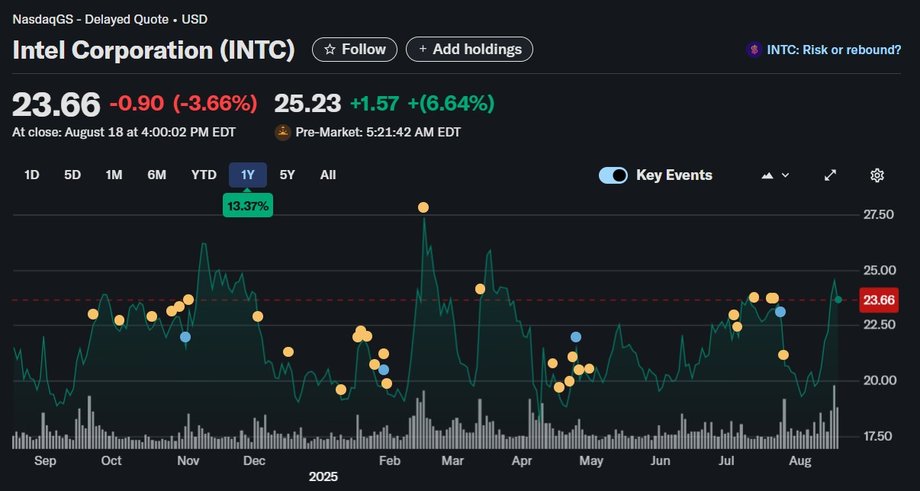
Intel shares generated 13 percent. profit for the last 12 months. However, if we rate 5 years, we have a loss of -51 percent, and from January this year. It is an increase of 18 percent.
|
Yahoo finance
See also: Intel resigns from investments in Poland. Mateusz Morawiecki spoke about her loudly
Competition without factories is about Taiwan
In a short term, the injection of Softbank's capital is primarily stabilization and time to complete the restructuring under the leadership of Lip-Bi Tana.
For AMD and Nvidia, this does not change the system of power right away, because both companies are without their own production plants and are still based on TSMC or Samsung. The advantage of these companies in AI systems does not result from subsidies, but from the ecosystem and the rate of iteration. In the background, however The US industrial policy is increasingly interfering with the rules of the game and, for example, the administration allows export of “cut” AI systems to China in exchange for 15 %. participation in revenues from these sales. Both AMD and Nvidia had to agree.
This shows that Washington can use regulatory and commercial levers, which indirectly affect the profitability and market strategies of leading players. And it may also suggest that if he has shares in Intel, it can provide Intel with preferential conditions.
Ohio investment remains the largest variable in the longer horizon. If Intel provides operating production capacity in the 18A/14A technology class on time and with acceptable quality, then the government's participation – together with the portfolio of defense clients – may become a catalyst for the reconstruction of position and improvement of margins. However, if the delays are piled up, the state shareholder will increase the pressure, and The market will easily recognize this as “soft nationalization” without improvement in efficiency. The history of the US Steel with a golden action reminds that state ownership instruments give a real influence, but will not replace operational enforcement.
Read also: The US president concludes a contract with Nvidia and AMD. What does this mean for the world
Intel's uncertain future
Three things are certain for today. First of all, Softbank actually entered the Intel shareholders register and really diligates the current capital in exchange for cash. Second, government 10 percent It remains in the sphere of negotiations for now – the script is possible, but still not extended. Thirdly, even if the US enters the shareholding, the legal obligation of competition in public procurement will not disappear, Although in practice some strategic programs may tilt the scales in favor of the manufacturer who produces chips in the States.
This does not necessarily mean unfair competition, but undoubtedly raises the bar for rivals and increases the political temperature in the entire semiconductor segment. One thing must be emphasized: Intel is not and probably will never be the company as it used to be.
Author: Grzegorz Kubera, Business Insider Polska journalist