The truth about the father of Marshal Antonescu. Had a little school, a scandal marked career and stayed several times in prison


The father of Marshal Antonescu was an officer in the Romanian army. Unlike his son, Antonescu's father had problems in military life, being described as an aggressive, mediocre and law. The appreciations were oscillating from year to year.
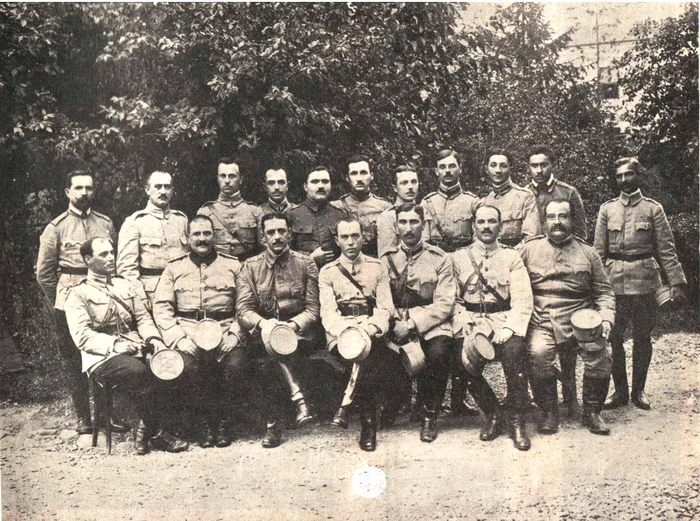
The officers of the Great Headquarters in 1918, Ion Antonescu was in the center, down Photo Wikipedia
Marshal Ion Antonescu (1882-1946) was an officer highly appreciated by his superiors, an early young man who quickly advanced on the steps of the military hierarchy. “Eminent officer in all relations. He distinguishes himself in all his actions and carries out an extraordinary energy. Exceptionally intelligent and conscientious. Very good instructor and daring rider. He loves the horse. Excellent comrade. Exemplary conduct. Finally, he is an officer of great value that can be contained. said his commanders in 1914. During the First World War, Antonescu became head of the Operations Bureau of the 4th Army Corps, and then, from 1917, of the Army Group commanded by General Prezan. In 1918, until the end of the war, Antonescu was head of the office of the office at the Great Headquarters. It was decorated with the “Order of Mihai Viteazul”, being considered a war hero. His career continued by becoming commander of the Special Cavalry School in Târgoviște, attached militarily to Paris and London, and from 1937, a division general.
“General Antonescu commands the 3rd Infantry Division from all points of view. General officer, who has all the qualities, virtues and capacity, recognized by the whole army-as an emeritus strategist, a fine tactician and an organizer of force,” said about Antonescu, in the year 1936 General Dumitrescu. Some would explain this bent of Marshal Antonescu for the military career due to the fact that it comes from a family of military. Specifically, his father, whom Ioan Antonescu also called, was a cavalry captain. From biographical data little known to the general public, however, it appears that Ashia jumped, this time, away from the trunk. Marshal Antonescu was the opposite of his father in terms of career success. Old Antonescu was a problematic military man, at least this comes from reports, aggressive, involved in all kinds of business and with a poor instruction. In fact, the superiors did not hesitate to punish him according to the military rules, being sentenced to prison days or worn, disciplinary, from one garrison. Colac over the stern, he is suspected of having left his wife (ie the mother of Marshal) for a Jew.
The soldier in the delea nine slum, becomes captain
The father of Marshal Antonescu was also called John and was born on June 29, 1853, in Bucharest, in the Delea Nouă slum. He was the son of Anton Vasiliu and Sultana. He came from a modest family of Bucharest mahalagians. Ioan Antonescu enrolled as a soldier in the army in 1870 at the age of 17. It is sent to the regiment and artillery. For a simple root it advances quite quickly and in 1873 we find it in documents as a sergeant. The following year advances to the rank of second lieutenant and we notice that it changes the weapon. More precisely, he went from artillery to cavalry to the Red Regiment. The war of independence catches it in this unit, where it fulfilled the role of accountant.
“In the section” The way the campaign made (1877-1878) “, it is shown to have been used as an accountant of the regime. 1 Roşiori, for one year, three months and six days and because of this “could not take part”specified the specialist Vasile Novac, in the article “Captain Ioan Antonescu-father of Marshal Ioan I. Antonescu” in Argesis magazine. During the war, the accountant from the Red Regiment 1 is well paid by responsibilities, say the superiors. “During the campaign, as a compactable officer on the active party he brought remarkable services”the Lieutenant-Colonel Alecsandrescu said on January 1, 1878. In fact, Ioan Antonescu received the medal “Defenders of Independence”, “Cross of the Danube crossing”, “Russian commemorative medal” and the order “Stanislav” class III “.
After the war, in 1879, while serving at the 2 Roşiori Călărași Regiment, he marries Chiriachița Dobian, from Pitești. It is said that this Miss Pitesti would have had Albanian origins. It is certain that after the marriage Ioan Antonescu senior we find him advanced to the rank of lieutenant, within the same regiment. From September 16, 1886 he was moved to the Calarasi Constanta Brigade and in 1889 he was advanced to the rank of captain. It is the maximum degree to which Ioan Antonescu reaches the senior, being blocked his advancement to the degree of major. His career ends in 1900, when he was in reserve from the 10th Calarasi Regiment.
A promising military career started, though he had little book
Ioan Antonescu Seniorul started his military career under the good auspices. Although he had only three or four classes, he was considered zealous, hard and listener. It was very useful in the area of intendency, where it was in charge of accounting, barracks and other administrative activities. He does not shine, but he is a worker, he notes the superiors. “Conduct – binişor, kept – cared. He knows French. How he serves – bin.stated in the Lieutenant-Colonel Solomon, the school commander.
At the graduation exam ends the ninth of 13 candidates. In 1879 and 1880, a 29 -year -old married young man, Ioan Antonescu Senior continues to be appreciated by colleagues. Mege on the same calapod, does not impress, does not shine, but thanks the bosses through his activity. “The military and private conduct is good; on his instruction I cannot pronounce, having no opportunity to know. The good outfit. Books do not play. His theoretical and practical knowledge are satisfactory”said Lieutenant-Colonel Rasty. Elogiously describes Major Călinescu: “He is serious, active, intelligent, he serves with pleasure, he goes well, he knows the regulations, in theory and practice. Good military and private conduct.”
“Incorpible officer to lead a single squadron”
However, the documents show that despite the praise from the beginning of his career, Ioan Antonescu Senior was a problem officer. He had serious disciplinary problems, he was suspected of business with the goods of the army and was considered violent in society, but also with subordinates. He has been incarcerated countless times and rebuked in reports. In 1884 he received over 20 days of imprisonment for negligence and some strange issues with a defective scales and an amount of barley, probably for the regiment's horses.
“This officer, being as an officer with the clothing, was raised the task of this service, out of distrust and bad management of the service. Nothing can be entrusted to him, because he finds means of abuse. In all respects he leaves much desirable; lacking his forms, he did not submit to the business of an barley, as one who was in court.”said Colonel Arion on January 1, 1884. In 1886, he received 15 days of imprisonment because he beat a man. In 1887 he received prison again because he hit a subordinate. Between 1891-1892 he receives prison again for a business with military livrets, but also for the sad state in which the squadron was at the inspection. “The incorrect officer to lead a single squadron. He abuses the right to give notes to the officers, to satisfy personal rancidity. The deplorable state in which we found the squadron proves even more.the General Cantili said in October 1892. In 1893 he was accused of theft, bribery and the inferior beating. And so on until the end of the career. Interestingly, these appreciations were ranging from year to year.
After doing it “wide”, Ioan Antonescu was the senior for a period. After which he was returning to the old metehne. Bad mouths say he was passionate about books, drinks and women. It is certain that around 1890 he divorced his wife. It is said to have remarried to a Jew, called Frieda Cumerman, and had children with her. That is, Marelasu Antonescu would have had step -brothers of Jewish origin. For now, there is no clear evidence in this regard. In conclusion, the father of the marshal had a mediocre military career, permanently marked by problems with superiors, being repeatedly accused of violent behavior, theft and bribe, but also of negligence. “From the characterizations of his bosses, the contradictory character of his behavior results: when punished for absences at work, when praised for conscientiousness and zeal in work. Accusations of theft and bribery alternate with the appreciation of” exemplary fairness “. The harshness and violence in behavior are, however, constant of its character ”adds Vasile Novac, in the same work.