The German city turned into an epicenter of the crisis. “Drug addicts and beggars”


Neumarkt in Colonies He is considered one of the worst places in Germany in terms of drugs.
The situation became so bad that customers do not have the courage to enter the stores. The reason is drug addicts, homeless people and beggars in front of the door. This has a huge impact on the economy.
However, since the colony authorities and the National Police were unable to remedy this situation despite multiple requests, I was asked to develop a security concept. I would be able to do it, but the city authorities did not want to cooperate.
What stood in the way?
Of course, this cannot be officially confirmed, but I can imagine that the city was simply afraid that a private service provider would solve problems, and then compromise would fall into the city.
What would your proposal be?
In addition to healthcare strategies and help, I am a great supporter of repression. The right services must ensure that people do not have a very comfortable life. In the entrance to the store, the owner's principles often apply, no one can break the camp or give away body fluids. However, we have too few policemen and order services. In Cologne, of 1.1 million inhabitants, there are fewer jobs than in Dusseldorf, which has 600,000 residents – and many of them are simply not planted!
If you want to implement such a strategy, at the beginning a sea of tears awaits us. The city, and therefore the city authorities and politicians, must withstand it. Then, all people get used to compliance with the rules and the consequences. During the year to two years, the situation will regulate itself.
Ensuring the necessary order forces will probably cost a lot of money.
Cities such as Dusseldorf or Krefeld have shown that in a very short time you can employ employees for the municipal order service. Of course, it costs money.
For example, large fairs take place in Cologne. And one of the criteria for granting consent to parties is security and order in the city. Cologne regularly receives zero points. This also applies to the awarding of sporting events such as the Olympic Games, the World Championships and the European Championships. Safety is an economic factor!
Do your proposals suppress the problem instead of solving it?
I call it “egoistic displacement of crimes”. Even in places where adventurers pull, everyone can ensure that such people do not settle there. If everyone displaces it, there will simply be no place for harmful behavior. I distinguish between those who really need healthcare from the others. The former may consider using the city's help.
Who are the “others”?
If you ask drug addicts about their favorite cities, Berlin, Cologne and Frankfurt will answer. Why not Hamburg, Stuttgart or Leipzig? Cities must do something to become hotspots: addicts have easier access to drugs there, and crimes have less consequences.
In Cologne, 80 percent The homeless comes from Eastern Europe and most of them belongs to organized crime.
According to this year's report on the safety of the percentage of people feeling safe, it fell from 76 percent. In 2022, up to 60 percent 41 percent He noticed the deterioration of the situation in its own district. If Safety in Germany In general, is it only a subjective feeling?
Security authorities will say that the overall crime indicator either persists or slightly decreases. However, in terms of safety, we must distinguish objective and subjective safety.
In addition to objective crime statistics, it also includes whether there is sufficient street lighting in the district or whether underground crossings need to be passed. Also in this respect we have arrears: damaged lighting is not replaced, graffiti is not removed, the garbage is longer.
The subjective sense of security has also dropped – and this is much more important. Thanks to the multitude of negative news in the media, we learn faster about crimes using violence, but also “interpersonal intercourse” is becoming more and more difficult.
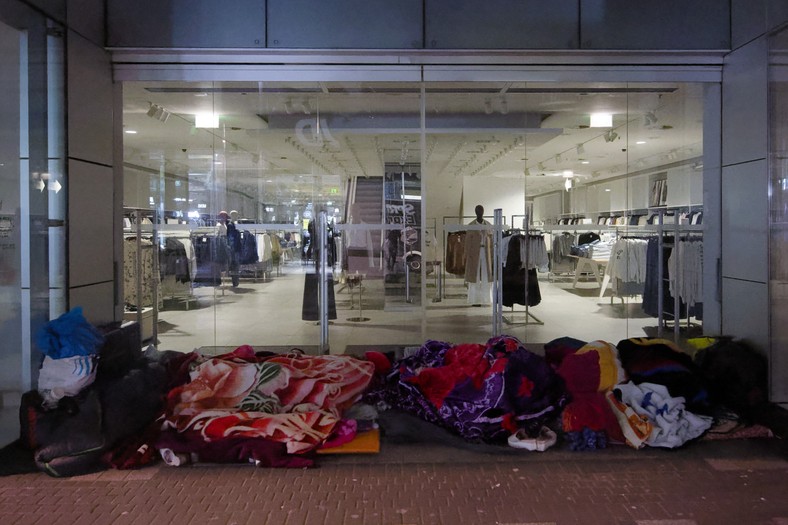
A camp of people in the crisis of homelessness in Cologne, February 2025 (illustrative photo)
You confess the theory of compact windows, according to which the district falls into ruin as soon as the window was broken and it was not mentioned …
I once conducted an experiment. I put crumbled chocolate paper in the pedestrian zone and waited. Soon it turned out that passers -by threw cigarette butts next to him and other rubbish. Because in my opinion the potential for people's aggression is higher than before, mutual social control is also decreasing. Today, the person who puts an empty beer bottle on the windowsill does not pay so quickly – for fear that it will explode.
Why is it so?
The sense of community and respect are becoming more and more disappearing. Even police, firefighters and paramedics are attacked. This is certainly caused by a less and less need for direct communication. Today, everything is done using short messages on a mobile phone, even relationships end in this way. This is how we lose the ability to perceive people and their feelings and interpret their behavior.
What role does migration play in this?
Immigration is one of the social factors that lead to further uncertainty. You should not basically condemn the influx of other cultures, but this is also associated with challenges. In some countries, red light is a proposal rather than a rule. Such a phenomenon is becoming more and more common in our country.
Can you give examples of cities where proposals similar to your strategy have been successfully implemented?
In Germany, Krefeld should certainly be mentioned, where the number of drug addicts was reduced by half. Zurich is given as an example around the world – quite rightly. A few days ago I was in place and listened to the explanations of representatives of the city authorities about the four -part model covering therapy, prevention, restriction of damage and repression. It works great and many cities could almost take over entirely.
It is important to deal with people addicted to drugs who are not registered in Zurich. They are sent to registration places. Everyone can only act as part of their competences, no municipality can deal with “everyone”. The condition is political consent and pragmatic solutions – not the implementation of ideology.