That is why Putin attacked Ukraine. Five points that allow you to look into his mind

1. Historical unity
Putin presents Russians, Ukrainians and Belarusians as one nation, derived from Kiev Ruthenia. It was the early medieval Eastern Eastern Empire from the center in Kiev between the 9th and 13th centuries and is considered the cradle of today's Russian, Ukraine and Belarus countries. Together with Christianization, in 988 the tradition of Orthodox culture developed, to which all three nations refer to this day.
In the essay published in 2021 “about the historical unity of Russians and Ukrainians” Putin writes: “Russians, Ukrainians and Belarusians are descendants of ancient Rus (…) connected by a common language (…) and – after the baptism of Ruthenia – Orthodox faith.”
However, historical reality is much more complex: for centuries Ukrainians and Russians lived more often in separation than in unity. Russian is just one of many languages used in Ukraine, and the Russian Orthodox Church is only one of many orthodox denominations.
2. Russian world
Putin justifies his claims to territories outside today's Russia that all places where Russian -speaking or Orthodox communities live historically belong to the “Russian Miru” – the Russian world.
Not only Ukraine, but also Belarus, the Transnistria region in Moldova, the entire Baltic States and part of Kazakhstan belong to Putin historically to the Russian world. This concept serves as an ideological basis for expansion. At the Russian embassy in Berlin, the arms of countries belonging to this Russian world, including Ukraine, hang on the walls.
The creation of the “Ruski Mir” Foundation in 2007, which is officially aimed at promoting language and culture, serves de facto as a diplomatic mechanism and pressure – with a purpose of mobilizing the Russian -speaking communities and using them as an excuse for “protective intervention”.
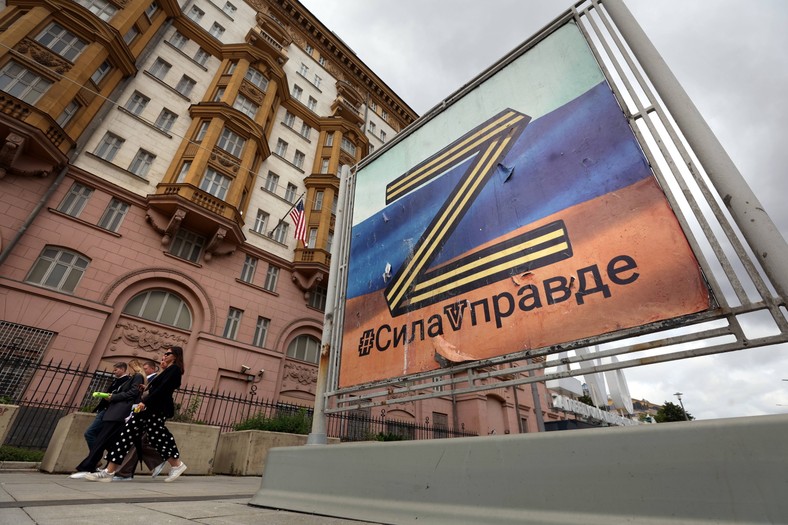
A poster depicting the symbol of the Russian army “with” and with the inscription “Strength in truth” in front of the main building of the United States embassy in Moscow, Russia, August 14, 2025.
3. Tsarist Empire
In his rhetoric, Putin constantly refers to the imperial tradition of the tsarist Empire. He compared himself, for example, to Peter the Great. He was the tsar and the Grand Duke of Russia in 1682–1721, and from 1721 to 1725 the first emperor of the Russian Empire. In the 18th century he annexed new territories. For example, during the Great Northern War at the beginning of the 18th century, Russia gained some of the Baltic countries and Ingermanland from Sweden. Russia then became a power.
Putin often talks about historical Russian lands – which is a direct reference to the tsarist concept of territorial unity. In June 2022, he declared: “Piotr the Great did not conquer anything. He only regained what was always belonged to Russia.”
4. Soviet Union
Putin has repeatedly claimed that Ukraine is not a “real state”, but a creation of Soviet times. He refers in particular to Lenin, who after 1917 created the Ukrainian Soviet Republic. On the eve of the invasion of Ukraine, Putin stated: “Contemporary Ukraine was completely and created by the Bolshevik, communist Russia.”
In addition, the breakup of the Soviet Union perceives “the greatest geopolitical disaster of the 20th century”, as a result of which “tens of millions of our compatriots were outside Russia”, as he explained, for example, in a speech delivered in the Kremlin in 2005.
For him, Ukraine is a kind of lost territory that should be restored to the Empire. In addition to Russia, Ukraine, Belarus, Estonia, Latvia, Lithuania, Moldova, Georgia, Armenia, Azerbaijan, Kazakhstan, Kyrgyzstan, Uzbekistan, Turkmenistan and Tajikistan belonged to the Soviet Union.
5. Second World War
Just as the Soviet Union fought in 1945 against Hitler, today Russia is fighting against “Nazis” in Ukraine. This is Putin's narrative. In his essay “about historical unity” he writes: “Ukrainians fought in the Red Army during the Great Patriotic War. (…) Over 2,000 soldiers became the heroes of the Soviet Union. (…) Forgetting about their heroism means the betrayal of our grandparents, mothers and fathers.”
Historically, Ukraine was an integral part of the struggle of the Soviet Union with Hitler: Millions of Ukrainians fought in the Red Army, and Ukraine was one of the most affected areas.
In a speech on the occasion of victory day in May 2022 – just a few weeks after Russia's attack on Ukraine – Putin made a historically comparison: “Today our soldiers are fighting again like their ancestors, arm in the shoulder to free their homeland from the Nazi occupation.” This is an absurd comparison, considering that Ukrainians and Russians are fighting against each other today.
Putin's presentation is also selective: he largely ignores the role of Ukraine as victims – great hunger, Nazi occupation, and double repression from Stalin. Instead, he stylizes contemporary Ukraine as a “continuation of the Nazis”, and Russia as a “liberator” again.
Conclusion: History is willingly used for political purposes. In the case of Russian invasion of Ukraine, it even became the basis of Putin's military strategy. George Orwell warned that the one who controls the past controls the future.