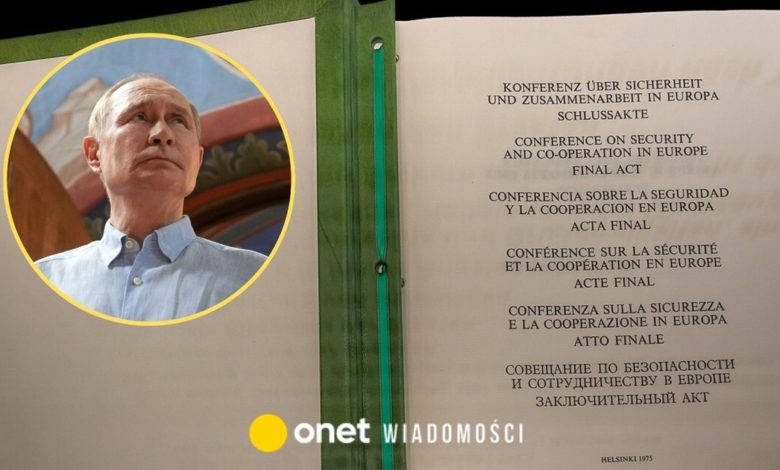
Exactly 50 years ago in Helsinki, 35 countries agreed to start a new cooperation process and strengthen world security. August 1, 1975, after the conference on safety and cooperation in Europe in Helsinki, In the final act, the signatories confirmed the mutual respect of European nations for the integrity of borders and the protection of human rights and fundamental freedoms. It was a breakthrough in the conditions of the Cold War at the time, because he created a new framework for the activities of human rights defenders and international dialogue on this subject.
The development of the Helsinki trial was influenced by the efforts of activists for human rights in the Soviet Union and Eastern Europe, and their devoted supporters in the West, as well as hard negotiations and compromises in the realm of Realpolitik between two opposite camps – the West and the communist block dominated by Moscow.
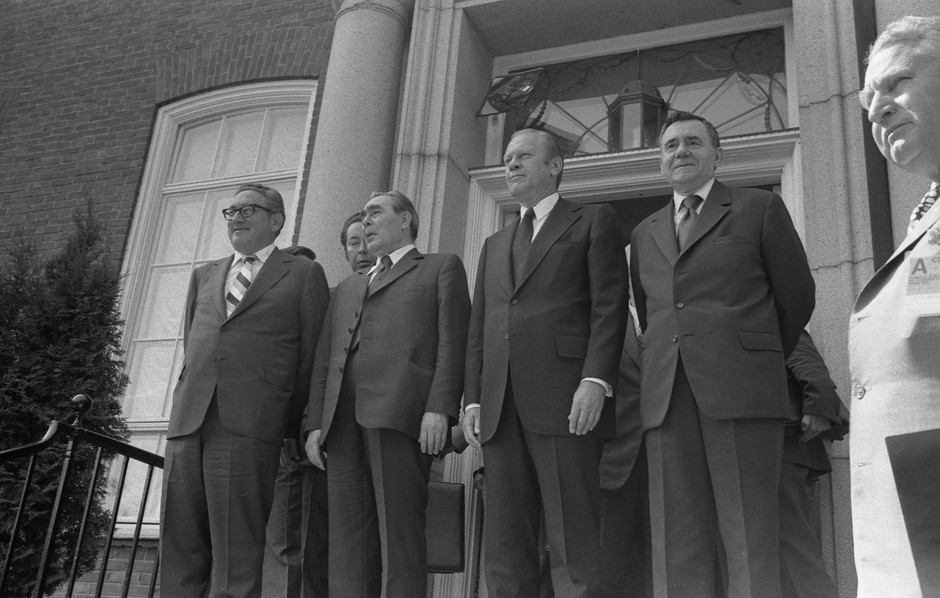
In the photo from the left: US Secretary of State Henry Kissinger, Secretary General of the Central Committee of the Communist Party of the Soviet Union Leonid Brezhnev, US President Gerald Ford and the Minister of Foreign Affairs of the USSR Andrey Gromko before the American Embassy in Helsinki, Finland, July 30, 1975.David Hume Kennerly / Wiki Commons
The control of the Soviet Union over Eastern Europe was approved in the Yaltan agreement of 1945 by the winning Allies (Józef Stalin, Franklin D. Roosevelt, Winston Churchill), and then strengthened by subsequent armed interventions in Eastern Germany (in 1953), in Hungary (in 1956), in Czechoslovakia (in 1968) and indirectly in Poland (in 1981). Western protests had no influence on this.
Without a formal peace agreement after World War II, the Soviet Union sought to convene a European security conference to ensure diplomatic recognition of the post status quo political and its achievements in Central and Eastern Europe.
Helsinki agreements and human rights
Finally, a compromise was reached in Helsinki in 1975. The Soviet Union obtained diplomatic recognition status quo In exchange for consent to comply with basic human rights.
Although the leaders of the USSR may have doubted the possibility of enforcing these obligations, for human rights activists in the USSR and Eastern Europe, the final act of Helsinki was a significant breakthrough. By combining human rights with broader security and cooperation agreements, activists have gained a new tool for undermining the activities of their governments and the possibility of supporting other state-owned states.
Competitive priorities in the West
Although Western countries publicly supported human rights, their priorities were often somewhere else. The United States focused on the distribution of NATO rockets and counteracting the influence of the Soviet Union, while the Chancellor of Western Germany Helmut Kohl publicly in favor of the union of Germany.
The policy was also influenced by economic interests, which can be seen on the example of the dispute between the administration of President Ronald Reagan, who called for a boycott of the Euro-Siberia pipeline, and the British Prime Minister Margaret Thatcher, who prioritized British jobs and contracts.
Changing strategies
While the Reagan administration promoted gradual democratization in the Soviet Union, Western European leaders distanced themselves from this approach, rejecting them as “megaphone diplomacy” [rozmowy między państwami prowadzone publicznie za pomocą mediów].
The death of three leaders of the Soviet Union in 1982–1985 was even more complicated by international relations. Despite the fluctuations and double standards of Western leaders, persistent activities of activists and non -governmental organizations meant that human rights remained one of the topics raised during meetings in Helsinki. Some dissidents who were released and received permission to emigrate, became strong advocates of changes, supported by the Helsinki trial.
Continued article under video material
Consensus and end of divisions
The Helsinki trial, based on consensus and related issues, ensured further involvement of the Soviet Union and its allies. To pursue their interests, these countries had to deal with the issue of human rights. In the second half of the 1980s, politics stroke [jawności i otwarcia na informacje ze świata] Mikhail Gorbachev caused unexpected political liberalization, the release of political prisoners and growing tolerance for pluralism. As the debates on human rights calmed down, the attention of the Soviet Union moved to disarmament, and the political situation in Eastern Europe began to change.
With the collapse of the communist block and the Berlin Wall in 1989, the rules recorded in the final act of Helsinki were finally implemented. At the top of Paris in November 1990, the Paris Card for New Europe was adopted, confirming and extending the original obligations and recognizing the important role of NGOs and religious groups.
The Safety and Cooperation Conference in Europe (KBWE) has transformed into an organization of security and cooperation in Europe (OSCE), ready to face the challenges of the new era, in particular the breakdown of the Soviet Union and the creation of 15 independent countries.
Heritage of Helsinki agreements and the current situation
Helsinki agreements contributed to the democratization of Eastern Europe and the end of the political division of the continent. The sacrifice and ingenuity of activists, non -governmental organizations and dissidents were of key importance for this transformation, and their efforts are testimony to strength and persistent struggle for human rights and political changes.
After Russia's violation of international law from 2014 by disregarding the integrity of recognized international borders, the occupation of Ukraine's territory and the beginning of the war in 2022 on a full scale against its neighbor, as well as the use of strict repression in the country and in allied Belarus, the Helsinki agreement and the OSC itself seem to be a large extent.
This article is based on the author's preface to the book by Christina Isajiw “Negotating human rights. In Defense of Dissidents During the Soviet era. A memoir“(Pol.” Negotiating human rights: in the coffee of the dissidents during the Soviet era. Departure “), published by the Canadian Institute of Ukrainian Studies Press, Edmonton, Toronto, 2014.
***
Bohdan Nahajło, editor-in-chief of Kyiv Post since December 2021, is a British-Ukrainian journalist, writer and experienced observer of Ukraine, living in Kiev and Barcelona. Earlier he was the head of the Amnesty International unit in the Soviet Union, a high -ranking UN official and political advisor and director of the Ukrainian section of Radio Wolność.
I’m Ashley Davis as an editor, I’m committed to upholding the highest standards of integrity and accuracy in every piece we publish. My work is driven by curiosity, a passion for truth, and a belief that journalism plays a crucial role in shaping public discourse. I strive to tell stories that not only inform but also inspire action and conversation.