Association of prosecutors, reaction in full scandal regarding special pensions: “Swiss watch is required in a mechanism that creaks like an old wheel”

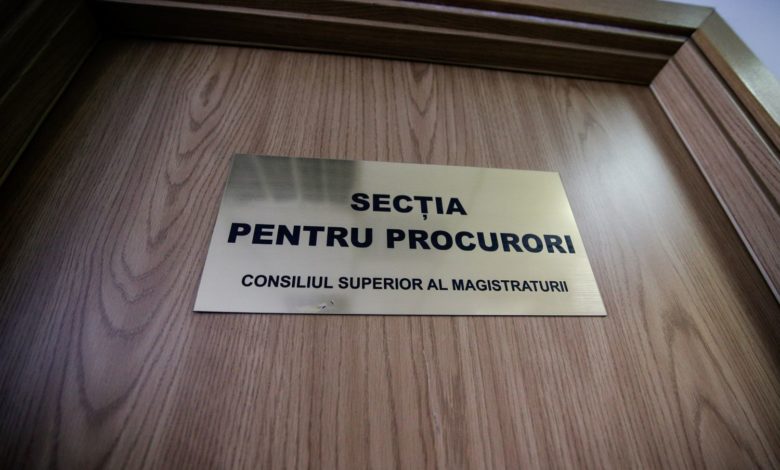
The Association “The Movement for the Defense of the Statute of Prosecutors” (Amasp) lists, in a press release, 10 problems of the system in which it works, in the context of the discussions in the public space about the salaries and pensions of the magistrates. Prosecutors criticize the legislation, which they call “incoherent and unpredictable” and talk about the equipment of the prosecutor's office and the high volume.
Amasp representatives say that “beyond perceptions, judgments and televised controversies, the judicial system lives in a less spectacular reality”: “that of shortcomings, daily pressure and a precarious balance between vocation and exhaustion.”
“The Swiss watch is required in a mechanism that creaks like an old wheel. It may not be seen from the outside, but inside, each day brings another fight over time, with the volume and the system itself,” the prosecutors say.
What is the “number 1 enemy” of prosecutors in Romania
They say that the number 1 enemy of the prosecutors in the country is the “incoherent and unpredictable” legislation, with tens of thousands of normative actors in force, which are often modified “without systemic impact or coherence.
“Countless laws that enter into force overnight, without clarity (eg: the law on the protection of the victims' data, even if necessary, does not contain solutions for the countless situations in practice in full dynamics – thus files have been sent back to the Prosecutor's Office for anonymization and copying, each court or parquet looking for the best solution”.
“It is the order of the day for the groups of magistrates to ask-how to do it? A good legislation would not take place on such questions. The laws are not adapted and upgraded to the realities of the present (eg computer offenses). The Criminal Procedure Code is effectively decimated, at present the institution of the preliminary Chamber, introduced to the case, not to find their delay ”, according to the press release.
Prosecutors complain about the procedures that claim to be “long, cumbersome, redundant and difficult to apply.”
“Many of the complex files, with many defendants, involve thousands of papers in hundreds of volumes, made in a certain order, all of them aroused discussions that receive different interpretations, this in the background that the probative standard has increased unjustified over time, without appropriate legislative changes. We have a criminal legislation that offers the most rights for the suspect/defendant, rights resumed several times during a case. The legislative issue implies an extremely broad discussion ”, according to them.
Prosecutors say that among solutions to this problem it could be found: simplifying the Criminal Procedure Code and introducing clear, standardized, institutionally verified forms to eliminate redundancy.
 Video Ilie Bolojan announced the change of special pensions: two thirds of the Romanian magistrates go to retire at 47-49 years, when they reach professional maturity / years, pensions were higher than wages. An average pension is 5,000 euros
“Almost all we find time over the program, Saturdays and Sundays, legal holidays to do what cannot be during the program.”
The Association “The Movement for the Defense of the Statute of Prosecutors” accuses that the level of work of the prosecutors is a high one, especially because all the magistrates are usually a week, which means that whenever the phone must be able to leave.
They claim that these hours are not “quantified nowhere and, of course, unpaid or rewarded with proper free time.”
“This means that, during the established period, if the phone sounds, at any time of day or night, you have to go to work or on the spot to commit a crime (we know and others do it, but that's not the discussion). There are no wage increases for this. In the prosecutor's offices or the small courts, it is not possible to work, so it is not possible.
In such cases, the 24-hour detention period is among the “smallest in Europe (we have France, Germany, Italy- 48 hours, Spain- 72 hours),” according to the association.
“The new case, which occurred during the service, usually, difficult and impactful, must be resolved quickly, and the perpetrator must turn into a proposed defendant for a preventive arrest in 24 hours, during which time from a phone call you must create a file with all the useful evidence for the person to be removed from the company,”
Prosecutors claim that “police workers are essential in the criminal process”, but a problem arises
The association that represents the prosecutors argues that without a “functional” relationship between police workers and prosecutors the activity of the prosecutor's office would be paralyzed.
“A prosecutor can supervise some police or common police stations, plus many other structures, that is to say each case and offered indications (by the common order 231/289/20.12.2024 of the Ministry of Foreign Affairs and PG has set an obligation for prosecutors for the professional training of the police), which was done anyway, and there is a lot of profession, issues to solve, because, unfortunately, each file or work implies an impressive amount of documents to be drafted ”, explains the prosecutors.
However, the police have a double subordination, they draw the attention of the prosecutors in the press release: to the Prosecutor's Office and to the Hierarchical Head, which creates dysfunctions.
“This (n. Red.: The hierarchical chief of the policeman) is the one who has to sign any paper leaving the police to the Prosecutor's Office, which attracts delays and is not justified considering that the investigation strictly concerns the police officer and the case prosecutor. For many years, I asked the police in the subordination of the Ministry, according to the Ministry,”
 An association of prosecutors demands “a dual -dangerous standard”: “Some magistrates seem to have more freedom to express themselves”
“In all the meetings with homologues from abroad, they listen to the impressed amount of things that are incumbent on the prosecutor.”
The prosecutors say that in “the higher prosecutor's offices, many files are being worked on their own criminal prosecution (in structures, absolutely all files) which means that the prosecutor is the one who does absolutely everything”.
“We have extremely few cases in Europe in which the prosecutor performs the criminal prosecution, in fact in all meetings with counterparts outside the country, they listen to the impressed quantity of things that are incumbent on the prosecutor. It is true that he can delegate some tasks, but the procedure is cumbersome, involves the papers, in two institutions, in two institutions possible ”, according to them.
Prosecutors also talk about the “problem” of delegations, detachments and transfers
Prosecutors say that transparent and concrete criteria regarding delegations, detachments and transfers in the system should be established, “because stability attracts efficiency.”
“The lack of continuity seriously affects the duration and quality of the criminal process,” the association points out.
“The computerization of the system is still insufficient and unequal, the communication between the institutions is slow and inefficient, the processes are still dependent on paper, outdated procedures and time consuming,” say the prosecutors.
They also talk about the “insufficient and non -performing” technical features.
“At present, the way of committing crimes, at least some, has been refined a lot and is made with sophisticated tools, which should be found at the reach of investigators. The absence of practical specializations leads to uneven solutions and delays. It is also the need for a coherent plan of improvement, adapted to the evolution, according to the association.
 The head of the Superior Council of Magistracy: A pension of 11,000 lei seems small / “From all points of view, we are unique”
“Disproportionate work volume compared to other EU states”
Prosecutors claim that there are “countless studies” that show that the level of work of Romanian magistrates is a much higher than that of magistrates in other EU states.
“The European magistrate has several people that he coordinates and who helps him, while the Romanian magistrate usually works with the support of a single clerk who is obliged to work additionally. There is no labor norm, which would be extremely difficult to achieve under the current structure of the system,” according to the association.
They say that the high work volume is caused by the personnel schemes that have not been changed since the 2000s: “There is no opening from the other two state powers to discuss the restructuring or abolition of small courts and prosecutor's offices that take very few people and are often non -functional and not adapted to the current dynamics.”
The prosecutors also specify that the staff assimilated to the magistrates “enjoy all the privileges of the state, without the appropriate liability, personnel who work in institutions that are not strictly related to the judicial activity, positions that could be transformed into positions of judicial assistants for judges and prosecutors”.
“The lack of staff translates to double or triple work volume in certain courts or prosecutors and has a direct effect on the duration of the processes and quality of the act of justice”, according to them.
“It is difficult that the criminal acts committed by the magistrates are effectively investigated.”
Prosecutors claim that at present “it is difficult” for the criminal acts done by the magistrates to be investigated and say that it would be necessary to return “to a system that has proven its efficiency.”
“Clear and independent investigation mechanisms are missing, which leads to an intangibility perception, which affect the credibility of the whole system. Selecting experienced prosecutors and who have proven their professionalism for these structures,” according to them.
“The appointments in the great management positions of the prosecutor's office should be endorsed according to the SCM and based on meritorious and well -formulated criteria, following a rigorous selection. Access to the judiciary will be done by maintaining a high standard to include a concrete psychological evaluation, repeated during the exercise of the function”, concludes the prosecutor of the prosecutor.
Prime Minister Ilie Bolojan announced last week a project that the Government wants to adopt which stipulates that the magistrate retirement age will increase to 65 years for, to increase the seniority, from 25 to 35, from which they can retire. The pension of the magistrates will be a maximum of 70% of the last net salary, compared to 80% of the gross salary, as it is now, said Bolojan.
 Video Nicușor Dan: “A question for CSM: What is this debt?”. Hard criticisms for another institution in justice: “Is it a huge problem” / And a question about citizens: “Do they believe us?”