
Rovina, Mount of copper and gold from the Aurifer quadrilateral. Controversies of returning to mining after two decades

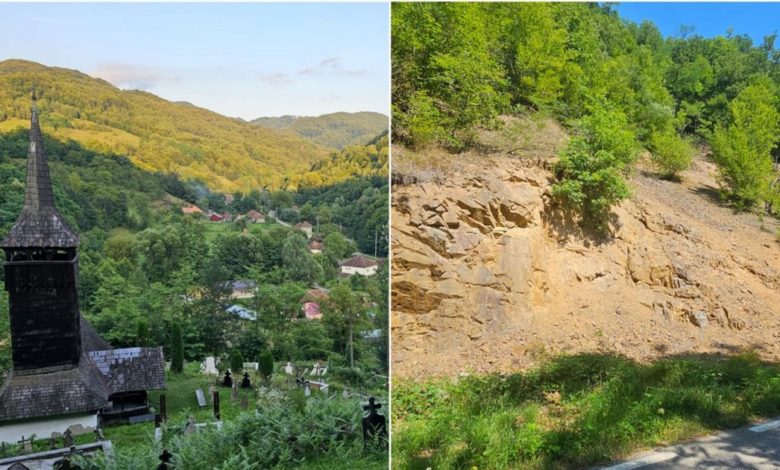
Challenged with incarnation by the environmental organizations, the Rovina mining project, aimed at the exploitation of one of the largest gold and copper deposits in Europe, could mean the return to mining, after two decades, in one of the famous areas of the “gold quadrilateral”.
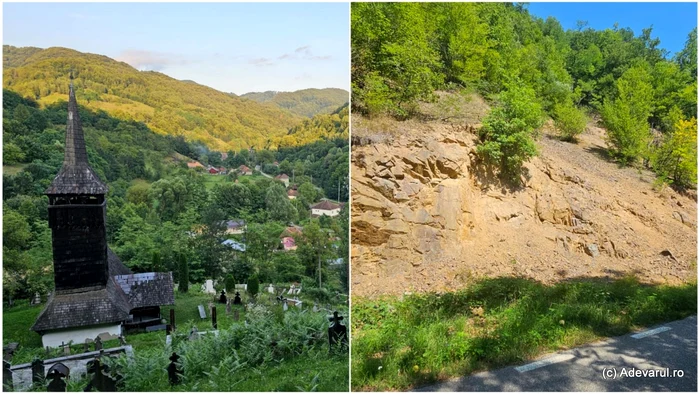
The village of Rovina and the place where the gold and copper deposit was discovered. Photo: Daniel Guță
Two decades after the abolition of the Barza mining center, where, in the 1990s, over 5,000 people worked, another mining project could take its place. Also in the area of Bradului, in Hunedoara county, in Rovina, one of the largest gold and copper deposits in Europe was outlined.
The quiet village, disturbed by the battle for resources
The village of Rovina from Hunedoara county, the place where the Porphyic and gold deposit was discovered, has just over 100 inhabitants and is 15 kilometers from the municipality of Brad (13,000 inhabitants), at the end of a deep valley that snakes among steep hills – an aspect that gave it the name of “Rovina”. In the past, many of the locals worked in the mines of Barza, gold, copper, silver and complex ore, which were closed in the mid -2000s.
As in other localities in the area of Bradului, the population of the village of Rovina has reduced in recent decades, and among those remaining are mainly pensioners who have worked in mining. Agriculture was never the strength of mountain settlements, and the breeding of animals was difficult by the small extent of the pastures.
In the mid -2000s, on the slope of the entrance to the village of Rovina, the geologists made a discovery that would bring the settlement to the world's attention. The drilling revealed, for the first time, a copper “mountain”, whose core is a few hundred meters from the village, on the Rovina stream. Part of the slope, discovered, with red rocks that do not betray the richness of the ore, marks the place where the mining exploitation could begin.
Mountain of copper from the edge of the village
In 2018, the Canadian company Euro Sun obtained a permit and a mining license, valid and renewable for 20 years, for the perimeter on the Rovina Valley, which includes an area of over 27 square kilometers.
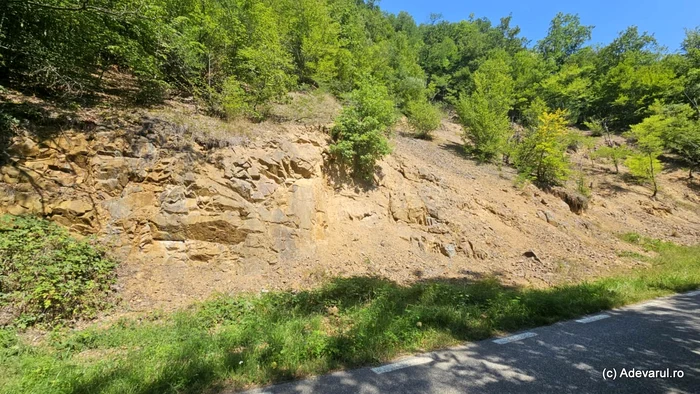
The place of a future career. Photo: Daniel Guță
The Rovina mining project concerns a production of over 42 tonnes of gold and over 200,000 tons of copper in the first 17 years since the beginning of the exploitation, for two of its deposits – Rovina and Colnic – to be exploited in the career, on the surface. Meanwhile, the third deposit, located in Cireșata, will be evaluated during the exploitation of Rovina and Colnic quarries and could be exploited later, underground.
The resources of the three deposits are estimated at about 217 tons of gold and 635,000 tonnes of copper, according to Euro Sun, which develops the project.
The reserves that can be extracted from Rovina over the next 20 years were initially estimated at $ five billion, the state will collect over $ 300 million from the manufacturer, respectively 6 percent for gold produced and 5 percent for copper. In addition to royalties, the investment will bring other sources of state income, from various taxes and taxes, the company representatives shows.
In 2025, the European Commission included the Rovina project, along with two other investments in Romania (the extraction of metal magnesium in Budureasa, Bihor, and the extraction of the graphite at Baia de Fier, Gorj), on a list of 47 strategic importance for the supply of Europe with 14 critical and strategic mineral raw materials.
Recently, the Euro Sun mining company announced that the Trafigura Group, a company of raw materials, will finance up to $ 200 million, through a medium and long term loan, the steps to continue the investment, in exchange for copper concentrates that will be produced in Rovina.
Challenged by environmental associations
In contrast, some environmental organizations and some of the locals oppose the project, considering it harmful to the environment.
“The Rovina mining project, which aims at the extraction of gold and copper, will devastate an extended area of the Apuseni Mountains. Its designation as a strategic project by the European Commission legitimizes an initiative already declared by the Romanian courts. This is not development, but destruction, and we will oppose with the decision. informs Roxana Pinta-Brădățan from Miningwatch Romania, in a press release regarding the inclusion of the investment among the strategic objectives.
In 2024, the Cluj Court of Appeal canceled the environmental notice for the Rovina mining project. The magistrates showed that, before the environmental notice was issued, cross -border consultation procedures were required, as requested by the declice and Echo Rovina Bucharest organizations.
Image 1/11:
The place where the photo career Daniel Guță (3) JPG will be
They claimed that the mining project can also have an environmental impact on the neighboring country, Hungary, due to the big forest areas proposed for deforestation, but also the effects on the Crișul Alb river, which crosses the area, reaching Hungary.
The representatives of the mining company, however, rejected the complaints of the environmental organizations, claiming that they were unfounded and that it was not necessary to consult the cross -border in the phase of elaboration of the zonal urban plan necessary to continue the mining project.
Sorin Halga, director Euro suS, claims that such a mining project cannot affect Hungary, when, for each hectare of deforestation, three hectares of forest are planted, “and the Criș river, which runs over 200 kilometers to the border with the neighboring country, will not be polluted, the ore being processed by floating?”he adds.
After the court's decision, the mining company has to consult the Hungarian authorities regarding the project in Hunedoara County, before continuing the steps to start the investment.
Advertise the consequences on the villages in the area
Viorica Bold, president of Echou Rovina Bucharest, argues that the project involves the surface mining exploitation, which has a devastating impact on the environment.
“He affects four villages, where over 2,000 people live. Some have been manipulated to believe that they will be enriched if they sell the land in the operating perimeter. The relocation, the loss of living and a significant disturbance of their way of life have not been taken into account by the project and is not taken. They seem easy to exploit and prostitute.says this.
It adds that although the project promises economic benefits, such as creating jobs and increasing income, locals have alternatives to mining.
“Tourism, agrotourism can develop, local gastronomic points, museums can be opened, cultural events can be made to promote places with historical importance (we have some important), European funds can be attracted to many types of investments. In our area, many people who come from the city have been moving in the last years and they want to be a life and a life and a life. Discovering that Rovina, besides being an ecological disaster, would force the inhabitants to relocate. add it.
The representatives of the mining company claim, however, that the project will bring safe jobs for the locals in the coming years, and the impact on the environment is reduced, due to the technologies used, both in the processing of the ore, through fleet and in the use of water through recirculation installations.
“The exploitation of Rovina is a mining project with zero cyanide in the process of recovering metals and with a low impact on the environment. The sterile will be deposited dry, and the environment will be restored to the initial state simultaneously”, They show them.
Ten kilometers from Rovina, another investment has been blocked in recent years, following the processes opened by environmental associations.
The works on the accumulation of Mihăileni (video) started in the 1980s and aimed at the construction of a dam on the White Crișul and an accumulation lake, which had the role of defending the area and locals against floods, to supply the water and electricity production. Only the dam has been completed so far, but the works of lake and roads around it are blocked by the court decisions.
Barza mining center with thousands of employees in the 1980s
In the mid -1980s, when the Barza mining complex, in the vicinity of Brad (Hunedoara County) had reached its expansion peak, almost ten thousand people worked in its mines and plants. The mining had become the main economic activity for the Brad region, with a population of over 30,000 people, living in the municipality of Brad and the communes neighboring it.
Barza mining company was in charge of the extraction, processing and use of complex, copper and non -metalliferous ores, included on an area of over 50 square kilometers, on the Crișului Alb Valley and in the Apuseni Mountains. The gold had been extracted here from ancient times, and the mining center had kept its reputation as one of the most productive gold exploitations in the history of Romania. From here, over the last century and a half were extracted over two hundred tons of gold, but also large amounts of silver, copper and complex ores.
In the 1980s, the workers of the Barza company worked in seven me, at Musariu, Valea Morii, Ruda, Brădișor, Valea Arsului, Brusturi and Caraci. The total length of the underground galleries of the mines in Barza has come to exceed 500 kilometers. At Vața Ponor a calcite career was operating, and in Gurabarza (Crișcior) a mineral preparation plant, with a capacity of 2,800 tonnes per day.
Also at Crișicor, on the bank of Crișul Alb, less than ten kilometers from Brad, the repair workshops of mining and metal garments, a maintenance and car repair workshop, as well as a semi-precious stone processing workshop. They all worked in the big Barza enterprises, but they were not the only ones in the area. The municipality of Brad was part of the “Aurifer quadrilateral” of the Apuseni Mountains, one of the richest gold regions in Europe.
Its perimeter of about 600 square kilometers, with important mining localities located a few tens of kilometers, included in the south of Săcărâmb and Certej (Hunedoara county), in the west the mines in Brad (Hunedoara county), in the east Zlatna and in the north Roşia Montană (Alba). Some authors also indicated Baia de Arieș from Alba county, as being an extension of the “quadrilateral”.
The decline of gold and copper mines
The gold and copper mines in the Brad area declined after 1990. Some deposits were exhausted, the investments in re -technologicalization were missing, the equipment and installations were exceeded, and the availability started in 1997 and the pension law of 2001, which provided for the reduction of the retirement age of the miners, only a senior, in the end. The Barza mining center was definitively closed in 2006, leaving behind serious social problems.
Thousands of miners have left the area in the last three decades, while the number of jobs has decreased drastically, while investments in the development of the area have stagnated. One of them, the dam and accumulation lake in Mihăileni, was blocked in court, following the processes opened by some environmental organizations.
The ruins of the former factories, the numerous sterile dumps and the unfinished environmental works, which make the Criș river polluted by reddish mine springs, contaminated with what the locals call “Galiţă”, iron and other non -ferrous metals).


