2025-07-31 12:01
publication
2025-07-31 12:01
The situation on the Saudi Stock Exchange is not optimistic this year. Her condition illustrates the fears of investors who look at oil prices and bringing limited effects of the kingdom's efforts to reduce the addiction of the economy on this raw material, “Financial Times” reports.

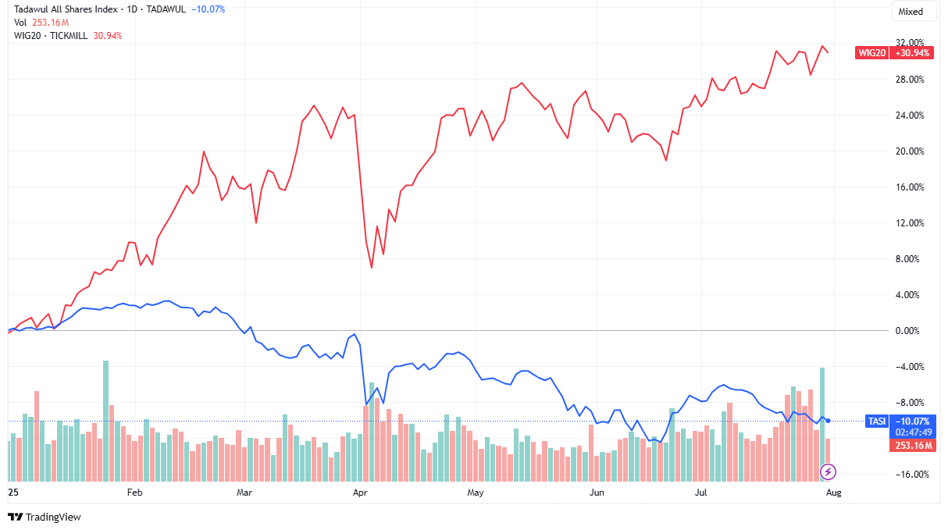
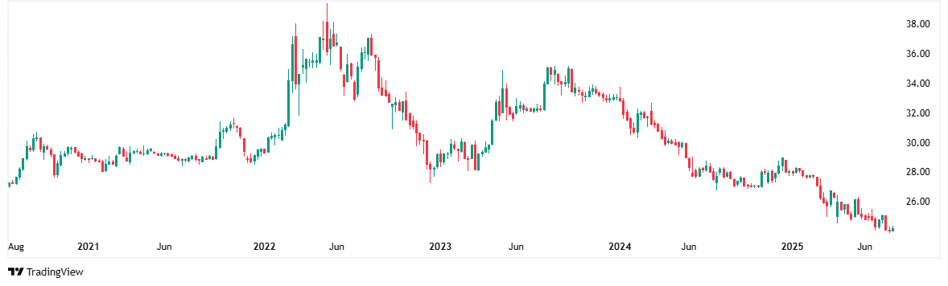
The main parquet index in Riyadh – Tadawul All -Share Index (Tasi) – lost 9.97% from January 1 and this year belongs to the weakest stock market benchmark in the world. According to the “Financial Times” in the ranking covering 90 global stock markets, only the indexes of exchanges from Jamaica, Denmark, Lebanon and Argentina did less well at that time.
Not only that, Saudi companies constitute 5 out of 10 companies with the worst results in the MSCI index in 2025, among over 1,200 emerging markets companies that are part of the benchmark.
Tasi pregnancy, among others A decrease in quotations of the most important Saudi company – the state oil giant Saudi Aramco. The company's shares lost 13.73%from the beginning of 2025. Her market capitalization, which only a year and a half ago exceeded USD 2 trillion, at the time of writing this text, about USD 1.56 trillion.
In addition to the poor condition of already listed companies, many unsuccessful debuts occur on the stock exchange in Riyadh this year. Although Saudi companies have raised over $ 2.8 billion this year, which is a faster pace than in 2024, they are doing much worse than in recent years.
According to dealogic data, newly operated to the Saudi parquet, the actions gained an average of 4% in the first month of quotations. For comparison, in 2024 the result was 27%. The biggest disaster turned out to be the debut of the United Carton Industries packaging manufacturer, whose quotations melted from IPO taking place in May by 35%.
Advertisement
The condition of listed companies and weakening debuts reflect on the results of the stock exchange operator. On Sunday, Saudi Tadawul Group presented its financial results for the first half of 2025. The company's revenues fell by 13% yard during this period, because the average daily value of trading on the market fell at the same time by one third – emphasized the Financial Times.
Refuge from oil
According to analysts cited by the British daily, the main factor of uncertainty that hung over the Saudi action market is its dependence on oil prices. The Riyadh Stock Exchange is highly exposed to this raw material by a large share of banks, oil companies and petrochemical groups, i.e. traditional sectors.
According to the Financial Times, investors bet that the stock exchange will be charged with a rapid increase in the debt of Saudi Arabia, which will take them in order to compensate for lower oil prices, in turn, threatens to increase the costs of financing banks and companies. The ambitious plans for the diversification of the economy are expensive.
In the face of lower oil revenues, Saudi Arabia sets priorities in expenses and in the first half of 2025. Its financing of projects to ensure the economy has fallen by 60% yard. And it was the lowest since 2021. Luka was created in the budget by decreases in oil prices, it is supplemented with foreign capital.
In 2024, Saudi Arabia was the greatest issuer of foreign bonds in emerging markets and may remain it this year, thus increasing the level of debt in dollars, which has grown dynamically over the past five years.
However, as the Financial Times emphasizes, the profitability of 30-year Saudi Arabia bonds is about 6%, and therefore only by about a percentage point more than the profitability of equivalent American tax bonds. In time, however, this will probably start to change.
The debt of Saudi Arabia in relation to GDP still belongs to the lowest in the world. At the end of last year, the chasing assets of the Central Bank of the Kingdom exceeded $ 415 billion. The surplus on the current account, however, disappeared last year and, according to the International Monetary Fund, Saudi Arabia will record a budget deficit each year to the end of the decade.
Foreign net assets of Saudi banks, which are the main buyers of government bonds, have become negative for the first time since 1993. This is because financial institutions from the kingdom have taken out more loans abroad to finance credit activities in the country.
Ed. Mm