The statistics counted how many Romanians are poor, that is, they manage to live with 63 lei/day


The value of the relative poverty threshold was, in 2024, of 23,262 lei per year, that is, about 63 lei/day, according to information published Monday by the National Institute of Statistics.
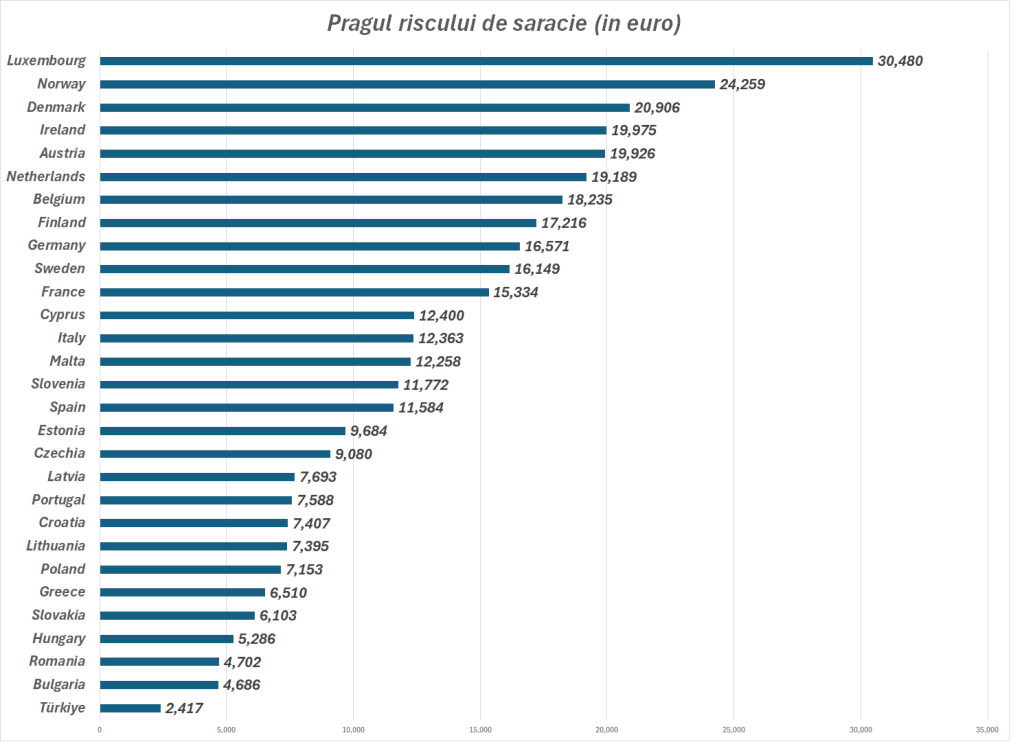
In absolute values, the number of poor persons was, in 2024, of 3.59 million people, the data of statistics shows.
Estimated on the basis of the total available revenues, exclusively the value of the consumption of own resources of the household, the relative poverty rate (AROP) was in 2024 of 19.0%, decreasing by 2.1 percentage points compared to the previous year.
The highest incidence of poverty met among people of 0-17 years (26.2%) and 18-24 years (22.2%).
The poverty rate of people living in households with minors and young people aged 18-24 was 22.6% in 2024, higher by 8.6 percentage points than that of people living in households without minors and dependent young people.
Social transfers play an important role in lowering the poverty rate
If in 2024 the pensions and other social transfers were not paid, two fifths of the population (41.4%) would have been below the threshold of relative poverty and obviously the situation would have worsen in the case of the elderly (65 and over) who, in a proportion of 84.8%, would have been in a state of relative poverty.
In 2024, of the ages up to 65, 615,000 lived in very low working households (households in which adults in work carried out activities that requested less than 20% of their work potential).
The risk rate of poverty or social exclusion
The risk rate of poverty or social exclusion (AROPE) was 27.9%, in 2024, corresponding to a number of 5.3 million people, say statisticians.
- The risk of poverty and social exclusion includes people who live in a household facing at least one of the following situations: risk of poverty, severe material and social deprivation and/or very low intensity of work in the household
Compared to the year 2023, there is a decrease in the value of the indicator, with 4.1 percentage points, representing a decrease with 740,000 people.
Age plays an important role, the AROPE indicator being, in 2024, higher in people of 0-17 years (33.8%) and in young people aged 18-24 (31.3%) and lower in people aged 25-49 (22.9%). The share of 65 -year -olds and who were at risk of poverty or social exclusion was 29.3%. In 2024, out of the total of occupied persons, aged 18 and over, 17.3% were at risk of poverty or social exclusion, compared to 37.5% of the total unoccupied persons, from the same age category.
The highest incidence of the AROPE indicator, in 2024, was registered with households consisting of two adults with three or more dependent children (50.9%), followed by that of households with three or more adults (37.2%) and single -parent households, with an incidence of 36.5%.
In the case of households without minors and young people of 18-24, dependent, the greatest incidence has been found among the households of one person (34.7%), compared with 17.6% in the case of households with three or more adults.
The highest risk rate of poverty or social exclusion has been registered in the South-East Region
The highest rate of poverty or social exclusion was registered in the South-East region (39.7%), followed closely by the South-West Oltenia region (35.1%), and the lowest rate was observed in the Bucharest-Ilfov region (12.0%).
The intersection of the components of the AROPE indicator provides information for the detailed analysis of the impact of each of the three components on the evolution of the compound indicator.
Of the 5.3 million people at risk of poverty or social exclusion, 3595 thousand people were at risk of poverty, the most common of the three situations.
Some of the people at risk of poverty or social exclusion are only in one of the three situations. Thus, about 1789 thousand people were only at risk of poverty, but were not in the other two situations, in severe material and social deprivation and did not live in households with very low intensity of work, 1596 thousand people were only material and severe social and 82 thousand people lived in the households with very low work.
Looking at the intersection of two by two of the AROPE indicator, it is observed that 1294 thousand people were at risk of poverty and were materially and severely deprived, 157 thousand people were at risk of poverty and lived in households with very low intensity of work, and the least persons, 21 thousand people, lived in the household and in intensity.
About 355 thousand people faced simultaneously with all three situations: in other words, they were at risk of poverty, they were in a state of severe material and social deprivation and lived in very low intensity households.