Poland could have a kingdom? “This message was a blow”

In the late winter of the last year of the war, the tactic of the Soviet forces consisted in pushing the opponent towards the Vistula Lagoon. March 20, 1945. Branches of the 3rd Belarusian Front of Marshal Aleksander Wasilewski They broke the resistance of the defenders and occupied Braniewo, which as a result of fights and later arson was destroyed in over 80 percent. Over 31 thousand were buried west of the city. Red Army soldiers. The necropolis containing over 700 graves is the largest cemetery of the Soviet victims of World War II in Europe.
The road to Königsberg, encircled since January, has been opened.
After the start of the assault, the capital of East Prussia lost its connection to the port in Piława (currently the Baltic), which turned out to be tragic for civilians. As in the book “Lost City” one of the participants of the event, after the World War, the Fine Fiolitis, Michael Wieck: “We all knew that the Russians had the advantage: the resistance was pointless. General Lasch estimated that the ratio of forces is about 250 thousand. attackers at 35,000 defenders. One -third of all Russian aviation was on Königsberg, while there was not a German aircraft. The ratio of tanks was like 100 to 1 “.
“Nobody understood why the civilian population still had to face the attack with his murderous bombing. Dalibóg, we all had enough suffered. We were filled with powerless anger to the commander, for whom the lives of his subordinate people meant so little. Now it was quite open and loudly cursed and chasted away ” – we read further.
German losses amounted to at least 40,000 killed and 90 thousand taken into captivity. Losses among civilians were equally high: nearly 25 percent from 100,000 people who were not evacuated were killed as a result of shelling. However, this was not the end.
The Germans who failed to leave were forced to slave work in removing the city and the port. For every 12-hour day they were entitled to 40 decagrams of bread and a plate of soup. Two years after the war, one of the Soviet generals wrote that the inhabitants of Kaliningrad were “unable to work because of strong weakness” and “physically extremely weak and deprived of food supply”.
Earlier, dated to the turn of May and June 1945, reports informed about the ubiquitous destruction: “A city in ruins. Very difficult conditions, from nowhere, no help, nor from the army, nor from the population”, “the castle is a complete ruin. Only a few chambers survived intact – in the north wing.”
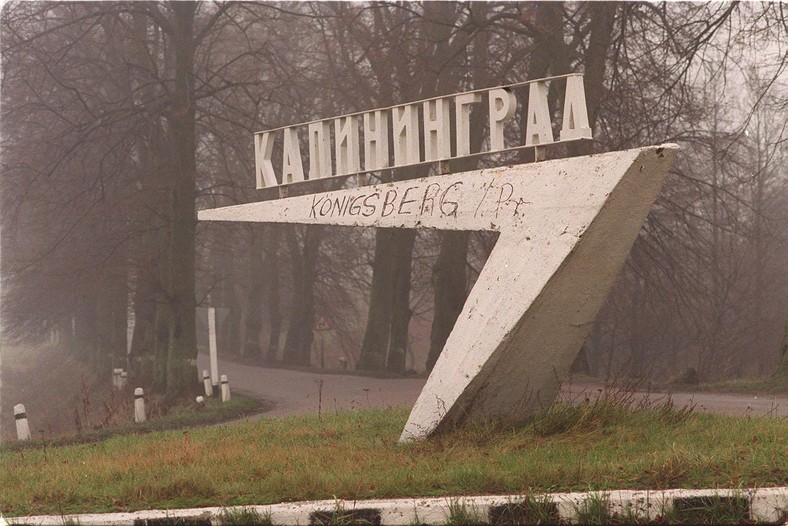
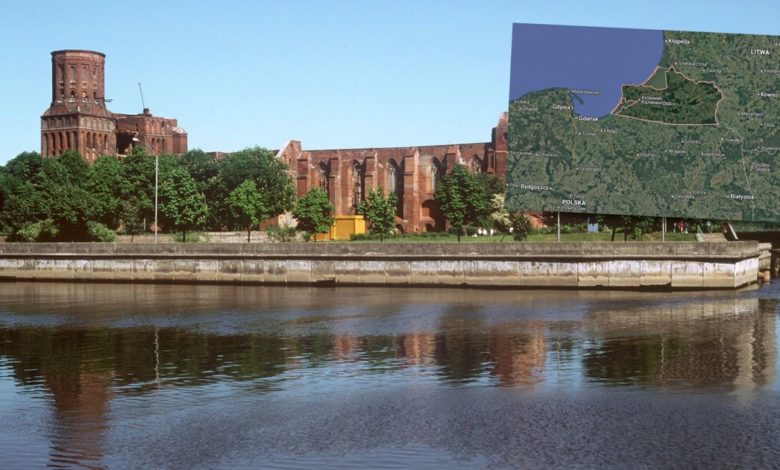
Królewiec, formerly Kaliningrad (photo from 1991)
“High mortality, caused by a difficult food and housing situation”
The Soviet authorities carried out registration of the German population in the acquired region. In 1945, 130,000 lived there. civilians, including 70,000 in a ruined capital. After a year, the last number decreased by 30 percent. And then it showed a downward trend, which, according to officials, was associated with “high mortality, caused by a difficult food and housing situation.” In addition to the revenge of the winners, the everyday life of the defeated was marked by hunger, work beyond strength and the collapsing homes.
To eat, you had to demonstrate a lot of cunning and steal. About 90,000 surrendered to the displacement at the end of 1947. people, of which 30,000 in Kaliningrad As Wieck rightly pointed out: “Revenge has nothing to do with justice. This is not the right way to equalize bills – and the rules affect the wrong people.”
After the end of World War II, the Soviet authorities consistently “ghermanized” the region.
On July 4, 1946, the official name of the city from the German Königsberg to Kaliningrad was changed – in honor of Mikhail Kalinin, a month earlier, the chairman of the Presidium of the Supreme Council of the USSR, whose signature appears under the decision to commit the Katyn massacre.
Instead of reconstruction, German objects were destroyed. Demanded, among others Monuments of Emperor Wilhelm and Otto von Bismarck, which was first replaced with the monument of Stalin, and then – Lenin. New monuments were erected on the former Adolf Hitler Square.
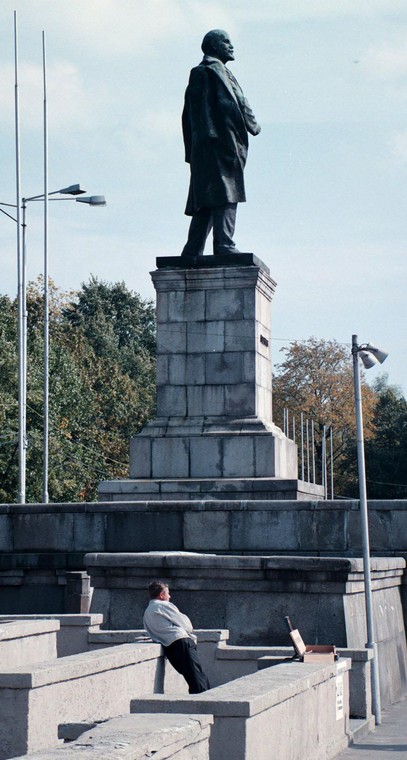
Lenin Monument in Königsberg (1998)
The ruins of the Królewiec castle, despite being considered to preserve some fragments as elements of new urban buildings, were finally completely demolished in 1968. This act can be considered a symbolic end of the Prussian city – destroyed first as a result of the Allied bombardations, then during a dramatic siege and finally the hand of Soviet officials.
“We are building a new city!” – Such a decision was made by the long -term secretary of the party's peripheral structures, Nikolai Konałow. Despite the pressure from the Ministry of Culture, he could not be convinced to change his mind. In 1964, the deputy head of the Museums and Protection of Monuments Board wrote: “The ruins of the castle may become one of the monuments of the victorious ending of the Great Patriotic War from 1941–1945. In addition, one must not forget about the hypothesis that there are decorations from the castle from the castle's basement, deported by the Nazis from the Palace of Katarzyna.”
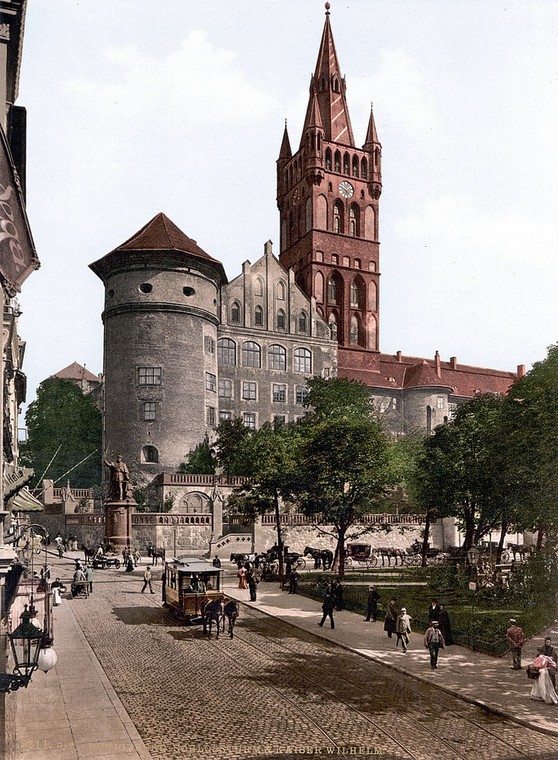
Teutonic castle before almost complete destruction in 1945; Other ruins were blown up in 1968.
“… in the basement of the castle there are decorations from the amber chamber …”
Numerous German cultural locks came to the war Königsberg – from the famous amber chamber, through artifacts taken from Ukraine, to treasures looted in Płock, which was included in the Reich and the province managed by Gauleiter Erich Kocha. He came to the city of Emmanuel Kant, among others A unique manuscript of the Płock Bible from the 12th century and an older manuscript of the Old Testament. While the first one was returned in 1978, the second monument never found itself.
Like the castle stored in the castle, the famous chamber looked at by the Germans from Tsar's Sioł near St. Petersburg, last seen in 1944. It was destroyed by a fire during the bombing of the city, hidden or embedded in the swamps during evacuation.
On August 28, 1941, the East -Prussian daily informed: “During the review and ordering of libraries in East Prussia, 50,000 theological volumes from Płock and 8,000 volumes of the Junior High School in Suwałki” went to the State Library in Königsberg. The Płock Bible, older than before the oldest copy in this part of Germany, was one of the most valuable achievements. The train with books was one of the last, which at the end of March 1945 reached Piawa. Then the transport successfully arrived in Kiel, and the Bible itself found itself in 1947 in Getynda, where the exported harvest was collected from the pregles. The fate of some of them has never been explained.
As soon as Erich Koch learned about the capitulation of the capital of East Prussia, he gave a telegram to Hitler's headquarters:
After a dozen or so days, his faith in victory weakened so much that he decided to leave his coastal residence – through Krynica and Sztutowo he arrived near Gdańsk, from where he sailed to the Hel Peninsula. On April 28, 1945, he set off on another cruise – he reached Copenhagen through Bornholm. He went ashore in civilian clothes not disturbed by anyone. He effectively hid until 1949. He was issued to Poland and sentenced to death.
Why did everything last so long? Why was the sentence never made? Did Koch have knowledge about the place of hiding the amber chamber? This may have been thought to Polish and Soviet services, which allowed the criminal to spend many years behind bars. Koch died in 1986 in Barczew near Olsztyn.
“This message was a blow to the Polish government”
Could the Królewiec become a Polish city? During the conference in Tehran, on December 1, 1943, Winston Churchill stated that “the root of German evil is Prussia.” Therefore, after the war, he intended to transfer these areas to Poland:
Although there was a real possibility that the city of Kanta would fall in Warsaw, Stalin's strong opposition was strongly objected. The Soviet leader sought to provide the USSR with access to the underestimating ports on the Baltic Sea – Królewiec and Klaipeda. He claimed that they have been “Slavic lands for centuries.” His arguments prevailed.
In exchange for Poland, territorial compensation in the West was proposed. The case took on a final shape in Yalta in February 1945. A few months later it was formalized in Potsdam. One of the resolutions adopted there was the title: “The city of Königsberg and the adjacent area”.
Although from today's perspective it is difficult to imagine effective opposition to the will of Moscow, it is worth recalling that The Polish emigration government firmly protested against decisions made in Tehran. Poland was officially informed about the provisions of the Great Three only in February 1944. Churchill then wrote to Stalin: “… I informed the Polish government that the Soviet government would like to establish the border of East Prussia in such a way that the kingdom was incorporated into Russian territory. This message was a blow to the Polish governmentseeing in this decision a significant reduction in the size and economic importance of those German areas that are to be attached to Poland as compensation. “
Interestingly, Prime Minister Mikołajczyk and Polish communists spoke with one voice. The PKWN manifesto announced on July 22, 1944 informed about the desire to “include East Prussia and the Regained Territories in the West in Poland – Silesia, Pomerania and the lands on the Oder”. An little -known episode from the history of Königsberg are the events of April 1945 – the establishment of local Poles, derived from forced laborers, substitutes of the City Board and the City Council and the Citizens' Guard.