Dozens of organizations dealing with digital laws and human rights in an open list addressed to the chairwoman of the European Commission Ursula von der Leyen and its colleagues said that the use of Hungary's face recognition technology is a “gross violation of” EU regulations on artificial intelligence.
These organizations want Brussels to initiate proceedings against Hungary regarding the violation of EU law. Such a step It would deepen the long -lasting tension between Brussels and Budapest regarding the compliance by the Hungarian government of the EU rule of law.
So far, Brussels has been limited to the statement that she was looking at the case – despite the fact that the Equality Parade in Budapest will take place on Saturday.
In April, Politico said that the Commission “assesses” the Hungarian law that allows the police to use facial recognition technologyIn order to identify people participating in equality parades and will not “hesitate before taking appropriate actions.”
Civil society is outraged by the commission.
“Disturbing precedent”
“The lack of actions of the Commission to enforce the basic laws and digital rights, despite the appeals of civil society, is deeply disturbing,” said Blue Tiyavorabun, a political advisor in the Edri organization dealing with digital laws, one of the signatories of the letter.
The commission did not respond to numerous requests for comment before the publication of the article.
In the commentary provided after the publication of the article on Thursday, June 26, the spokesman for the Commission Thomas Regnier said that the institution contacted Hungarian authorities in order to obtain “explanations” regarding provisions related to data protection and privacy. “We will consider all the necessary steps to protect EU law, according to the situation,” said Regnier.
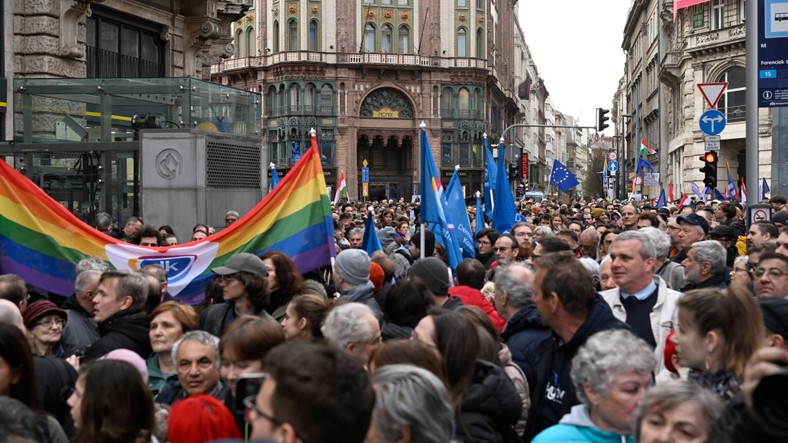
In mid -March, Hungary banned organizing equality parades, claiming that this was to protect children. Thanks to a series of changes in applicable regulations The police have gained the possibility of facial scan in the case of all kinds of crimes – including participation in banned assemblies, such as the Equality March.
EPA / ZOLTAN MATHE / PAP
Demonstrators during a protest against the amendment to the Act on assemblies, prohibiting, among others Equality parades, Budapest, March 25, 2025.
If the face recognition takes place in real time, it constitutes a violation of EU regulations on artificial intelligence. The law prohibits the law enforcement agencies of biometric identification in real time in public places. This recipe came into force in February.
The case of Hungary is “the first known violation of these provisions” – wrote human rights organizations in their letter, claiming that it will establish a “worrying precedent”.
“If this is not solved, This can cause a domino effectas a result of which other Member States may feel encouraged to adopt similar regulations, “it was emphasized.
EC is analyzing the matter
However, the Commission must also assess whether the use of this technology by Hungary will take place in real time. EU principles regarding artificial intelligence are less strict in relation to biometric identification, which is not used in real time. For example, such biometric identification would be allowed with the consent of the court in the case of specific crimes after their commitment.
Organizations dealing with digital rights and human rights are trying to convince Brussels that the Hungarian system allows the authorities to act “in a way that should be considered as real -time action,” results from a legal analysis that made available to the Commission, and to which Politico reached.
Continuation of the material under the video
The Hungarian authorities did not provide details regarding the implementation of this technology, but the Hungarian Union of Civil Liberation has developed a list of questions and answers that contains some explanations about the system.
Facial recognition is based on photos, and the system can only be identified by persons with a Hungarian identity document with a photo, because the photos are compared with the register of facial profiles kept by the Hungarian Institute of Forensic Sciences (HIFS) – the organization said.
The register does not contain real photos, but “biometric ID” – added.
In their legal analysis, human rights organizations say that the police can connect directly with HIFS systems and check if the image matches the biometric identifier. According to them This meets the definition of real time contained in an act of artificial intelligence, which speaks of “a lack of significant delay”.
HIFS did not answer the request for comment.
Budapest sees no problem
A spokesman for the Hungarian government said in April that in his opinion “everything is in line with our constitution and EU law.”
On Saturday, several well -known European politicians are to take part in the Equality Parade, including Commissioner for Equality Hadja Lahbib, Minister of Culture of Spanish Ernest Urtasun, Minister of Education of the Netherlands EPPO Bruins, former Prime Minister of Belgium Elio di Rupo and former Ireland Prime Minister Leo Varadkar.
Kim van Sparrentak, one of the co -authors of the Act on artificial intelligence, also announced her participation in the parade.
Ursula von der Leyen on Wednesday evening called Hungary to permission to organize a parade in Budapest “without fear of criminal or administrative sanctions against organizers or participants.”
In response, Prime Minister of Hungary Viktor Orban appealed to von der Leyen to “refrain from interference in issues of enforcement of law in the Member States in which she has no role to play.”
I’m Ashley Davis as an editor, I’m committed to upholding the highest standards of integrity and accuracy in every piece we publish. My work is driven by curiosity, a passion for truth, and a belief that journalism plays a crucial role in shaping public discourse. I strive to tell stories that not only inform but also inspire action and conversation.