After talks from 16 thousand people in 12 European countries, our organization, the European Council of Foreign Relations (ECFR), came to the conclusion that Trump's victory changed the nature of Europe's internal policyas well as its geopolitical position.
Almost from day to day the extreme right in the EU has gone through the die -hard defense of national sovereignty before a federalist threat to Avant -garde of the supranational movement, which is in favor of a kind of civilization of nationalism. And vice versa, many mainstream parties – or rather former globalists – have transformed into new sovereignists, defending national dignity against what they perceive as an ideological interference of Washington.
Supporters of European populist parties are also no longer voters of protest. According to our data, most people supporting each of the 10 far -right parties we surveyed believe that Trump's re -election will be good for the USA and perceives his actions with sympathy and excitement. Like the extreme -right EU leaders who copy his policy in everything, from immigration to blowing up domestic bureaucracy.
Continuation of the material under the video
The result of all this seems to be an ideological transatlantic relationship that He no longer divides the continent into pro-American and anti-American countries. In contrast, for example, to the split war in Iraq in 2003, Eastern Europe is not more friendly to the USA than Western Europe because of a strong pro -American social consensus, but because its extremely right -wing parties are stronger.
It is not clear, however, whether the European extreme right will be the main beneficiary or victim of the Trump revolution. On the one hand – as in the case of Brexit – its re -election shows that it is still possible to come to power. However, if people turn against Trump and his policy, these parties will be the greatest losers. Their support depends on the American leader in the same way that support for Western European communist parties depended on how people perceived the Soviet Union and his policy during the Cold War.
At the other end of the spectrum we now see some of the most traditionally Atlantic parties in Europe, such as the German Christian-Democratic Union (CDU), which They become defenders of national sovereignty against Trump's America again. This is a change that coincides with the results of our surveys, which clearly show that the countries that today seem the most skeptical to America seemed the most Atlantic yesterday, such as Great Britain, Germany and Denmark.
In particular, dishes – where 86 percent respondents believe that the US political system is broken – it is best illustrated that people are radically turning against the United States Not when Trump attacks Europe, but when threatens the sovereignty of their country.
Naivecs or realists?
The ongoing transformation of Europe's geopolitical identity is equally dramatic. Trump's re -election forces Europe to A serious approach to your own safety. More precisely, while the fear of Russian aggression remains mainly limited to countries directly bordering it, according to our surveys, currently exists A clear general European fear of nuclear conflict and a new world war.
Alex Wroblewski / AFP
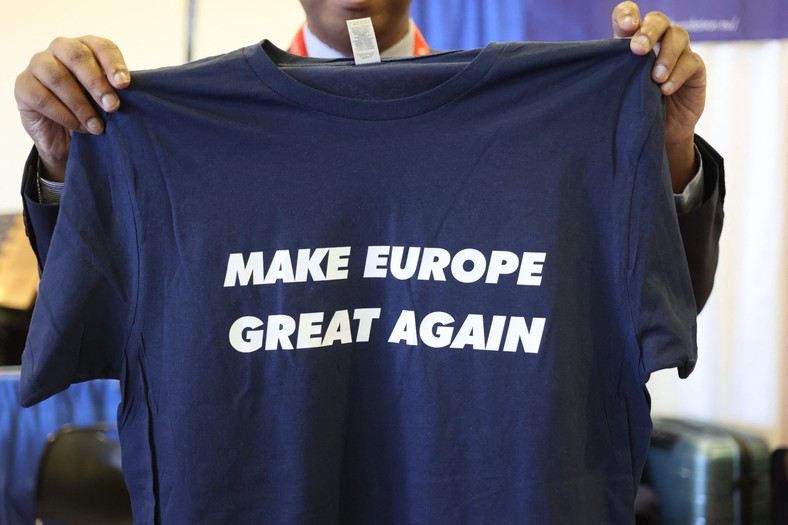
T -shirt with the slogan Make Europe Great Again. Illustrative photo
Looking at the results, we see that the majority are currently in favor of increasing defense expenditure, further support for Ukraine in the event of the US withdrawal, and in many countries even for the introduction of compulsory military service. In many countries – with the exception of Italy and Hungary – most exceeding 60 percent It even tells himself for development of European nuclear deterrencewhile some also demand domestic nuclear deterrence.
As the EU changes, Europeans still have doubts whether they are able to get their way quickly enough to defend yourself In the absence of Washington – especially in short -term perspective.
The main paradox that results from our research is that although Europeans are aware of the threats related to the policy of the new US administration, they still express the belief that Trump will not withdraw American troops from Europe and that transatlantic relations can be easily repaired after his departure from office. The question is, are they naive when it comes to the nature of Trump's revolution, or are they simply realists about what the EU can achieve in a short period?
While European NATO leaders are gathering in Hague to agree on the historical goal of defense expenditure at 5 %, The answer to this question may be surprising. The French revolutionary Louis Antoine de Saint-Just was to say that “the current order is a disorder of the future.” Today, the heart of this maxim fits Europe like a glove.
I’m Ashley Davis as an editor, I’m committed to upholding the highest standards of integrity and accuracy in every piece we publish. My work is driven by curiosity, a passion for truth, and a belief that journalism plays a crucial role in shaping public discourse. I strive to tell stories that not only inform but also inspire action and conversation.