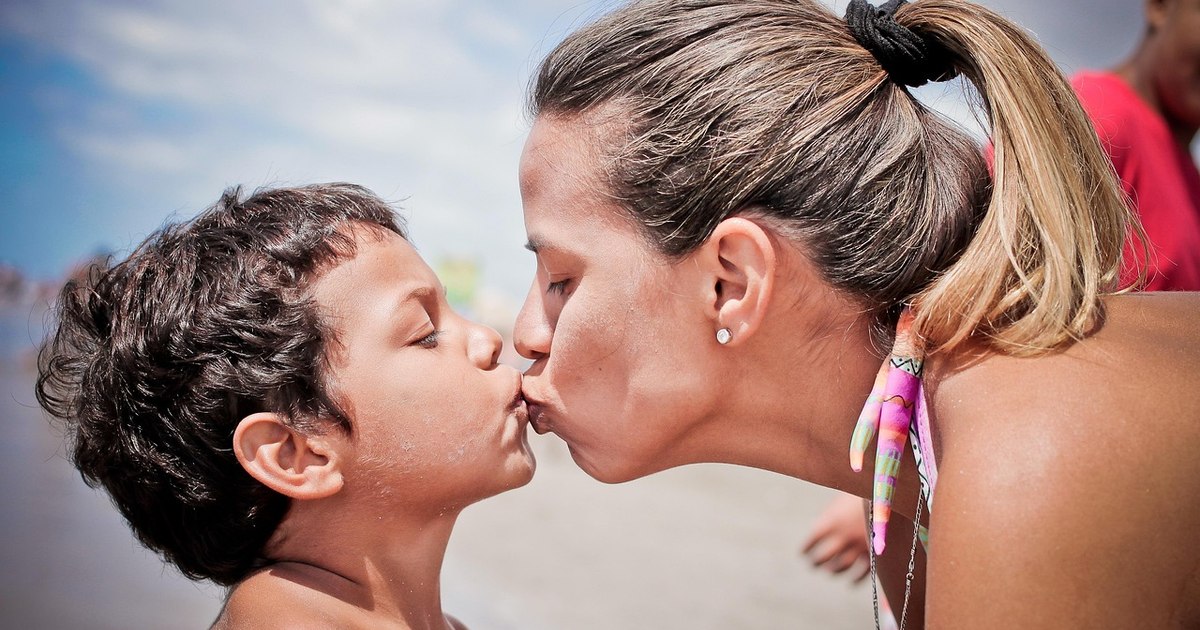
Some consider it a natural gesture of love. Others say there shouldn't be. The debate about kissing the baby on the mouth doesn't just divide parents into two camps. Psychologists, pediatricians, and early development specialists have been arguing over the topic for years. And the question remains: What actually happens when you kiss your baby on the mouth?
PHOTO by Pixabay
Cultural perspective: a gesture that divides the world
In 2017, a photo posted by Victoria Beckham, in which she kisses her little girl on the mouth, caused widespread reactions around the world. Things haven't changed much since then, and the subject remains a controversial one.
Things also depend a lot on the culture the parents were born into. In a large part of Europe (including Romania) and North America, opinions are divided: some see kissing a child on the mouth as a natural expression of family love, others consider it an inappropriate or even taboo gesture. In contrast, in many Mediterranean or Latin American cultures, the practice is completely normalized and an integral part of the affective language of the family. Japan provides the opposite example: physical displays of affection between family members are generally more restrained.
Psychologists do not agree on whether it is natural or not
Naturally, many parents at the beginning of the journey wonder what the psychologists say? But there is no universally accepted answer. And here the debate is heated.
Charlotte Reznick, author and professor of Psychology at the University of California (UCLA) is one of the most extensive opponents of the gesture. She has repeatedly stated that parents should not kiss their children on the lips. Her argument: the lips and mouth represent an intimate, personal area, and invading it can send confusing signals to the child. Reznick said in an interview with The Sun: “If mommy kisses daddy on the mouth and vice versa, what does that mean when I, a little girl or a little boy, kiss my parents on the mouth?”.
In addition, she raised another objection: “If you start kissing your children on the mouth when they are little, when do you stop? It's extremely confusing.”
Reznick has been contradicted by several other psychologists:
“It's an outrageous thing to tell parents. It completely ignores the special relationship parents have with their children and the non-sexual nature of that particular behavior.” said the Australian psychologist Heather Irvine-Rundle. She added that most children naturally ask their parents to stop kissing them on the lips by the time they reach primary school age.
Another psychologist likened the gesture to other natural ones in the mother-child relationship:
“It's like saying breastfeeding is confusing. Some people might have a problem with it, but it's no sexier than giving your baby a massage,” she said. Sally-Anne McCormack for The Independent.
And Dr Fiona Martin, from the Children's Psychology Center in Sydney argued that there are no documented negative effects on the psyche caused by this gesture.
Are there health risks?
There are, however, more arguments against when it comes to potential health risks, especially in the first months of life.
The risk of transmission of the Herpex Simplex virus is undoubtedly the most serious medical argument against oral sucking of babies. Herpes simplex virus type 1 can be transmitted through saliva, even when the infected person has no visible symptoms. Babies (especially in the first four weeks of life or if they are born prematurely) are more vulnerable than older children and can get severe infections.
The UK National Health Service (NHS) guidance on herpes in newborns states:
“The safest place to kiss your baby is on the top of the head. Puppeting near the mouth, nose or eyes should be avoided.”
The risk is greater in the first four weeks of life, when the newborn's immune system is almost unformed. Premature babies are even more vulnerable.
Beyond herpes, RSV (respiratory syncytial virus), influenza, whooping cough or even streptococcus can be transmitted through mouth buccal. Many of these infections are relatively mild in adults, but can become dangerous in babies.
“Parents should not kiss babies if they have any kind of infection”the doctors are categorical.
Beyond the pros and cons of psychologists and doctors, specialists seem to have reached a consensus on one point: affection shown by parents to children must respect the boundaries set by them. In addition, it is important that the little ones are taught about the types of touching that should not be accepted in the relationship with other adults.