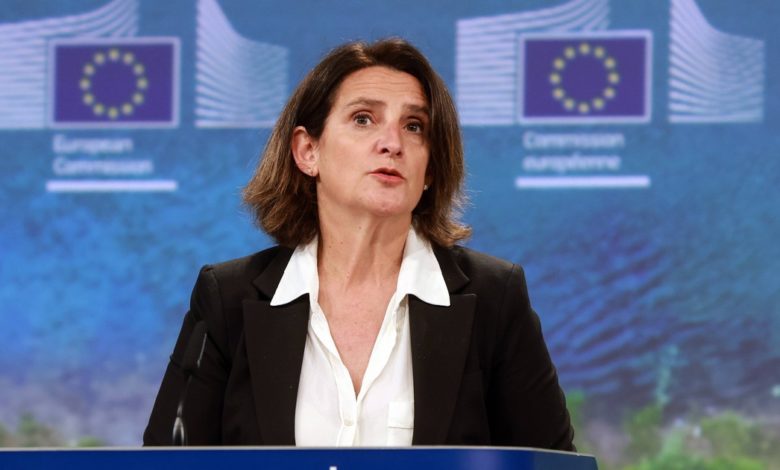
On Tuesday, the European Union presented the long -awaited legal proposal, which aims to eliminate the import of Russian gas by 2027. Brussels is trying to eliminate an important stream of income for the Kremlin's warfare in Ukraine. But to do this, he must also overcome an unexpected obstacle: the resistance of a powerful commissioner for clean technology, propagator of ecology and an avid supporter of Ukraine.
The spokesman of Teresa Ribera calls these accusations “absurd”, arguing that the Spanish politician He called companies many times to stop buying Russian energyat the same time consistently promoting a policy aimed at withdrawing all fossil fuels.
However, according to three EU officials and two EU diplomats, which we provided anonymity so that they could speak freely, Ribera intervened many times when in recent months her colleagues from the EU executive body developed this strategy. They claim that She acted for fear that Spanish companies would face an avalanche of lawsuits from Moscow.
“For five weeks, Ribera said that a good assessment was not carried out, and the risk of lawsuits from the Russians was high,” says one of the officials, arguing that the Spanish politician “used her role” in discussion groups as the vice -president of the executive of the commission, that try to weaken the plans.
According to our interlocutor Ribera lobbyed in the inner circle of Dan Jorgensen, a commissioner for energyresponsible for the strategy, formally its subordinate. However, his “office remained adamant” and refused to give up the general plan.
Continuation of the material under the video
Ultimately, however, the efforts ended with a last -minute change in the text which It leaves the door ajar to return to Russian importstwo officials say. This movement was also historically supported by Moscow -friendly EU countries – Austria, Hungary and Slovakia.
Spanish problems transferred to Brussels
Ribery spokesman admitted that the Commissioner was involved in the preparation of the application, but argued that she did it in the interest of Europe. – We help in developing a legal proposal in terms of legal terms and help dispel the concerns of others – he says, referring to inland countries that have less alternatives to Russian gas.
Lobbying comes when the EU is increasingly looking for creative ways to weaken the Russian war budget, trying to overcomeOpposition of Bratislava and Budapestwhich have the right of veto regarding sanctions And they are largely dependent on Russian imports. However, the ban issued under the energy and trade law would only require a qualified majority among EU capitals.
The ban would also have an impact on Spain, the third largest in the EU buyer Moscow liquefied natural gas. Currently, this country is obliged to buy supplies from the Russian company Nowatech until 2042 as part of a long -term contract signed with the National Energy Company Naturgy. According to the KPLler trading platform, last year, the Spaniards imported 4.7 million tons of Moscow LNG.
While the commission insisted that this prohibition would be a tight way for companies for the earlier completion of contracts with Russian companies, experts say that This agent can still expose the EU importers to responsibility, Forcing them to pay millions of fines if they lose in court.
– Arbitration claims can be initiated by Russian contractors – admits Agnieszka Ason, a lawyer specializing in the energy sector and scientific employee of the Oxford Institute for Energy Studies. In her opinion The current EU proposal does not guarantee that the ban will be effective.
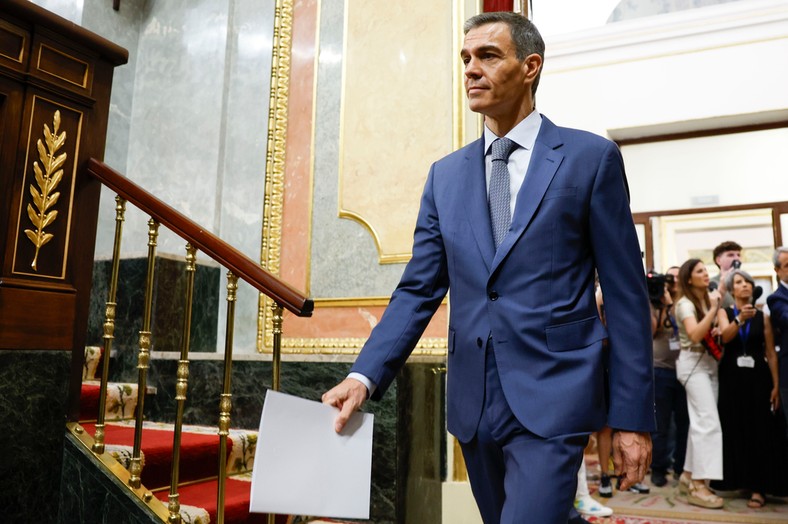
According to officials, it was partly intervened by Ribera, Being under pressure of the Spanish Prime Minister Pedro Sancheza close ally of the frontal Eurocrat.
Despite the fact that Madrid publicly supported the plans, “Spain was particularly concerned, The government strongly pressed who would bear the costs“Potential lawsuit, another EU official tells us.
PAP/EPA/Mariscal
Pedro Sanchez, Spanish Prime Minister. Madrid, June 18, 2025
Sanchez is struggling with growing corruption scandals in the country. – Spain is in a difficult situation and I do not want further problems on the part of Brussels – explains the official.
Ribera's credibility in question
Ribera spokesman replies that the claims that the politician favored Spanish interests and acted under pressure are “completely false”. He adds that her role as the Vice -President of the Executive was considering projects of commissioners working under its leadershipsuch as Jorgensen.
The draft regulation is now “much better than the initial project and was largely supported by” EU countries, emphasizes. In turn, a spokesman for the Spanish Ministry of Ecological Transformation says that “it did not exert pressure on any European Commissioner.”
Preparation of the plan “was in line with normal work practice [komisarzy] In the cluster “, i.e. a discussion group, is also emphasized by Anna-Kaisa Itkonen, a spokeswoman for the European Commission.
Despite this, this movement prompts you to call a new amendment – which theoretically allows the Commission suspend the ban on Russian gas if the security of the country's supply is at risk.
This recipe is a “step back”, as Politico Lithuanian Energy Minister Zygimantas Vaiciunas says. – sends a signal that partly, indirectly and under certain conditions, Financing Putin's war in Ukraine can still be tolerated [z] some countries obtaining margins from this – argues the minister.
This also puts the personal credibility of Ribera. Ivan Hortal Sanchez, conducting the EU campaign in the Ukrainian NGOs at the stand, calls lobbying “deeply disturbing”. – The Commission should act in the interest of the European Union, and not in the interest of companies such as Naturgy in Spain, which still import Russian LNG and transfer millions of euros to Putin's war machine – comments Sanchez.
I’m Ashley Davis as an editor, I’m committed to upholding the highest standards of integrity and accuracy in every piece we publish. My work is driven by curiosity, a passion for truth, and a belief that journalism plays a crucial role in shaping public discourse. I strive to tell stories that not only inform but also inspire action and conversation.