Households and companies look impatiently on the horizon of lower energy prices, which in Europe exceed those from China or the USA. High costs are considered one of the major obstacles to competitiveness of EU economiesand their causes are seen, among others depending on the import of energy resources. The development policy of renewable energy sources instead of fossil fuels is therefore associated with the promise of a long -term bill reduction.
Rightly? Published by the Center for Development Strategies, the latest report of Marcin Izdebski and Wanda Buk (authors of the high -term study from the cost of ETS2), shows unhappy conclusions on this subject. Experts in the analysis “Green account of conscience: real costs of energy transformation – the future of energy prices and our accounts” prove that the actual picture of the situation related to energy costs is complicated and unfortunately It is not limited to the renewal of prices on the stock exchange observed thanks to the expansion.
Read also: Will the new windmills reduce bills? “Not necessarily”
PLN 37 billion for distribution fees
Energy sold on the market by manufacturers is cheaper, so what is the problem? The authors of the report correspond to: “(…) The main source of growing energy bills is not the price of energy itself, but the system costs accompanying its production, transmission and balance sheet “.
In other words – a complex infrastructure, which we owe electricity in sockets, is responsible for high bills. The authors include the costs of balancing system and sales service, distribution and transmission costs, as well as other taxes and fees, including those that make up existing support systems for renewable sources.
Let's look at them on the example of Poland. Contrary to the often repeated opinions, Energy in our country is not the most expensive in Europe – We slightly exceeded the EU average in 2023.
In 2024, the total cost of active energy, in accordance with transactions on the wholesale market, was OK. PLN 72 billion. However, the costs of balancing the system should also be added to this sum, and thus maintaining a real -time balance between demand and supply – we are talking about OK. PLN 4.5 billion. This amount, however, fades at the amount of distribution fees of OK. PLN 37 billion.
Next are the fees that covered the functioning of support systems – primarily the power fee (covering the operation of the power market), to which we spent OK. PLN 6.1 billion. Ok PLN 1 billion They cost green certificates (older renewable energy support system), approx. PLN 0.8 billion cogeneration fee, and approx. PLN 0.1 billion – Transition fee.
Although we did not pay the renewable energy fee, which covers the functioning of the auction system, it returned at the beginning of 2025 and is now PLN 3.50 for a megawatt hour. As for taxes, we spent OK on excise duty. PLN 0.5 billionbut VAT for households cost about PLN 5.6 billion.
Read also: The fee is returned to renewable energy on energy bills. We know how much it will
Increase in balancing costs
We wrote in this article about the scale of investments in the network, which will translate into distribution fees. Until 2034, Polish electricity networks want to spend PLN 64.5 billion on transmission networks, while operators of distribution systems (OSD) in the years 2023-2028 will invest in total PLN 72.6 billion.
Izdebski and Buk point out that in 2020 the total investment outlays of the five largest DSOs were in total PLN 6.3 billionin the meantime from 2024 it will be over PLN 12 billion.
– “Changing the amount of distribution fees, resulting from the intensification of investments in network infrastructure, is JEden of the most overlooked aspects of energy transformation” – they write experts. As they add, the reasons are not only the aging of the network, but also a rapid increase in the number of new renewable energy installations.
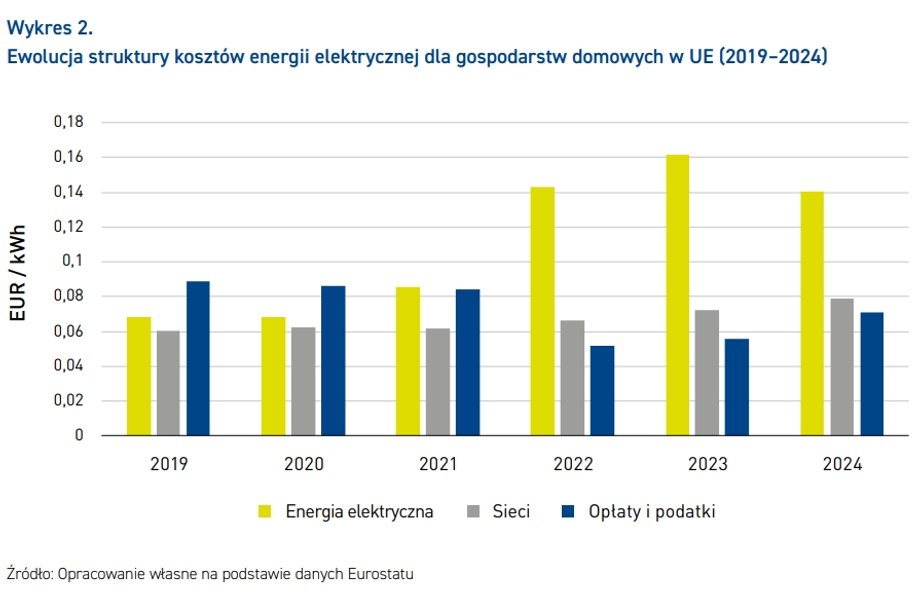
Distribution fees will play an increasingly important role in the energy bills we pay
The costs of operating the power market are also to increase. For conventional energy sources, it is today securing revenueswhich fall on the energy market due to the growing presence of renewable energy, predictions also say about the increase in the demand for power (including the periods of so -called RES drought), so the instrument will have to secure it. It is also indexed by the inflation rate.
The same applies to the auction support system, in which energy will also come, and decreases market prices during high -generation periods from renewable sources will cause the need for more frequent subsidies to the guaranteed price.
“You should also take into account the increase in the costs of balancing the power system” – add the authors of the report, referring to the case of Blackout on the Iberian Peninsula. As they write, in 2024 the generation of energy changed by more than 1 GW per hour for 885 hours, and for 210 – by more than 2 GW per hour.
Various support models
Interestingly, the solutions used in our country differ from those that prevail in Western Europe. We protect primarily householdswhose energy bills are up to 30 percent. Large, energy -consuming recipients are lower than the EU average, relatively higher costs. In Germany, France or Italy, smaller companies bear relatively higher costs than the large industry.
– “This demonstrates the conscious policy of allocation of energy transformation costs, in which smaller entities – having a lower share of energy costs in full costs and more difficult to relocate They are more charged with system costs” – write Izdebski and the beech. States offer business regulated tariffs, subsidies or exemptions from part of the fees, social acceptance for relatively high bills for households is to result from greater wealth.
The results of the analysis of the dependence of energy prices on the structure of individual energy mixes did not confirm the thesis about the impact of high renewable energy share on lower costs for recipients. The same conclusions are shown by a separate analysis, in which only seogonous sources, i.e. wind and solar energy (excluding biomass power plants, hydroelectric power plants or peak-comporated power plants) were influenced.
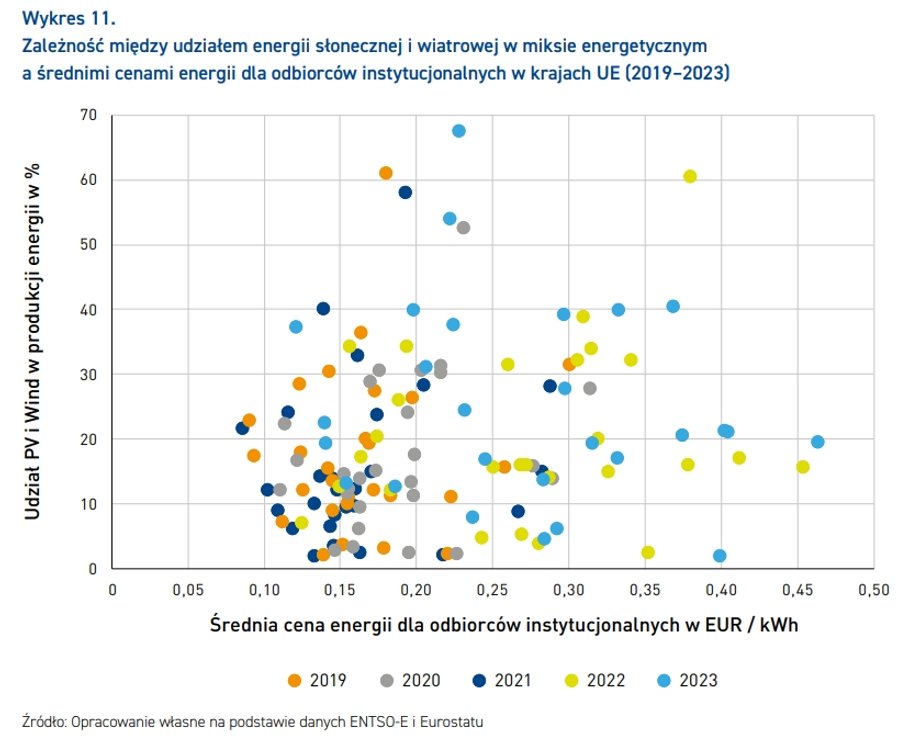
Analysis of Marcin Izdebski and Wanda Buk shows that in countries with a high share of sunlight and wind, electricity bills do not fall
“(…) In countries with a greater share of wind and photovoltaic power, the end recipients bear relatively higher total electricity costs” – we read in a report, which in this context lists Denmark, the Netherlands or Germany. The analysis of countries from higher participation of the atom. Radioactive waste safety, supervision and waste management systems, but also support for new investments in nuclear powers.
The share of fees will grow
– “(…) technologies characterized by low variable costs – such as renewable energy or nuclear energy – Although relevant from the point of view of decarbonization and energy security, they also generate significant investment and system costs” – experts remind again.
The more the situation on the wholesale energy market will stabilize, when the shielding mechanisms are extinguished for recipients, the more the share of distribution fees and costs will grow. The authors of the report also write that the transformation is not a “one -off modernization effort” – it must be seen rather as A continuous process in which the infrastructure will be replaced constantly.
Can we do something about it? The supported solutions concern, among others rationalization of plans to expand the network, so that they are based on “real system needs”, and not only on constantly connecting new power. Experts call to include full costs when planning transformation, without limiting themselves to the costs of producing energy or impact on stock market prices.
They are also in favor of more effective help for the energy -intensive industry, which is threatened with a permanent loss of competitiveness, they also want reforms of support systems for renewable energy (e.g. so that the manufacturers do not receive it at negative prices). It is also worth increasing the flexibility of energy consumption, even as part of dynamic tariffs – while warning recipients with the risks related to this.