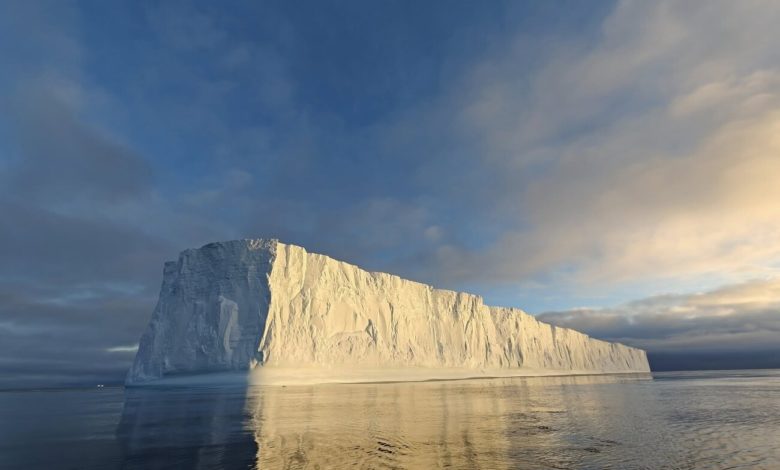
According to the measurements of the polar explorers, the length of the ice block is 1285 m, that is, as in the main street of Kyiv – Khreshchatyk, the NANC was noted. The maximum height of the visible part is 80 m, and the width is approximately 90 m.
“Now my sixth wintering is on Vernadsky, and I have never seen such huge icebergs here. We are watching him directly from the station’s windows, although he will drift a few tens of kilometers from our island,” said the head of the 30th Ukrainian Antarctic Expedition.
In shape, this is a dining iceberg, that is, with vertical sides and a flat top. Such icebergs break off the shelf glaciers and may be extremely, explained to the NAC. Iceberg near Vernadsky, probably, broke away from one of the shelf glaciers located south: George VI or Wilkins.
The largest recorded iceberg B-15 had an area of 11 thousand km² and a length of almost 300 km. But it melted, and now the largest iceberg is considered A23A with an area of about 3.1 thousand km². The NANC noted that almost four Kyiv can fit on it.
The largest iceberg broke away from the 1986 film glacier, along with the Soviet seasonal station “Druzhny-1”. Later, structures and equipment were removed and moved to another station. A23a stood at the Vedalel sea for many years, clinging to the bottom. But in 2020 he began to drift and sailed to the Subantarctic island of South Georgia, overcoming a distance of more than 2 thousand km. There, in March, it sat aground and is destroyed: thousands of fragments are fixed around it.
Context
The Ukrainian Antarctic station “Academician Vernadsky” is located on the island of Galindez. Previously, it belonged to Great Britain and was called “Faraday.” On February 6, 1996, the station was transferred to Ukraine and renamed.
At the station, scientific studies are conducted on a change in climate, ozone hole, reaction of animals and plants to warming.