
The head of the German Ministry of Foreign Affairs: The Polish moment in Europe is currently underway

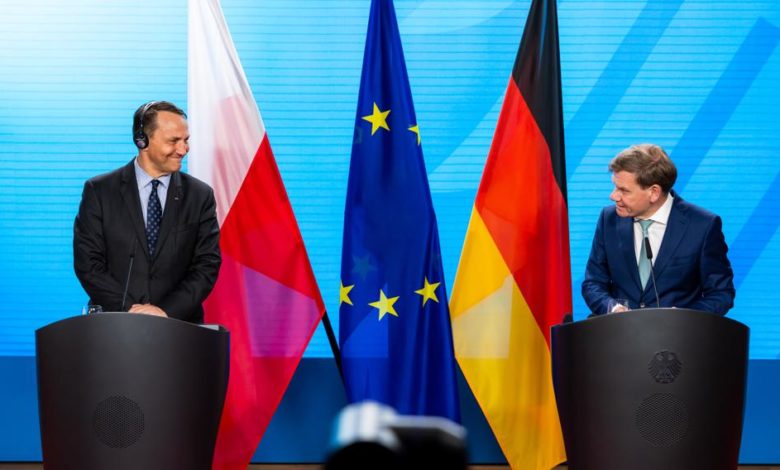
Currently, a Polish moment in Europe is underway, and at the same time our common moment – for Germany, for Poland, for a strong, capable of defending Europe – emphasized on Wednesday in Berlin the head of German diplomacy Johann Wadephul after meeting the head of the Ministry of Foreign Affairs Radosław Sikorski.
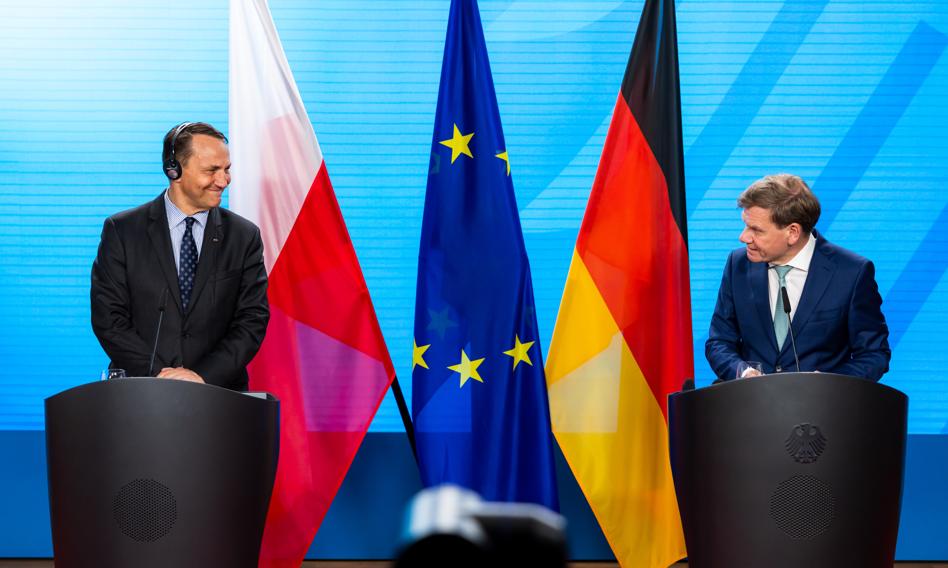
On Wednesday in Berlin, Sikorski talked to his German equivalent, among others on European security and further support of Ukraine and on bilateral cooperation and historical issues. Diplomats also took part in the opening ceremony of the Polish-German Forum at the Embassy of the Republic of Poland in Berlin.
“When we talk about the ability to defend, we ultimately talk about what we protect – our freedom, our values, our democracy. And this is also, as the foundation of our cooperation, also a common memory” – noted Wadephul at a conference in Berlin together with the Sikorski conference. He declared that the Germans would never forget about Polish Nazi victims, and a permanent monument will be devoted to them with the Polish-German House.
“It is as recently wrote +The Economist +, a Polish moment in Europe, and I will say that this is our common moment – for Germany, for Poland, for Poland, for a strong, capable of defending Europe,” said the head of German diplomacy.
Sikorski and Wadephul opened the Polish-German forum in Berlin
Foreign ministers of Poland and Germany, Radosław Sikorski and Johann Wadephul opened on Wednesday at the Berline Polish-German Forum. Politicians, experts, business and culture and representatives of non-governmental organizations discuss the future of Polish-German relations. The motto of the two -day meeting is the slogan “Community for difficult times”.
“In the current difficult geopolitical situation, with the ongoing Russian war against Ukraine, our cooperation is not a choice but a necessity,” he said, inaugurating the Sikorski forum. The head of Polish diplomacy emphasized that Warsaw and Berlin are developing a common position towards Russia, “trying to write history again.” “Moscow still speaks the language of strength, intimidation and violence,” he added, assuring that “there is no consent for it.”
According to Sikorski, Polish-German relations “entered a new stage, based on mutual understanding.” He stipulated that “declarations – this is not enough to build trust.” Specific activities are necessary.
Referring to the issue of compensation for Polish victims of war and occupation, Sikorski emphasized that Polish society did not forget about the harm, which was German aggression in 1939. “There are still those among us those whose fate was marked by the stigma of this war” – said the minister.
He noted that Polish expectations for compensation for the victims of World War II “remain current” and – as he added – talked about it with his German counterpart. He stipulated that this topic “is not part of the current policy, but an expression of a deeply rooted need for memory, justice and recognition of the suffering that left a lasting trace in Polish families.” Sikorski referred to the concept of the Polish-German “Community of Interests” created by the Minister of Foreign Affairs in the government of Tadeusz Mazowiecki, Krzysztof Skubiszewski and, referring to Motta Forum, assured that Poland and Germany would “conduct Europe through difficult times.”
The head of the German Ministry of Foreign Affairs Wadephul stated that “Poland's security is the security of Germany.” He assured that Polish-German friendship and partnership belong to his priorities. The minister said he was aware that some Polish residents have the impression that knowledge about Nazi crimes is insufficient in Germany. “It hurts me. That's why Germany can't forget and will never forget about millions of victims of the German occupation of Poland,” he emphasized. That is why work on the monument for Polish victims of war and the “Polish-German home” should go forward quickly.
The bosses of diplomacy presented the Polish-German award for 2025. This year's winners are the director of Elwira Niewiera and the Bredbeck educational center. The jury appreciated their merits – as representatives of civil societies of both countries – for dialogue between Poland and Germany, combined with activity and support for Ukraine, fighting Russian aggression. In a very emotional speech, she has strongly criticized Western countries for negotiations with Russia since 2014, while Russian soldiers in Donbas tortured Ukrainian prisoners of prisoners, including women.
The opening ceremony of the Forum with the participation of ministers took place in the new building of the Embassy of the Republic of Poland, located at the Representative Avenue of Unter Den Linden, leading to the Brandenburg Gate. On Thursday there will be a number of thematic discussions. Participants will discuss security, competitiveness of the economy, the future of the European Union, memory policy and cross -border cooperation and the role of media.
The Polish-German forum was founded in 1976 as a dialogue platform, used to build trust at a time when Poland and Germany belonged to opposing political and military blocks. The format of cooperation was continued until 2018. Due to the voltages after the PiS took power, the meeting was suspended.
From Berlin Jacek Lepiarz (PAP)
Lep/ Mal/ LM/


