The number of insolvency increases alarmingly in Central and Eastern Europe, except for Hungary. How Romania stands


The situation of insolvency in Central and Eastern Europe (ECE) reveals a contradictory image, say the specialists, specifying that, while the economic growth returned in 2024, the stability of companies continued to deteriorate.

The number of insolvency increases alarmingly in Central and Eastern Europe. Photo archive
Despite the decrease in inflation and a return of GDP, insolvency rates have increased in most countries in the region.
The ECE region registered an average GDP growth of 2.6% in 2024, a significant improvement compared to 0.8% in 2023. The recovery was determined by the decrease of inflation, the increase of real wages and a strong private consumption, especially in Poland, Hungary and Romania. Inflation decreased to 4.6% in 2024, from 11.2% in the previous year, due to the decrease in energy prices and improving the conditions on the supply chain.
However, economic relaunch did not translate into the resilience of companies. The number of insolvency decreased at regional level by 9%, from 50,248 to 2023 to 45,938 in 2024, but the decrease is misleading. The regulatory changes in Hungary have distorted the figures. If Hungary is excluded, insolvency procedures actually increased from 29,771 to 2023 to 30,680 in 2024 (+3%), which highlights the persistent fragility in the landscape of enterprises in the region.
“After the turbulence of 2023, the macroeconomic indicators suggested an improvement. But many companies, especially those in the processing and transport industry, had already absorbed too many shocks.“said Mateusz Dadej, Regional Economist Coface Central & Eastern Europe.”Increasing the number of insolvency reflects deeper structural problems and the delayed impact of previous crises. “
Countries show a mixed insolvency dynamic in 2024
Hungary registered the most accentuated decrease (-25.5%) due to the normalization of legal procedures after a temporary increase in 2022, while Serbia and Bulgaria also registered decreases (-12.1%and -5.7%respectively), reflecting more stable macroeconomic conditions. In contrast, insolvency increased significantly in Slovenia (+32.4%), Latvia (+24.6%), Estonia (+10.2%) and Croatia (+7.3%), as a result of low internal demand, increased costs and structural challenges, especially in construction and trade. Romania also registered a notable increase of 9.4%, especially among the average and large companies, against the background of the high inflation and the fiscal imbalances. Poland reported a 19% increase in insolvency, largely due to the permanent adoption of restructuring procedures during the pandemic period, now widely used to manage liquidity problems. Meanwhile, the Czech Republic (+1.9%) and Slovakia (-3.5%) recorded relatively stable trends, and Lithuania remained stable compared to 2023 (-1%), the insolvency being concentrated in construction and retail.
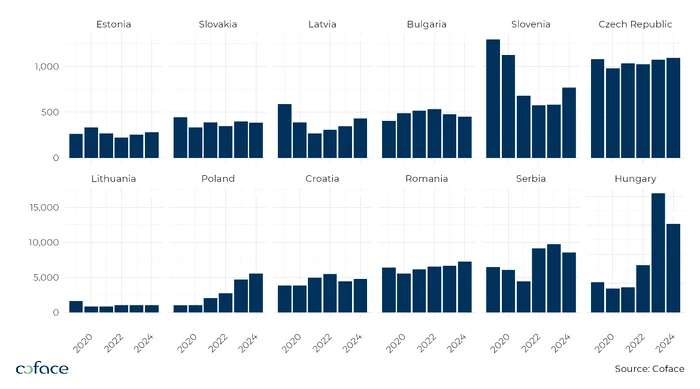
Source: Coface
Transport, processing industry and construction: key sectors under pressure
Several key industries were especially vulnerable. The transport sector faced the decrease of the volumes of transport and with persistent pressures on the costs. The processing industry faced the decrease of the volume of orders and the lack of workforce, while the construction sector was affected by the increase of interest rates and the decrease of investments, especially in residential projects. These sectors have registered above average increases in insolvency rates.
Perspectives for 2025: Investments, Prudend Optimism
“We expect a modest improvement in insolvency trends for 2025”said Mateusz Dadej. “The release of delayed EU funds and a recovery of household consumption will be essential. However, strict lending conditions and global commercial uncertainties – especially the escalation of commercial stresses between the US and the EU – present a substantial risk of lowering our scenario'he added.
]Coface report offers a comprehensive analysis of how legal frameworks, economic conditions and geopolitical risks shape the dynamics of insolvency in the ECE region.', added Jarek Jaworski, Ceo Coface Central & Eastern Europe.]Although the growth has returned, many companies have remained in the survival mode. SUPPORTED INVESTMENTS AND POLICY CLARITY WILL BE EASY TO Ensure Long -term stability. ”
]The conclusions of this study highlights a crucial reality: insolvency does not occur overnight. Most of the companies that went into insolvency in 2024 presented early signals in this regard. Although these findings reflect a significant risk exposure, they also emphasize the value of predictive information. Companies that actively monitor financial indicators are better prepared to adjust the terms of contracts and make informed decisions before the risks materializedfinally obtaining an advantage ”, Support Matei Mihailescu, Business Information Services Director Coface CEE Region.