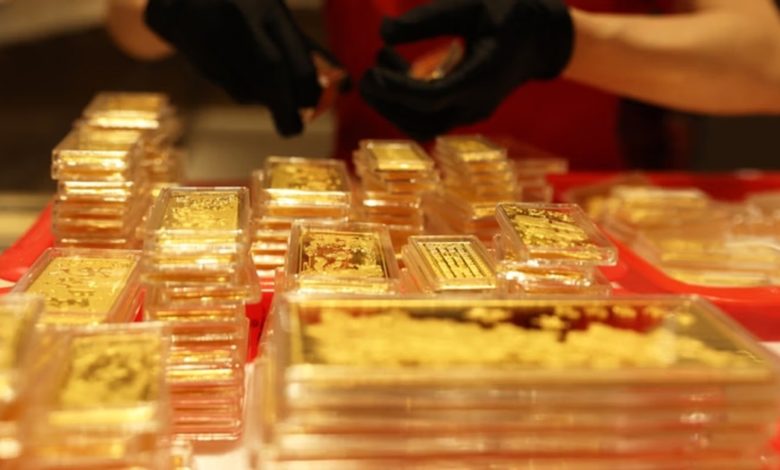
Gold was on a wave of rising when Donald Trump announced widely extensive duties to most countries of the world. This decision briefly raised the price of the ore to a record level of $ 3166. (PLN 11,000 911) for the Trojan ounce – it was 17.4 percent. more than on the day of the inauguration of the presidential Republican. On April 11, it exceeded the level of $ 3,200. (12 thousand PLN 039) for the Trojan ounce. In one of the parts of the world, however, this did not reduce the enthusiasm of consumers.
“Rising gold prices stop you from buying wedding jewelry? Nothing for your dream” – this inscription appears on the facade of the Tanishq facility – the largest jewelry seller in India – located in Bombay. The brand organizes the “Exchange Festival” – as part of it you can mention old jewelry with a new one.
Even when the price of gold in 2024 increased rapidly, the demand for them in India remained constant. – Prices don't really matter. It is important that there are no violent declines – says Anindia Banerjee from Kotak Securities, one of the largest brokerage houses in India. According to World Gold Council – an international association operating in the gold industry – Hindus still buy gold jewelry “depending on the needs” – for example for weddings and other occasions. They use the offers of companies such as Tanishq to renew old jewelry or buy new models. The number of loans against gold is also growing rapidly.
Asian countries are the greatest consumers of yellow metal. Last year, India was the world's largest buyer of golden jewelry – In total, they bought 560 tons, which even outdoed China (in their case it was 510 tons). These, however, overtook India in purchases of golden bars and coins – Beijing bought a total of 345 tons, new Delhi – 240 tons. In Thailand, the demand for these ore in 2024 increased by 17 %, to 40 tons – mainly due to the growing popularity of applications selling physical gold online.
The results of these countries, in combination with other markets, such as Indonesia and Vietnam, make it Last year, Asia was responsible for 64.5 percent. global demand for golden jewelry and ore. These calculations do not include purchases made by central banks of those countries that were more or less in accordance with their participation in the world population, but greater than the average income would suggest.
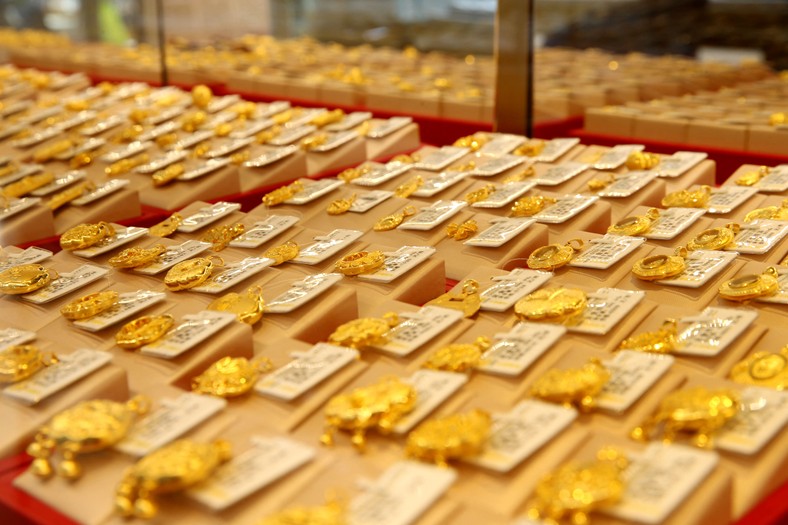
Cfoto / Nurphoto / Nurphoto Via AFP / AFP
Gold ornaments for the store's website in the city of Lianyunggang in the East Chinese province of Jiangsu, April 12, 2025.
The Asian passion for gold is partly associated with its role in important life events of the inhabitants of this region, especially in weddings. Kalyan Jewellers, a large detecta seller of jewelry in India, estimates that in this country “about 10 million marriages are concluded a year, and the market itself is estimated at 300 to 400 tons of gold”. Many Hindus also buy gold on Daliwi – a light festival celebrated in autumn or Akshaya Tritiya – a spring holiday that falls this year on April 30.
Gold is also deeply woven into Chinese cultural traditions. They are bought on the occasion of weddings, the child's first month and other events that are milestone in life. This custom is supported by both the inhabitants of China and the diaspora. In previous generations it was one of the few ways to store wealth and pass it on to descendants.
The wedding tradition cultivated by the Teochew community living in Southeast Asia is also related to gold. According to her, the groom's family buys four elements of gold jewelry – usually a necklace, a bracelet, earrings and a ring – for the bride. This is to symbolize four roof horns at home, which the husband should provide his chosen one.
Security for uncertain times
The passion of Asians to gold is often attributed to cultural reasons. However, this is only half of the truth. India and China are very culturally different, and the countries of Southeast Asia would be annoyed if they were thrown into the same bag. At the heart of the passion of Asians to gold, deeper economic and financial motifs are.
The issue of diversification is crucial. Investors around the world value gold as a means of storage of value and protection against inflation, especially in restless times. There is something to it – also Americans have accumulated gold since Donald Trump's office. At the beginning of March, they bought this ore more than in the peak of the pandemic in 2020. The gold broker in Singapore claims that he organizes mass gold delivery for worried rich people who eagerly accumulate this ore.
Continuation of the material under the video
In a large part of Asia, however, it plays an additional role – it is treated as a currency security and a way to obtain assets not related to the national economy. Asian countries, especially India and China, are poor in the investment freedom index. Capital inspections are common in them, and investing in foreign markets ranges from difficult to impossible.
– This is the only way for our capital closed in the cage to easily buy assets not fed on rupees – says Joseph Sebastian, an investor in Blume Ventures, a high -risk company in Bombay. Despite the recent investment boom, less than 6 percent Household assets in India are located in actions. In gold, however, there is 15 percent.
Security in old age
In China, even domestic investments can be difficult. Many profitable industries are controlled by the government and remain beyond the reach of retail investors. Chinese stock markets were listed below their pandemic peaks even before the threat of imposing duties by President Trump caused swirls on the market. Since the government's hearing with speculations and debt of real estate, they have ceased to be an attractive way of getting rich in China – the prices of new homes compared to the peak period in 2021 dropped by 5 percent. The reference price of gold in five years doubled to 737 yuan (about 380 sales), which means an annual refund of 15.4 percent.
For Chinese from continental Chinese, gold became more attractive along with the slowdown of the Chinese economy. Instead of keeping cash in a bank that can generate interest in the amount of 1-2 percent. Annually, young Chinese prefer to buy small amounts of gold – even individual bars. Interest in it is also driven by government policy. “When the Chinese central bank buys gold, people think: I should do it too,” says Alex He, a gold trader in Siijan. More and more Chinese are moving away from golden jewelry in favor of ore, which suggests that shopping is driven by investments.
The role of gold in ensuring financial stability is no less important. In China, India, Pakistan and most Southeast Asian countries, less than half of people of working age are covered by mandatory pension. Gold serves there as a security in old age. This is especially important for women who do not have such economic potential as men in many Asian countries, and in some South Asia countries they often do not have any of their assets.
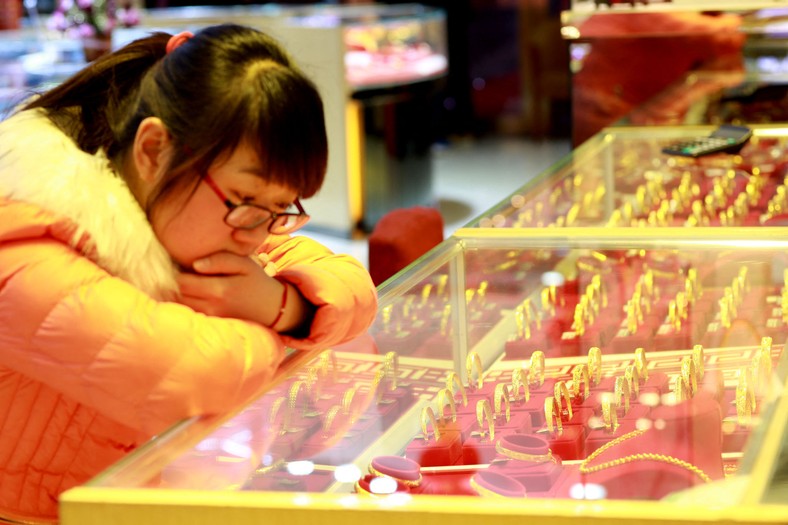
Song Chenglin / Imaginechina / AFP
Khinka watching gold bracelets in a jewelry shop in the city of Nantong in the eastern province of China Jiangsu, April 15, 2014.
Gold is also of key importance for securing farmers and traders whose income is susceptible to climate and economic whims. Like Chinese youth, many Indians living in the villages put off small amounts for the purchase of gold to ensure financial liquidity in difficult times. The weak land record system in India and the poorly developed mortgage market are an obstacle to taking loans against land. So more and more often they are pledged against gold.
Muthoot, the largest Indian company dealing with such loans, gives them in less than 15 minutes. It records a noticeable increase in the number of medium income borrowers. In the period from April to December last loan against gold, they increased by 68 percent. Compared to 12.7 percent Over the past nine months of 2023.
Economists complain that colossal amounts invested in gold could be allocated to more productive investments. An even greater accusation that they raise is the impact of gold purchases on the commercial balance. Last year, the Central Bank of Thailand stated that the large import of this ore was the reason for transforming the surplus on the current speed into the deficit.
Gold is 8 percent total import of India. In some months it is the largest import category in the country. In the tax year ending in March 2024, net gold import in India, worth $ 45 billion. (approx. PLN 169 billion), was almost twice as high as the deficit on the current turnover account. This accelerates the decrease in the value of the Indian rupe, additionally increasing the demand for gold. -From a macroeconomic point of view, gold is bad, but from a micro-personal point of view I still have 20 percent. its assets in gold – says one of the inhabitants of India.
Travel in gold
There is no easy solution. Governments could implement a policy discouraging from buying gold, but this would only strengthen smugglers and the black market. Another option is to increase production in the country, although geology does not always allow it. China is the world's largest producer of gold – in 2023 they extracted 378 tons of this ore. Even this, however, accounted for just over 40 percent. demand for jewelry and gold bars. Its production in India, despite the significant Ruda resources, has been decreasing for decades – this is partly a reason for the restrictive provisions in force in the country. In 2022, they produced only one ton of gold, and imported over 700 tons.
Governments that want to reduce gold imports must consider more difficult, not quite convenient reforms – such as deepening credit markets, regulating land registers, unlocking the judicial system or the release of capital flow. Regardless of the cultural reasons that you talk about so often, economics and politics make Asians so addicted to gold.
I’m Ashley Davis as an editor, I’m committed to upholding the highest standards of integrity and accuracy in every piece we publish. My work is driven by curiosity, a passion for truth, and a belief that journalism plays a crucial role in shaping public discourse. I strive to tell stories that not only inform but also inspire action and conversation.