The true origin of the Aromanians. They are not one and the same as the Romanians and have mysterious and controversial roots

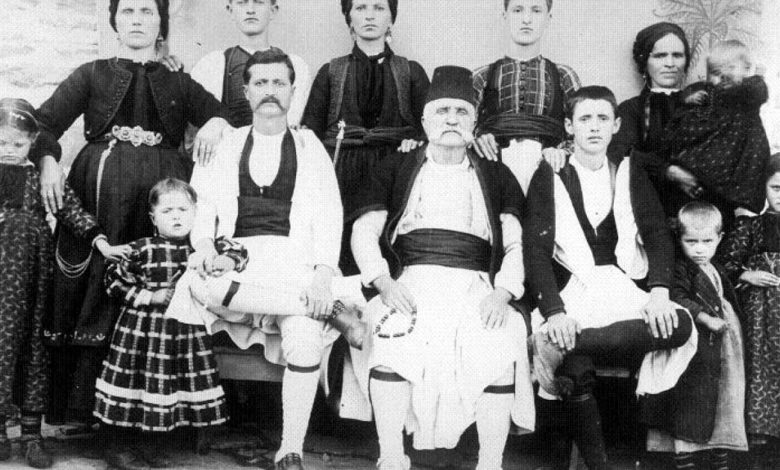
Aromanians are one of the most controversial and at the same time mysterious populations in Europe. Their origin has been intensely disputed in the scientific environment, with many conclusions drawn rather on the basis of nationalist ideologies than on scientific realities

Family of Aromanians (Manakia brothers) Photo project avdhela.com
On May 23, Aromanians from all over the world celebrate their national day. The date of this holiday was adopted in 1990. Aromanians are well known to the population in our country. And this is because many personalities in Romania have or had Aromanian origins. For example, the writers Ion Luca Caragiale, Octavian Goga, Stefan Iosif, Constantin Belimace or Gellu Naum, the actors Toma Caragiu and Ion Caramitru, the director Sergiu Nicolaescu, the screenwriter Stere Gulea, the philosopher Constantin Noica but also the footballer and coach Gheorghe Hagi.
In fact, on the territory of Romania, especially in Dobrogea, it is a powerful Aromanian community or “Machidons” as they are told. There are over 100,000 Aromanians on the territory of Romania. Although many consider them Romanians and I think they are one and the same people, only with some minor differences, because of the influences gained throughout history, Aromanians are a controversial, as well as mysterious population.
“The academies of each state in which they live support their own theory about the origin of the Aromanians: Romanians, Romanized or Latinophonic Macedonians. Even the specialists of Aromanian origin have integrated the academic currents in the country where they live, which causes an even greater question among the Aromanians in Romania, the Macedonia and the History. Under various names: Vlahi, Vlasi, Aromanians, Macedonians, Fârşeroţi, Poor, Armenians, Raramians, etc. ”the historian Marius Diaconescu said for the magazine “Historia”.
What do the sources say about the origin of the Aromanians
Aromanians or Vlachs as they were known especially in the Middle Ages, have a long history. They are mentioned, especially by the Byzantine springs, south of the Danube, on the territory of Bulgaria, Macedonia and Albania today. They lived in limited communities and dealt mainly with the sheepfold, but also with the mercenary. There were appreciated warriors, being especially framed in the Byzantine army. The famous Peter and Asan, Geambași and mercenari, who, alliances with the Bulgarian population, managed to establish the first Vlah Empire in history were erected.
“At this time, the Vlachs from these parts are often spoken. They entered as special troops in the hosts of the East emperor and distinguished themselves in the struggles with the Normans, who had landed on the coasts of the Ionian and the Adriatic. Other times, the Vlahi from the Balkans are fighting in the army of Alexios Comnenul at the Danube against Pechenegs, a Turanian people who were invaluable to the Lower Danube in the eleventh century. In 1166, Emperor Manoil Comnen made an expedition against the Hungarians, passing the Danube and the Carpathians through Muntenia, with a large army in which there were a special body of Vlachi, gathered from the neighboring parts with the Black Sea“, The historian Petre P. Panaitescu also shows, in his work” Romanians and Bulgarians “. About the origin of the Vlachs also wrote the Byzantine scholars of the XI-XII centuries, saying that they are the Dacians, Romanized by Trajan.
“Waring with the war by Emperor Trajan and fully defeated, they were subjected by it, and their king, called Decebal, was killed and the head was stuck in a spear in the middle of the Romanians. For these are the so-called Dacians, Zişi and Besi. Natural and difficult to reach. Several of them settled in Elada ”wrote the Byzantine author Kekaumenos, author of the work “Strategikon”.
In other words, they were descendants of the Dacian tribes, living on both banks of the Danube. In addition, Kekaumenos also talks about their basic occupation, the transhumant preservation in the Balkan, Rodopi and Pind mountains. “For this is the custom, that their beasts and their families stay from April to September in high mountains and in very cold places.”adds the Byzantine author.
For his part, Kinnamos, another Byzantine chronicler of the 12th century, believed that the Vlachs or Aromanians are the followers of the Roman colonists, brought to Moesia and then to Dacia.
“It is said to be the long -term colonies of the Italian”Kinnamos wrote about the Aromanian mercenaries of Leon Vatatzes's army, who went against the Hungarians.
“The Romanianization” Aromanians
Buscantine medieval books and chronicles, such as Kaukamenos and Kinnamos, but also the linguistic similarities made some specialists, especially from the period of Romanian national and beginning of the 19th century, to believe that the Aromanians are actually detached from the Romanian populations, from the north to the Danube.
Probably also following the relocation made by Emperor Aurelian, in the third century, even, even during the constitution of the Romanian national state and then of Greater Romania, it was considered that the Aromanians are Romanian Get-Beget and that their arrival on the territory of our country was like a return to the “mother country” after almost two millennia. It all started in the 19th century, the “century of nations”, when the United Principalities of Wallachia and Moldova began to open, in 1860, Romanian schools in many localities in Macedonia and the current Greece, inhabited by Aromanians.
It was like a counteracting the increasing Greek influence on the Aromanians. The initiative belonged to a group of Aromanian intellectuals, established in Bucharest, and who militated for the integration of Aromanians within the Romanian nation. And this in the conditions in which the Aromanians were claimed by all the peoples on the territory of which they had founded communities.
More than 100 Romanian schools were opened, for Aromanians, in Greece, Macedonia and Albania, from the middle of the 19th century to the beginning of the 20th century. The reason was clear, the Romanian state wanted the integration of the Aromanian populations. In 1920, the Aromanians from Greece, Albania and Bulgaria were invited to colonize the Dobrogea counties, ceded by Bulgarians after the First World War. Subsequently, after 1940, after the loss of the quadrilateral, they migrated to the Northern Dobrogea area, to remain on the territory of Romania.
The Greek influence on the Aromanians
Living on the territory of the Byzantine Empire, many communities of Romanians have undergone a slow process of elenization. The “Greekization” of the Aromanians became more important with the eighteenth century, that is, during the beginning of the struggle of emancipation of the Orthodox Greeks under Ottoman rule. The Greek patriots preached Hellenism and union of all Orthodox believers against the Ottomans.
The Aromanians were threatened with anathema if they do not speak Greek, the language of the Orthodox Church in Greece. In addition, the Greek Church has set up over 100 schools in northern Greece, today, through which the students and teachers were Hellenized, in order to become “Greek patriots”.
The systematic elenization of the Aromanians struck in the 19th century, by the “Romanianization” practiced by the Romanian state in the same territories. Caught between two cultural-ideological fires, the Aromanians chose the camps as they knew better and survived and prospered with the same instinct and extraordinary skill that marked their history in a territory washed with blood and rifle powder.
Aromanians are not drawn from Romanians
Beyond the national ideologies that were trying to make the Greek, Macedonians, Albanian or Romanian Aromanians, the “Vlahii” are and remain what were always: Aromanians. It is certain that the Aromanians speak a Romanic language, although they live in a Greek-Slavic world and have been associated by the old Byzantine chroniclers with the Romanian Dacians or colonists. Most of the specialists, whether it is linguists, ethnologists or historians, say that the Aromanians are neither Greeks, nor Macedonians, nor Romanians, but a self-employed people, yet enslaved with the North-Danube Romanity. That is, a kind of “cousins” of the Romanians.
It is certain that they come from a population of Thracian, Romanized population. They would have been part of the populations of Thracian origin (especially Dacians and geets) on both banks of the Danube, which suffered a process of Romanization. In the case of those in the south, the process of Romanization happened earlier, by founding the province of Moesia. Subsequently, after the conquest of a part of Dacia, the systematic Romanization, north of the Danube, occurred.
In the 6th century, with the establishment of strong Slavic communities on the territory of Serbia and Bulgaria, today, there has been a break between the mass of Romanic speakers, on both banks of the Danube.
To the north of the Danube, especially by the influence of the Slavic language and ethnic, the Romanians were formed, and on the south, probably migrating to Greece, Albania and Macedonia formed the Aromanians. The differentiation occurred without some depending on the others. Simply, because of the cultural-linguistic separation, they have become separate. But these are just theories. The mystery of the origin of the Aromanians remains.
“No one can, practically, agree where the Aromanians come from, who they are, in fact. They come over the Danube,, reaching the southern and western part of the Balkans, shaken by the invaluations of the migratory peoples? Gustav Weigand, who brought the term Aromanian to the scientific world, oscillated for a while. Only in 1895 it reaches the term “Aroman”shows Eugen Matzota in his work “Romanians against the Aromanians?”
DNA analyzes have shown that Aromanians do not constitute a homogeneous group and cannot be specially linked to Greek or Romanian. “The Aromanians could have their origin to the south of the Danube, with a large flow of genes with neighboring populations”shows a series of scientific tests, quoted in the work of Eugen Matzota.