Almost one third of the inhabitants of a country that sinks into the sea have submitted asylum applications in Australia

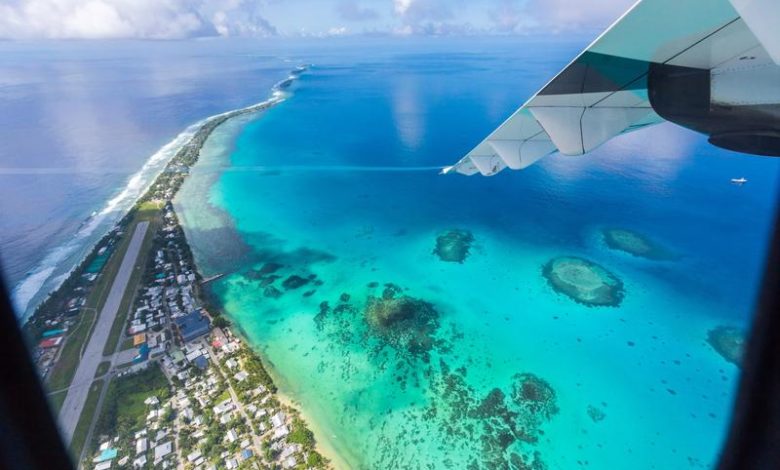
As the level of oceans and seas continues to increase and gradually affect the island nations of the world, many citizens will have no choice and will have to leave their homes. In Tuvalu, one of the most threatened archipelagos by climate change, migration has already begun, Gizmodo reports.
Almost one third of the approximately 11,000 inhabitants of Tuvalu, an island country in the Pacific, tries to get Australian visas to get rid of the advanced waters. In 2023, Australia announced that it will launch these visas as part of a bilateral treaty signed with Tuvalu – the first treaty in the world to create a special visa in response to climate change.
Australia will offer 280 visas a year, and the first batch became available on June 16. Over 3,000 inhabitants of Tuvalu have already submitted applications.
Those who will be selected should find out the result of the extraction by the end of July, and the first migrants are expected to reach Australia by the end of the year, according to The New Scientist. Upon arrival in Australia, visa holders will have immediate access to education, medical health system, national disability insurance program (NDIS), family allowances, child care subsidies and financial support for young people.
“Australia recognizes the devastating impact that climate change has on the means of living, security and well -being of climatic countries and populations, especially in the Pacific region,” said Australian business department for The Guardian.
Tuvalu is just 3 meters above sea level
TUVALU is located in the central-western part of the Pacific Ocean and has an average altitude of less than 3 meters. Some studies quoted by the World Bank suggest that many of its islands will become uninhabitable before the end of this century due to floods, salt water infiltration, waves and erosion.
NASA researchers, for example, predicted that Tuvalu and other island nations in the Pacific will record an increase in sea level of at least 15 centimeters in the next 30 years.
“I live the reality of climate change,” said Grace Malie, a citizen of Tuvalu and delegate of youth within the initiative of the nations in ascension. “Everyone [în Tuvalu] She lives on the coast or near the coast, so everyone is seriously affected by this situation, ”she said.
Funafuti, the capital of the country and its most populated atol, has already registered an increase in the sea level of about 14 centimeters in the last three decades, according to NASA. This is about 1.5 times higher than the global average.
Funafuti houses 60% of the population of Tuvalul, and by 2050, scientists foresee that half of its surface will be covered by daily tides.
The inhabitants of the island country face a gloomy reality
The inhabitants here are already feeling the effects of increasing the level of the seas. The constant influx of salt water has contaminated the agricultural land and the sources of drinking water, forcing citizens to rely on rainwater collection tanks and raised gardens, located centrally. This made the island nation even more vulnerable to drought, water and outbreaks, according to UNICEF.
Tuvalu has implemented strategies to combat the level of sea level, especially through the project of adaptation of the TUVAL coast (TCAP), launched by the government in 2017. There were some successes, including improvements in monitoring the rib erosion, the recovery of the land and the protection of the coasts of the islands. However, many challenges remain.
As Tuvalu faces the reality of the immersion under waves, the government works to preserve its territory and sovereignty by creating a “digital children” of the country. The project aims to “recreate the territory [Tuvalului]to archive its rich history and culture and move all government functions in a digital space, “according to the official site.
Tuvalu could become the first country to disappear due to climatic changes, researchers estimate that, although they contribute only 0.02% to global carbon emissions, the Pacific islands are facing much higher climatic risks than any other region of the planet.
As more and more residents of Tuvalu make the final decision to leave their homes, the citizens of other small island nations will probably have to weigh their options.
Photo: Maloff2 / Dreamstime.com.