Ukrainian secret services have analyzed a new cruise rocket model used by Russia in Ukraine

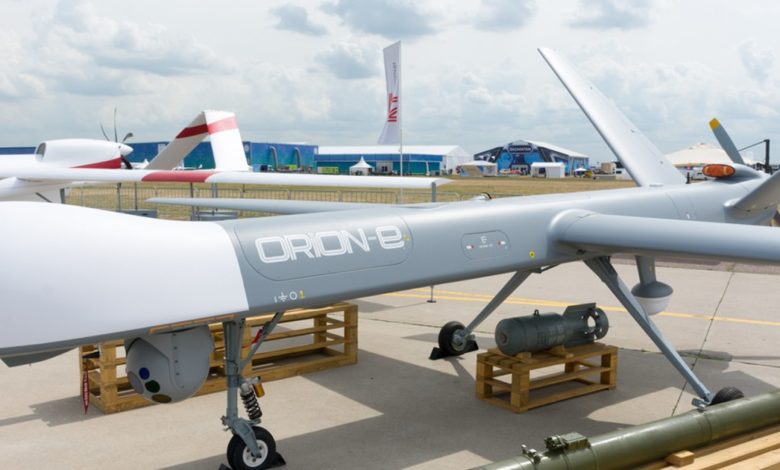
Ukrainian military intelligence services have released details about a new Russian cruise missile, S8000 Bangerol, which contains largely components from foreign producers, including from the US. From the first information, the rocket was developed to be launched from drones and would have already been used on the Ukraine's battlefield, The War Zone reports.
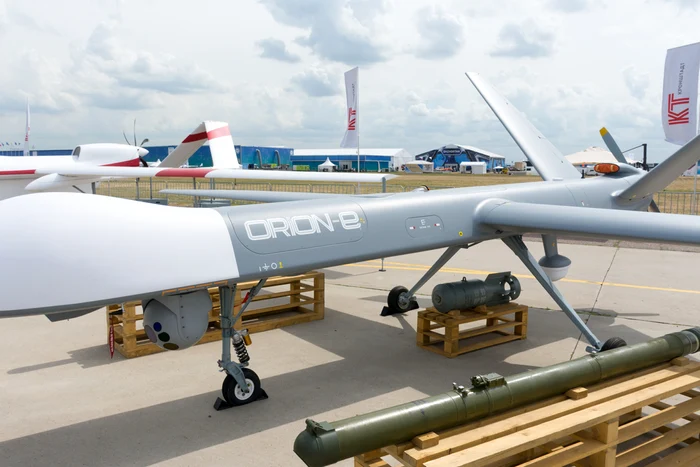
Ukrainians have identified a rocket that can be launched from a shutterstock photo drone
The Main Directorate of Information (GUR) in Ukraine has also published photos of the rocket model. Produced by the company Kronstadt, mainly known for the development of drones, Banderol would be intended for launch on the orion pilot aircraft, which is approximately similar to those of a Predator MQ-1 drone. Banderol means small package or parcel.
Proposed by a reaction engine and equipped with retractable wings, the Banderol drone has a 500 -kilometer range and a speed of 500 kilometers per hour, according to GUR. The focus would weigh 113 kilograms. Gur considers that banner is more agile than other Russian cruise missiles, suggesting that it could be intended to use flight platforms capable of avoiding Ukrainian air defense systems.
Although GUR does not mention details about the operational use of banner rockets, the detailed technical study suggests that Ukrainian services have had access to one or more relatively intact specimens, probably recovered after they collapsed or were shot down on the Ukrainian territory. Unconfirmed reports suggest that rockets have been used to attack targets in southern Ukraine on multiple occasions.
GUR analysis also offers a list of foreign parts used to produce banner, namely from “about 30 companies” that provide “over 20 key components”.
Foreign components include the rocket engine, a SW800Pro reaction engine of the Chinese Swiwin company.
GUR also identifies a Telemetry module RFD900x (originally from Australia or a Chinese copy after the original), an inertial navigation system (“probably of Chinese origin”), rechargeable batteries (Japan) and Dynamixel MX-64AR servomotor (South Korea).
They were also found “almost two dozen microchips” in such a rocket, “from American, Chinese, Swiss, Japanese and South Korean producers,” adds Gur. They are supposed to be mainly provided by the Chip and Dip, one of the largest electronics distributors in Russia and a company that is under international sanctions.
Other parts are Russian production, including a Kometa digital antenna for satellite navigation, designed to reduce the enemy's jamming capacity. This equipment is also used in the long -range attack drones, as well as in various bombs.
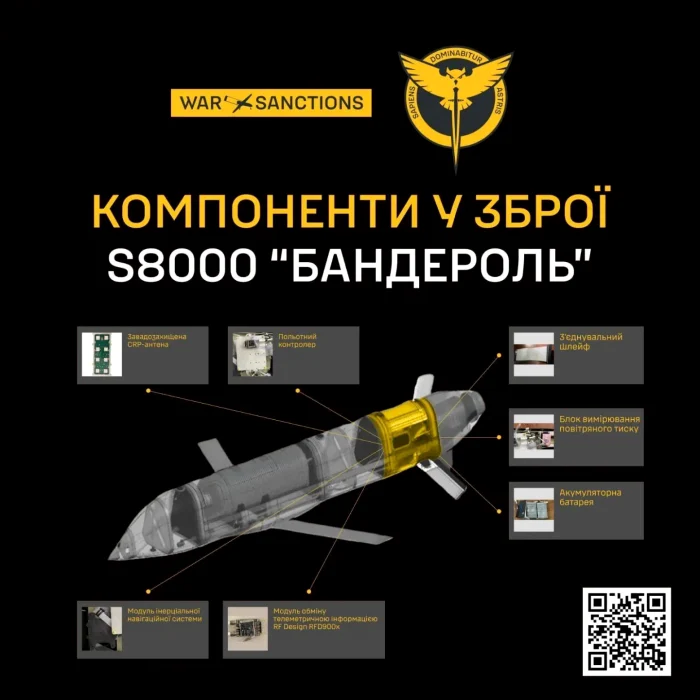
Part of the components identified by GRU photo gru via the war zones
Gur previously stated that he had found dozens of components manufactured in the West in the winged drone S-70 Ohotnik-B (Hunter-B) that was shot above the Ukrainian territory.
In particular, microelectronics and other high technology components are regularly found in Russian weapons.
These “depend on foreign components,” said Gur. “Without them, I cannot continue to fight, occupy and kill.”
In November last year, Gur said he found over 4,000 foreign pieces in almost 150 Russian weapons captured or recovered.
Increased losses of Russian tactical aircraft in front of Ukrainian terrestrial air defense have highlighted the need for weapons that can hit surgical precision behind the front lines and beyond.
The best known example is FLEPK, a rather rudimentary guy type that has caused considerable difficulties in Ukrainian air defense since its inception at the beginning of 2023. The UMPK series has been followed by the UMPB, a precise, more refined, wings.
The exact guide method used in the banner is unknown, so it is not clear whether the weapon can be scheduled with the target coordinates after taking over the aircraft, which would be necessary for the time -sensitive targets.
Overall, although banner could have limitations compared to state -of -the -art cruise missiles used by Russia, it is still a slightly cheaper solution.
On the other hand, if this model is optimized for launching on non -traditional platforms, such as drones and attack helicopters, this means that the bombing fleet and tactical aircraft with fixed wings can focus on their main roles.
In particular, in particular, its launch on drones, the model seemed to blur the borders between a cruise missile and the ammunition launched from the air, an idea that quickly gains land in the United States, according to the specialized publication.