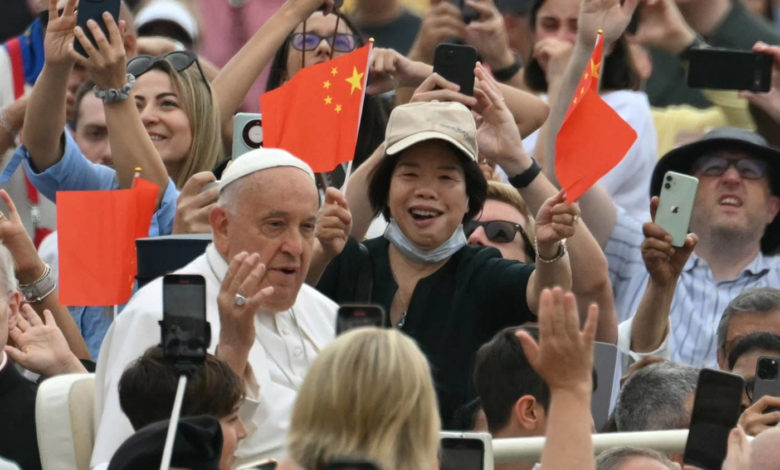
While the whole world rushed to pay tribute to Pope Francis after his death, the reaction was relatively discreet in China-an atheist official state, but with millions of Catholics, whose government had a difficult and complex relationship with the Vatican, writes CNN.
By Pope Francis's death, Beijing lost a respected world leader, who tried to bring the Vatican closer to the leadership of the Chinese Communist Party more than any of his predecessors.
However, the state -controlled Chinese press was laconic about his death.
The Chinese government expressed its condolences almost 24 hours after the Vatican's announcement on the pope's death-when he was asked about this at an ordinary press conference at his Foreign Ministry.
“In recent years, China and the Vatican have maintained constructive contacts and have engaged in beneficial shifts. The Chinese side wants to collaborate with the Vatican to promote continuous improvement in China and Vatican,” said Guo Jiakun, a ministry spokesman.
A complicated relationship
China's retained response emphasizes the sensitivity of the links between the atheist communist party and the Holy See, notes CNN.
The Vatican had no official diplomatic relations with China since 1951, when the newly established communist regime broke the connections and expelled on the papal wedding, the sending of the Holy See.
Instead, the Vatican remains one of the few states – and the only one in Europe – which recognizes the sovereignty of Taiwan, the self -government island that Beijing claims as part of China.
Taiwanese President Lai Ching-Te showed “Sincere condolences on behalf of the Taiwanese people” for the pope's death shortly after the Vatican announcement, while the Foreign Ministry said that Taipei will send an emissary to the funeral of the Pontiff.
This diplomatic loyalty to Taiwan has remained a sensitive point for Beijing, which has been contracted with the Vatican for decades about who has the right to name the Catholic bishops in China.
Pope Francis tried to approach this issue through a historical-although controversial agreement-with the Chinese government, pressuring relationships.
China's Catholic problem
In China, the Communist Party in power keeps religion under control, fearing challenges to its authority, and allows worship only in state controlled churches, writes CNN.
For decades, the Catholics in China – in number of 10 million – were divided between a state endorsed by the state, led by bishops ordained by Beijing, and an unofficial one, which swore to the Vatican.
In 2018, Beijing and Vatican reached a historical agreement under Pope Francis to find a middle way on the appointment of bishops.
The details of the controversial agreement have never been made public, but many of the clandestine congregations in China that remained loyal to Rome and have long experienced persecutions are afraid to be abandoned.
The agreement, which was part of Pope Francis's strategy to extend the number of believers of the Catholic Church worldwide, was to help the Vatican gain access to millions of potential converted in China.
The agreement was renewed in 2020 and 2022, and in October last year, both parties agreed to extend it for another four years.
But the critics wondered why the church would willingly unite their forces with the Chinese government, which, under the leadership of Xi Jinping, has further reduced religious freedom. Many of the criticisms of the agreement came right from within the Catholic Church.
Francisc did not arrive in China
The Vatican insists that the agreement is already fruitful and hopes to open a permanent office in China. This made the Catholics in Taiwan wonder what would happen to them if the Vatican ever changes the decision to recognize the island's sovereignty.
On Tuesday, Guo, the spokesman of the Chinese Foreign Ministry, said that “the implementation of the provisional agreement on the appointment of bishops is carried out without problems.”
Catholicism is one of the five beliefs recognized by the state in China, where religious practice is strictly controlled by the Communist Party.
According to official counts, there are about 6 million Catholics in China, but the number can be higher if we consider those in clandestine churches, to avoid the vigilant eye of Beijing.
Francis has repeatedly expressed the desire to make a trip to China-a country that no pope has ever visited. But the Chinese Catholics will remember him as the first pope who was authorized to fly over the Chinese airspace.
On the way to South Korea in 2014, Pope Francis sent a radio message to Xi when he spoke China: “At the entrance to the Chinese airspace, I send the best wishes to your excellence and your fellow citizens and invoke the divine blessings of peace and well -being on the nation.”
In 2023, during his visit to the neighboring Mongolia, Francis made a rare gesture to send a “warm greeting to the noble Chinese people.”