The hard warning launched by the China countries trapped in the middle in the commercial war with the US

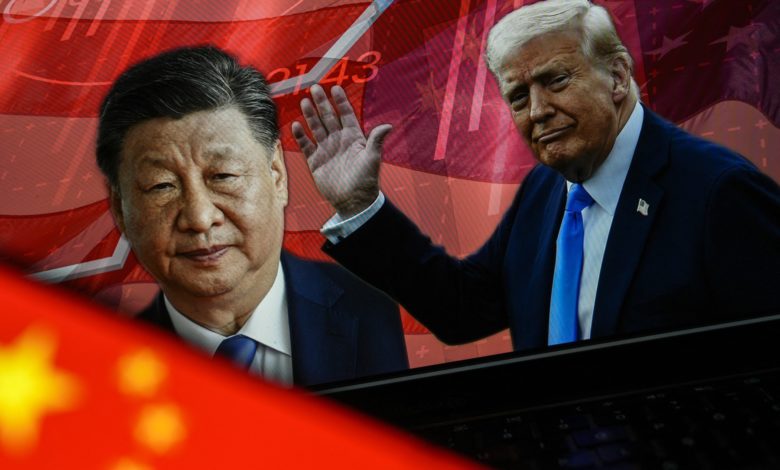
China was accused of Washington of abusing customs duties on Monday and warned countries around the world against the conclusion of an economic agreement with the United States to the detriment of Beijing, intensifying its rhetoric in a spiral commercial war between the two largest savings, writes Reuters.
Beijing will firmly oppose any part that concludes an agreement on China and “will take countermeasures in a firm and mutual manner,” the Beijing Ministry of Commerce said Monday.
The ministry thus responded to a Bloomberg article, according to which the Trump administration is preparing to exert pressure on states requesting reductions or tax exemptions from the US, to convince them to reduce trade with China, including by imposing monetary sanctions.
President Donald Trump has suspended radical taxes imposed on countries around the world this month, with one exception – China.
Then, in a series of successive measures, Washington increased taxes for Chinese imports to 145%, which has caused Beijing to apply 125% retrival fees for American goods, practically instituting mutual commercial embargo.
Last week, China pointed out that its taxes will not increase.
“The United States has abusively applied taxes to all trading partners under the banner of the so-called” equivalences “, while forcing all parties to start the so-called” mutual rates “with them,” said the spokesman of the Ministry of Beijing.
China is determined and capable of protecting its own rights and interests and is willing to strengthen solidarity with all parties, the ministry said.
No one wants to choose a part
The conflict between the two great economic powers puts many countries in a complicated situation.
“The truth is that no one wants to choose a part,” said Bo Zhengyuan, a partner at the Planum political consulting company, based in China.
“If countries are very based on China in terms of investments, industrial infrastructure, technological know-how, I don't think they will accept US requests. Many countries in Southeast Asia are part of this category,” he said.
Following a hard position, Beijing will convene this week an informal meeting of the United Nations Security Council to accuse Washington of intimidation and “throwing a shadow on global efforts for peace and development” by instrumentalizing taxes.
On the other hand, earlier this month, the US commercial representative, Jamieson Greer, said that almost 50 countries approached him to discuss the additional taxes imposed by Trump.
Several bilateral discussions on taxes have taken place since then, Japan taking into account the increase of soy and rice imports as part of its discussions with the US, while Indonesia intends to increase the imports of food and goods from the US and to reduce orders from other countries.
Trapped in the middle
Trump's tariff policies have shaken financial markets, because investors are afraid that a serious disturbance of world trade could throw the global economy in recession.
On Monday, Chinese actions increased, without reacting too much to the comments of the Minister of Commerce, although investors generally remained cautious.
China's President Xi Jinping visited three Southeast Asia countries last week in a regional ties consolidation action, appealing to trading partners to oppose unilateral intimidation.
Beijing said that “torn walls” and expands its circle of trading partners in the context of the commercial dispute.
The stake is high for Southeast Asia states trapped in the cross-fire of the tariff war between China and the US, especially given the huge bilateral trade of the ASEAN regional block with both China and the United States.
The ministers of the economy in Thailand and Indonesia are currently in the United States, and Malaysia are about to join them at the end of this week, all pursuing commercial negotiations.
Six Southeast Asia countries were struck with taxes between 32% and 49%, threatening trade dependent savings that benefited from investments due to Trump Beijing taxing in its first term.
ASEAN is China's largest trading partner, the total commercial value reaching $ 234 billion in the first quarter of 2025, Chinese customs agency said last week.
Commercial exchanges between ASEAN and the US totaled approximately $ 476.8 billion in 2024, according to US figures, making the fourth largest trading partner of the regional block.
“There are no winners in commercial and tariff wars,” said XI in an article published in the Vietnamese press, without mentioning the United States.