The UK tests a microwave weapon to deactivate drone swarms.
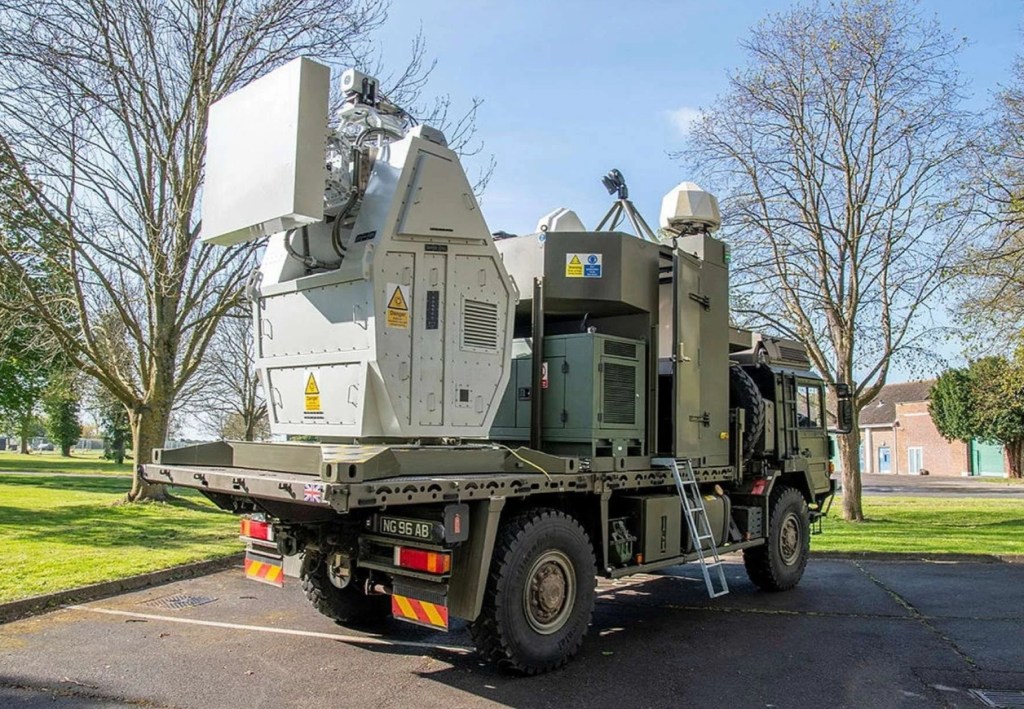
Baptized “RapidDestroyer”, the new weapon tested by the UK armed forces uses a high power radio frequency to “fry” the remote drone systems before they become a threat.
The British Ministry of Defense has announced that it has successfully tested a new type of electronic weapon to combat drones, a new type of equipment that has potential implications for modern battlefields, including Ukraine, reports FT.
The “RapidDestroyer” weapon is designed by a consortium led by the French defense conglomerate Thales and uses a high -power radio frequency to deactivate or fry the electronic remote drones.
Two eight drones were neutralized by the weapon in a recent test, the Ministry of Defense announced, while “over the project, over 100 drones were followed, engaged and defeated using the weapon in all tests.”
The technology is still in the early stage: “RapidDestroyer” is transported on the back of a platform truck and requires a large amount of energy.
How do microwaves against drones work
The “RapidDestroyer” Thales system is designed to counteract small and fast drones, a relatively cheap attack of an enemy potential, but that would pose big problems to a defender who could not follow and hire too much targets or should use much more expensive interceptors.
To counteract the drones, the system emits microwaves concentrated in a certain direction and strong enough to bury and damage the electronic components of drones, up to 1 km.
The system has a cost of 10 pence (0.6 lei) per “blow” and can emit instantly and continuously as long as the energy source is kept connected.
The microwaves used in the attack are electromagnetic waves that are between radio waves and infrared waves in the electromagnetic spectrum.
“RapidDestroyer” is designed to hire targets on very short rays, especially drones, and be completed in an air defense system, with medium and long rays missile systems that counteract rockets and enemy aircraft.
Small and cheap drones, a successful tactic used in the Ukraine War
However, the system tested by the United Kingdom is not the only one of its kind in the world.
An American equivalent, Tactical High-Power Operational Responder (Thor), designed by US Air Force and a number of private companies, has the size of a shipping container. Another similar system is Leonidas, which has been designed by the Epirus technology company for the USA and is to be used on board ships.
Since Ukraine's large -scale invasion by Russia in 2022, both armies have used drones with fatal effects, both for supervision and to launch or use as rockets.
According to Roman Kostenko, the chairman of the Defense and Information Commission in the Ukrainian Parliament, the drones caused or helped to produce up to 80% of the fighting victims in the Ukraine.
Numerous, small and cheap, drones are a difficult target for defenders, many defense systems not being able to follow and hire too many targets in the fight. At the same time, interception rockets are generally more expensive than the drones used for attack.
The new technology of electromagnetic weapons launches a wide energy beam that is relatively cheap and capable of breaking several drones at the same time. Experts say this makes the weapon effective when facing an adverse swarm, although its mode of operation is non -discriminatory, that is, it can hit its own units and systems – which makes it less suitable for infrastructure defense, such as an airport.
“High -power microwaves are potentially a very effective tool for defense against a large number of [drone] And possibly, also of cruise missiles, under circumstances in which their wide effect cone does not create more problems than solve, “said Justin Bronk from the Royal United Institute in London.
“In certain circumstances, such as the bases in the desert or on the line of the kinetic front, where you are not very concerned about the things that are heading in the direction of the enemy, or for the war vessels, yes, absolutely, they offer a significant increase in the ability to combat drones, but they are not a unique solution.
The war in Ukraine was a battle in which the electronic war played an essential role and compromised precision technologies, such as some Western missiles or bombs that are guided by GPS, due to the jam. The drones appeared as a significant force on the battlefield, but they have to sail through an “electronic jamming wall”, a high British military official said.
“It's a game of measures [vs] Contrames, “he said, adding that there are ways in which drones could be protected from microwaves, such as protecting their circuits with materials that block external electric fields, reports FT.
Finally, the technology also aims to define rockets. The US Marina has announced that it will test in 2026 a high -power microwave weapon, known as Project Meteor, which is capable of breaking antinava ballistic missiles that move quickly.