A world phenomenon: many people give up the religion in which they grew. Polls made in 36 countries show that Christianity and Buddhism have the greatest losses

In several countries in the world, one fifth or more of the adults left the religious group in which they were raised, a Pew Research research shows in 36 countries. Christianity and Buddhism have undergone very great losses from this “religious change”, while an increasing number of adults have no religious affiliation, according to Pew polls.
The rates of change of religion vary greatly all over the globe, the polls show.
What is religious change?
During this report, religious change refers to a change between the religious group in which a person says it has been increased (during childhood) and his religious identity now (in adulthood).
We use the term of religious change instead of “conversion” because changes can take place in several directions-including from being raised in a religion to being religious.
Countries in which the change of religion is a rarity
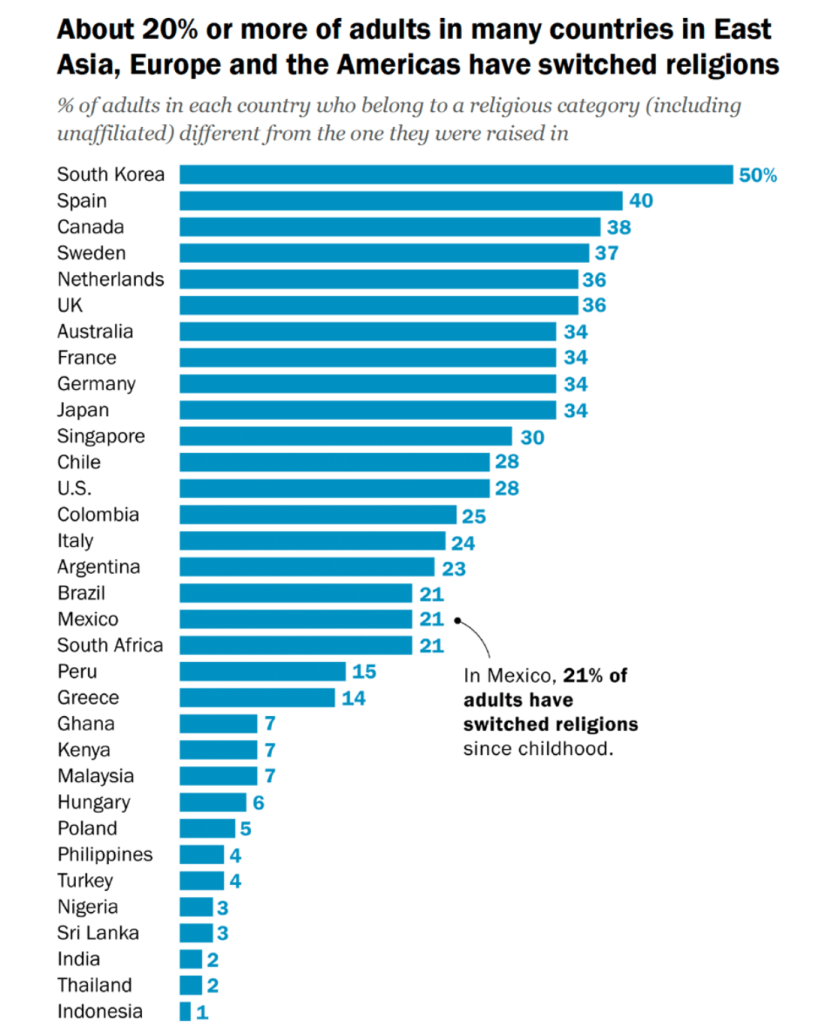
In some countries, the change of religions is very rare. In India, Israel, Nigeria and Thailand, 95% or more adults say they still belong to the religious group in which they were raised.
But in Eastern Asia, Western Europe, North America and South America, change is quite common. For example, 50% of adults in South Korea, 36% of the Netherlands, 28% of the United States and 21% of Brazil are no longer identified with childhood religion.
What religions do people pass to?
Most of those who leave a certain religion move to the category “religious”, which consists in people who say they are atheists, agnostic or “nothing special”.
In other words, most of the change is disifilitating – people who leave the religion of childhood and no longer identify with any religion.
Many of these people were raised as Christians. For example, 29% of adults in Sweden say they were raised Christians, but now they are religiously described as atheists, agnostic or “nothing special”.
Buddhism also loses followers through displeasure in some countries. For example, 23% of adults questioned in Japan and 13% in South Korea say they were raised as Buddhists, but they do not identify with any religion today.
However, not all changes are far from religion. But some people move in the opposite direction. Of the 36 countries questioned, South Korea has the highest share of people who say they were raised without affiliation, but have a religion today (9%). Most of them (6% of all adults in South Korea) say they have not had a religious education and that they are now Christians.
Although these figures reflect the religious tendencies from the 36 countries included in the poll, they are not necessarily representative for the entire population of the world. Christianity – religion in the world The greatest and most widespread, according to the estimates of the Pew Research Center – is the majority belief
Islam, the second largest religion in the world, is a historically predominant religion in six of the 36 questions questioned: Bangladesh, Indonesia, Malaysia, Nigeria, Tunisia and Turkey. (We believe that both Christianity and Islam predominate in Nigeria, which is divided from a religious point of view.)
Buddhism has been predominant in five other questions: Japan, Singapore, Sri Lanka, South Korea and Thailand. (We also believe that South Korea has two predominant religions, Buddhism and Christianity.)
Hinduism and Judaism are every predominant religion in a single studied country (India and Israel respectively).
Which religious group has won the most of the religious change?
The category that has recorded the biggest net gains in change is the religious one.
In countries with a substantial number of people who describe themselves that they have no religion, many more respondents in the poll have become non-affiliated than those who joined a religion after they were raised without one.
In Italy, for example, the ratio between departure and joining among the non -affiliated is 1.0 to 28.7. For every person who has been raised without religious affiliation, but now has a religion, more than 28 people say they have been raised in a religion, but have no one.
However, this is not the case of Hungary. For every Hungarian who has become religious, almost two others say they were raised without religion, but now they are identified with one. Most of the Hungarians who chose a religion after they were raised without one are now Christians.
Age
In most countries questioned, approximately equal percentages of younger and older adults have changed their religion. For example, in Singapore, 29% of adults between the ages of 18 and 34 say they belong to a religious group different from the one in which they were raised, like 29% of adults over 50.
However, in 13 countries – including almost all nations in Latin America questioned, as well as in several countries in Europe and North America – adults under 35 are more likely than 50 years old and has changed religion.
In Spain, for example, 48% of young people between the ages of 18 and 34 have changed religion, compared to 36% of adults aged 50 and more. And in Colombia, 34% of the youngest adults changed religion, compared to 14% of the elders.
Education
In most countries, religious change rates do not vary much between people with different levels of education.
However, in 12 of the 36 countries questioned, people with more education tend to have higher religion change rates.
Lower countries have the biggest differences in change rates according to education: 42% of Dutch adults with high education levels have changed their religion, compared to 29% of Dutch adults with lower education.