The annual inflation rate in Romania fell marginally in October, from 9.9% in September – according to the National Institute of Statistics (INS) data – to 9.8%, according to a press release sent by the INS on Wednesday. Energy is at the top of the ranking of price increases, propagating in the costs of other goods.
In parallel, a basic good such as bread has risen in price by about 10% in the last 12 months, signaling that inflationary pressures persist and that there will be several months of accelerated price increases. Calculated according to the European methodology (to make the data comparable between countries), the harmonized price index in Romania is, according to Eurostat, by far the highest – 8.4% – the next ranked, Estonia, having an inflation half of ours.
Jjournalist Dan Popa sends the “EconoMix” newsletter every Thursday morning. If you are interested in personal finances and want to receive economic recommendations, you can subscribe here:
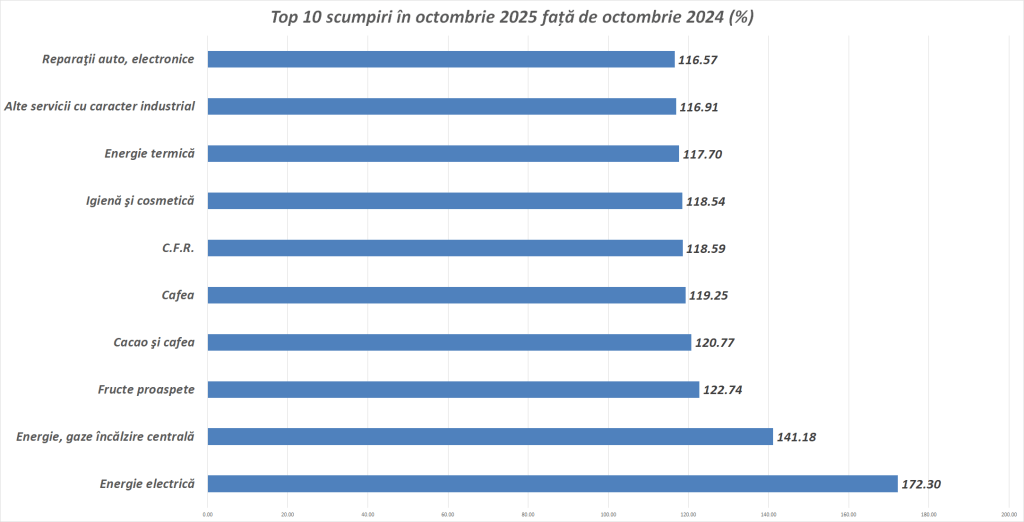
In food, the biggest price increases were also maintained in this interval for fresh fruit (22.74%). A coffee costs 19.25% more than last year, while fruit and fruit preserves are 14.96% more expensive.
Prices in the group of sugar products, sugar products and bee honey increased by 13.27%. Although more moderate compared to those of the previous months, other more substantial increases are also found in cow's milk, 11.46%, in bread, with 9.5% and in citrus fruits with 8.16%.
Eggs increased their price in this interval by 9.03%. In the category of alcoholic beverages, the price of beer increased, in the last year, by 7.39%, and that of wine by 6.57%. Another important increase in tariffs is also found for beef, by 10.39%.
In the services category, the highest price increases in October 2025 compared to the same month in 2024 were recorded in the case of CFR tickets, which increased by 18.59%, followed by hygiene and cosmetic services, by 18.54%. â
Other significant increases in this category, over the course of a year, were recorded in car repair services, 16.57%, followed by footwear and clothing manufacturing and repair services, with 14.76%. Rents have increased in the last year by 8.86%. At the same time, healthcare became more expensive by 13.53% and urban transport increased its tariff by 12.41%.
Among non-food goods, the most significant price increases in October continue to be in the electricity tariff, which increased by 72.30% after the elimination of the support scheme regarding the capping of electricity prices. Other tariff increases in this category were recorded for thermal energy (17.70%), for books, newspapers, magazines (10.11%), detergents (8.9%), tobacco and cigarettes (6.68%). Last but not least, medicines also increased their prices in October by 5.45%.
Below, the top 10 biggest increases:
Today, the National Bank of Romania (BNR) convenes its Board of Directors to approve the new “Inflation Report” and to decide possible monetary policy directions. Background: Inflation remains high and bills, food and services continue to rise.
In September 2025, the annual inflation rate was 9.9%. However, this slight reduction in October is more of a “plateau” than a pronounced real decline – a sign that monetary policy must remain vigilant.
The price of bread – a personal indicator of inflation
Consumers feel more acutely significant increases in basic products. For example: bread has become more expensive by approximately 10% compared to the previous year, which creates a dissonance between the aggregate figures and the daily experience of a family.
This anticipation of the fact that “official inflation is falling” but “prices continue to rise” generates an increase in distrust
What will the BNR decide today?
At today's meeting, the Board of Directors of the BNR has on the agenda:
approval of the quarterly/annual report on inflation;
evaluation of the inflation trajectory for 2026;
reference interest rate policy — currently 6.50% per annum.
Analysts anticipate that the BNR will keep the interest rate at 6.50% in the meeting on November 12, 2025, until a possible relaxation in 2026.
Implications for consumers and households
Even if the figure of 9.8% seems “better” than 9.9%, the difference is insignificant to someone who sees bread at +10%.
Basically, inflation acts as a regressive tax — the poorer you are, the higher your “personal rate of inflation.”
Also, even if inflation continues to fall, we will enter a period of “inflationary hangover”—prices never return to where they were before. This “inflationary hangover” is a term used to describe economic difficulties that persist even after inflation begins to decline. The effects of inflation—such as higher prices, reduced purchasing power, and disrupted business and consumption habits—continue to affect the economy, households, and public policies.