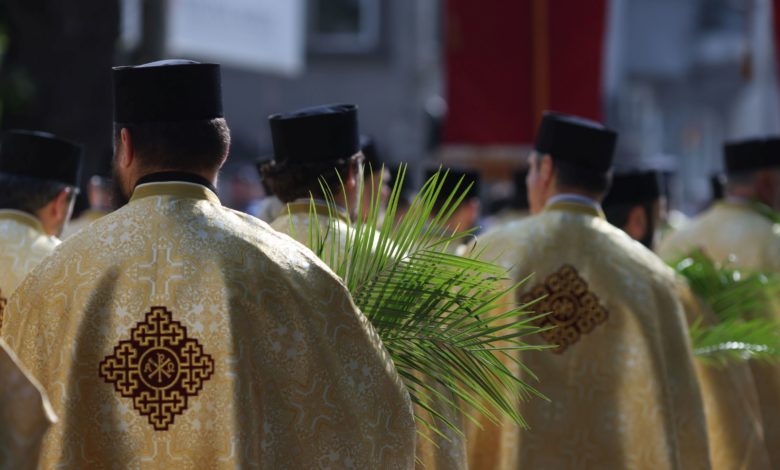
Orthodox Christians and Catholics celebrate Flowers on Sunday. The willow branches are brought to the church to be sanctified and then taken home, and in the old days there were various rituals, to try to influence the future.
- The Flowers, celebrated on April 13 in 2025, mark the entrance of Jesus to Jerusalem and represent one of the most important Sundays in the Orthodox Calendar. The believers bring willow branches to the church to be sanctified, and then they use them in the household for protection and blessing.
- Flowers are also seen as a “strong time” day in which rituals were made to try an influence of the future. The children played an active role, caroling with willow branches, like Sorcova, to bring health and luck to houses.
- Habits range from one region to another, but many have the theme of vegetation and resurrection in the center. From ritual games such as “Lăzărița”, to the habit of clinging the martyr in flowering trees, the day of flowers is a mixture of archaic beliefs and Christian traditions.
A few digits about flowers
According to the Orthodox Pascal Calendar, Flowers can never be earlier than March 28, but no later than May 1st.
Over 1.7 million Romanians bear flower names. On the Sunday of Flowers, over 1.1 million women and 600,000 men celebrate their onomastics, the data MAI shows. Florin and Florentina are the most popular names.
But what does tradition say? Flowers are personifications of the flowers celebrated on the Sunday bearing their names, Sunday of Flowers, over which the Christian Church overlapped the feast of the triumphal entry of Jesus in Jerusalem, writes Ion Ghinoiu, in the Romanian mythology dictionary.
- “As mythical representations, the Flowers are identified in Roman mythology with the goddess Flora, frequently attested by archaeologists in Roman Dacia. At the resurrection of nature, when the plants, the willow and the fruit trees, have added new meanings, especially those related to the cult of the estates and the ancestors. willow, the spirits of the dead are invoked ”, writes Ion Ghinoiu.
What symbolizes the willow branch
The holy willow branch in the church is a symbol of the annual chastity and rebirth of the vegetation. With finical branches, identified by Christians with willow, the Jews welcomed Jesus at His triumphant entrance to Jerusalem.
- The blooming branches of willow consecrated on the Sunday of Flowers had various uses: they adorned the icons, the crosses, the graves, the trout, the windows, the doors and the gates of the houses; they provided magical protection and drove the evil spirits; They were given to cattle to be eaten to multiply; They are stuck in the ground of holdings or hanging in fruit trees and vines to give them rich fruit.
Some believed that they prevented the pain in the harvest, if women and men warm with them. Moreover, it was believed to stop hails and rains with hail during the summer and help to “catch” the spells and spells/
The willow branches were placed in the icon and used in times of the year, such as disease, drought or hail. Therefore, these sanctified branches were sometimes used for spells, sometimes they were as a “medicine” and to keep the house and animals in the household.
The “hard” time of the holiday
“The Sunday of Flowers is the most important holiday of the Passover, as it reminds the Christians the moment when the Savior decided to face the adversar. Salcia is the vegetal “emblem” of this holiday, being the first tree that is green.
And the time of flowers, as well as in the case of other holidays, was considered magical and that is why various rituals took place to try to influence the future.
“The sixth week of the Great Lent is the whole of the Renaissance of nature. Her last days, Lazar's Saturday and Sunday of Flowers, are holidays marked by customs whose protagonists are the children. perpetual ”, it is written in the quoted volume.
Lăzărița and Lăzărel
The author also describes a habit called “Lăzărița”, a kind of “game of wedding death” in the villages of the southeast of the country. Basically, a girl adorned like a bride measures the host's yard long and wide, mimicking the pain and pain, waiting for the groom left in the forest, while the group sings a sad song.
- The Lăzărel is a strange, barely outlined character and “it seems to be a spirit of vegetation whose premature death is on account of the evil clock or birth at an unfavorable moment,” writes Narcisa Știuca. The Lăzărel has nothing to do with Lazarus from Bethania, the one the Orthodox Church in celebrates because Jesus had resurrected, being the last wonder before entering Jerusalem.
In some areas, because the nettles were blooming, the day of flowers was also called the “Nettics wedding”, writes Ion Ghinoiu in “Dictionary of Romanian mythology”. He recalls another local custom: the martyr received from March 1 is removed and hangs into a mulberry or any flowering tree. In some houses, clothes were removed and the dowry of the girl to be married.
In restricted areas, the girls collected a plant that was called “naval” and was used in love enchantments.
The day of the flowers is also special by the fact that it is a day of “release” at the fish in the big post, a post that has a total of 48 days and which offers only two days in which fish can be eaten (the other is the day of the Good News, March 25). The unraveling at the fish has a symbolism rich in orthodoxy and is not a violation of the job, but it must be viewed as a comfort given to the believers.
Sunday of flowers to Orthodox
One week before His passions, our Lord Jesus Christ entered Jerusalem, on an asin surrounded by the 12 apostles. The crowd, recognizing him as the true Savior, greeted with branches of finic and songs of joy, explains the Christian-ortodox.ro.
From a liturgical point of view, this day begins the week of passions, and in the churches every evening are officiated, services through which the believers spend Christ on the path of the cross, until death and resurrection.
Why does Jesus come to Jerusalem? The Jewish law demanded each Jew to go at least once a year to the temple in Jerusalem to bring sacrifices to God. The Savior comes to fulfill the prophecy and to call the Jews.
The Jerusalem in which Christ enters is the image of heavenly Jerusalem, where the Son reigns eternal with the Father and the Spirit, and pre -imagines the New Jerusalem – the Church, in which He will always be present through the Holy Spirit.