The Sunday of Flowers, the feast under the protection of acacia. Who was the flora, the nymph that is found in Romanian mythology

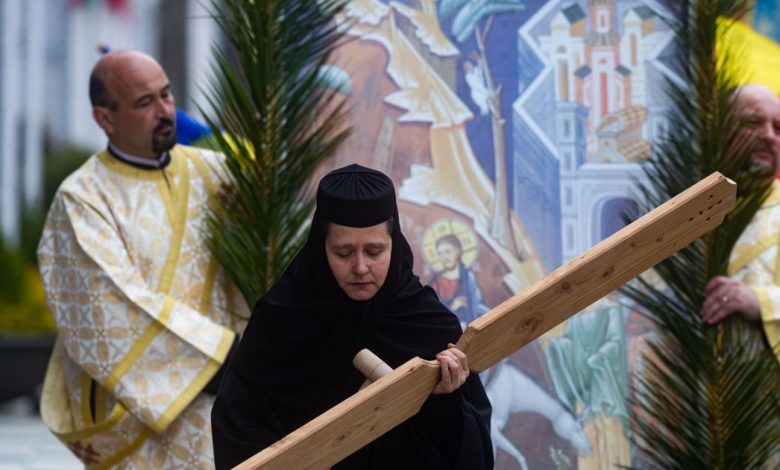
The biblical moment when the Jews in the city of Jerusalem have laid down at the feet of Jesus Christ branches, to glorify the one who had risen from the dead on Lazarus, is celebrated by the Christian world on the Sunday before Easter.
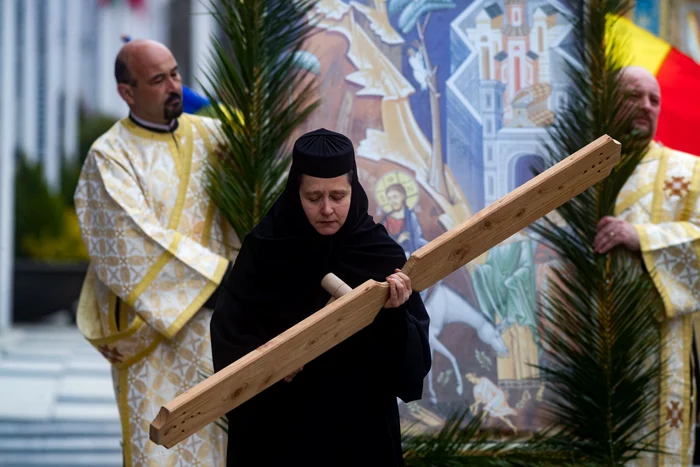
Photo Flower job Inquam_photos Virgil Simonescu
It's Sunday, but not every Sunday. Christians dress with good clothes and go to the church. Wearing a willow branches in their hand, children and old people also fill the heartfelt and the soft smell of spring flowers. It is the feast of Flowers, which Christians have been celebrating for over 2,000 years. Regardless of whether it is a pagan holiday, Floralia, dedicated to the Roman goddess Flora, or one of Christianity, and now, people believe that the willow branch at the church is lucky and keeps them from the evils over the year. The willow branches, blessed by the priest, represent, in the popular faith, the victory of life over death.
“Blessed is the one who comes in the name of the Lord!”
The holiday has crossed the centuries, world wars, cataclysms and pandemics. The entry of the Lord to Jerusalem or Sunday of Flowers is celebrated this year together by Orthodox and Catholic Christians. According to the four evangelists Matei, Mark, Luca and John, after committing the miracle of Lazarus, Jesus entered Jerusalem, where people were at the temple to celebrate Easter, on an Asin. As the crowd had heard of his miracles, he met with fan and fly and olive branches, laying on their way.
In the beginning of the beginning, there is talk of finic branches, that is, the palm tree, but as this plant does not grow in all the territories where Christianity has developed, the tradition of the flowers branches has adapted, and the place of the fine was taken by olive or willow. In order to give sacred powers to the willow, in the Romanian folk faith it is said that on his way to the place where Jesus was crucified, the Mother of the Lord was helped to pass a water by such a plant, which made a bridge with one of his branches, while all the others remained still. As a reward, the Virgin Mary blessed her, and the priests serve her in the church, on the Sunday of Flowers. In memory of the finic branches, which signifies the victory of life over death, at the end of the service, willow branches, blessed by the priest through a special prayer, are divided.
Lăzărel, usually in the memory of the resurrected one from the dead
The Flowers open the Great Week of Easter and are preceded by another significant holiday, namely Lazar's Saturday, a biblical character raised from the dead by Jesus. “According to the legends, in the Romanian pantheon, this Lazar or Lăzărel is a local god of vegetation, created by the popular imaginary in his memory. On the eve of Flowers, in the villages of Northern Dobrogea, the children go with Lăzărel or Lăzărița, an ancient habit, a kind of gaming to the death. Wedding.says for “Weekend Adevărul” Dr. Cerasela Dobrinescu, head of the National Cultural Heritage Section at the Museum of People's Art in Constanța.
In fact, says the museographer, in memory of the biblical moment of the Savior's entry into Jerusalem after the miracle of the resurrection of Lazarus, the Christians are used to lead to the church to be sanctified. “The feast of flowers is considered to be the flowering of the willow. The explanation of the veneration of this tree, however, also resides from the extraordinary vitality that this plant is stubborn to grow in less favorable places. At the same time, it is said that the holy branch has a magical power, and then it will be a role. Keep all the year at the icon of the Virgin Mary or in the threshold places of the household, to keep the family and the storm house or fire, to stop the diseases, for the increase of the seeds, of the host, of the hives, of the animals and in general, as I said, for everything that is considered to be defended. “explains Cerasela Dobrinescu.
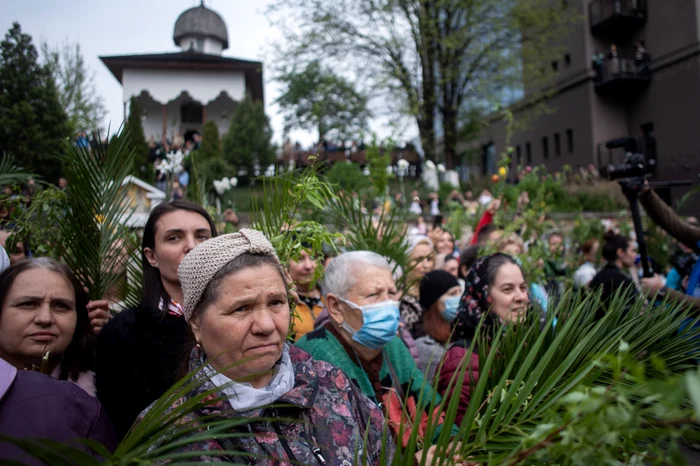
Pilgrimage photo inquam_photos Ilona Andrei
Salcie spell
About the power that the Romanians in ancient times believed that the holy willow or its buds have, we find out from the writings of the time. “The willow branches from Flowers hold the peasant after the icon and always summer, when it is a storm, take the aftermath of the icon and put it in the middle of the house, as it forms of lightning. to the Romanian people “in 1903.
From the same author we find that the Romanians from the past used the willow in the enchantment: “Through Botosani, with the pillars that are given on the day of Flowers, a virgin girl can drive away. When he comes from the church, the twig will not take it in the house, but to be able to under the eaves of the house and say a spell and when he will see the nourish to take the branch and, where he will threaten to fall, there he returns to the nour. “.
All the popular faith says that if willow flowers from the flowers are thrown on the fire, their smoke will spread the storms and “angry rains”. “Others, when I see that there is a big hail, city, say it is good to take holy grinders, to go with the hail before it starts to pass on the village border and the words used at the eve, when I post, so that you can stop, and how you do it.
Salcia, love cure
In the rural area it is known that Salcia brings good luck to the family, especially the one who is at the beginning of the road. People used to bind themselves with willow branches around the middle to get rid of pain. Also for beneficial, medicinal purposes, willow buds were swallowed by children for sore throats or were put in the past in the babe, or even on the graves of the dead to ensure them. It was also used to the willow branches to be made crowns or salbs, the circle being a solar symbol, and everything that is of the sun is considered to be good. The girls keep this wreath in the willow because it is good as a love cure, the museographer tells us.
Around this plant, a symbol of the feast of Flowers, there were also a series of superstitions that meet in the Dobrogea villages and beyond. It is said that the flowers are not good to wash your head because your hair will become white. In the week before the flowers, nothing is resembled, believing that the plants will not have fruit. Being a holiday dedicated to flowers, Christians were placing flowers in the garden or in pots or changed the land of plants to grow vigorous. The popular faith says that if the branches of apple or cherry that are placed on the day of St. Vari in pots with water will bloom until the day of Flowers, it is a sign of a rich year, according to “faiths and superstitions of the Romanian people” collected by Artur Gorovei. In the same collection we find that the vineyards connected some vines with the willow from the Flowers to be away from the stone.
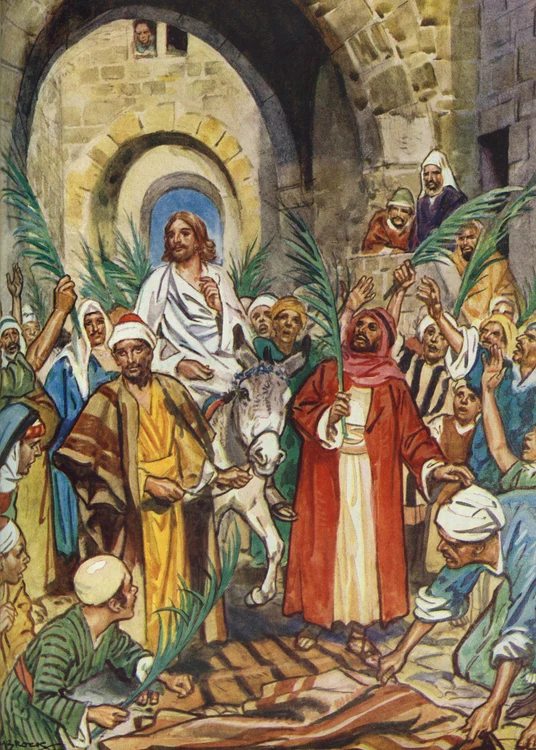
Biblical moment Photo Getty Images
On the Sunday of Flowers, it is not working. The one who will go through the household will take harm all year, according to the popular faith. Starting with this day, no nettles are eaten because it is considered that they reach maturity, and then follow the week of passions, during which Jesus Christ was hit with nettles and then vinegar and all these foods are forbidden to be consumed by Christians.
If the willow is the star plant on the Sunday of Flowers, the other flowers are no longer.
“It was considered that the flowers have a soul. Whoever collects flowers on the day of flowers must ask for forgiveness, because the flowers represent the day of all flowers”says the Museographer Constanţa. It is said that as the weather will be on the day of Flowers, so it will be Easter. So we also have a meteorological forecast on this day which is one of the most important holidays of Easter week.
Floral's holidays, inheritance from Romani
Over time, the scholars have tried to find out whether the Christian flowers celebrate the entry of Jesus into Jerusalem or Floralia, April being the month of the goddess Flora, a deity of flowers and seeds. From where the appointment of Flowers came for a holiday in which the flowers have not yet given and when they barely soften the first plants, the historian Gheorghe Popa-Lisseanu asked in the volume “Romance. Historical, philological and archeological studies”, a work published in 1926. And they are a direct inheritance from the Romans.
The flower was personified by the Romans in a nymph, called the flora, which was celebrated in the most beautiful spring month, April. The wife of Zefirul was represented as a virgin carrying a crown on her head, and holding several bouquets of ginger flowers. The most beautiful statue of the flora was discovered in Caracalla's terminals, which was called “Farnesa Flora”. In Rome, the goddess Flora had two temples: one in the Sabin neighborhood, and the other next to the maximum circus.
The Flora's feast was a special one, in which many public games were held, the first being documented in 240 BC. From the writings of Ovidiu we find that until this time, the people were not able to punish their cattle on the village. That is until the public editors fined the guilty and from this paid money, games were instituted in honor of the flora. In fact, from 173 remained a coin of the Servilia family with the legend “Floralia Primus”, on one side being represented the head of the goddess crowned with flowers.
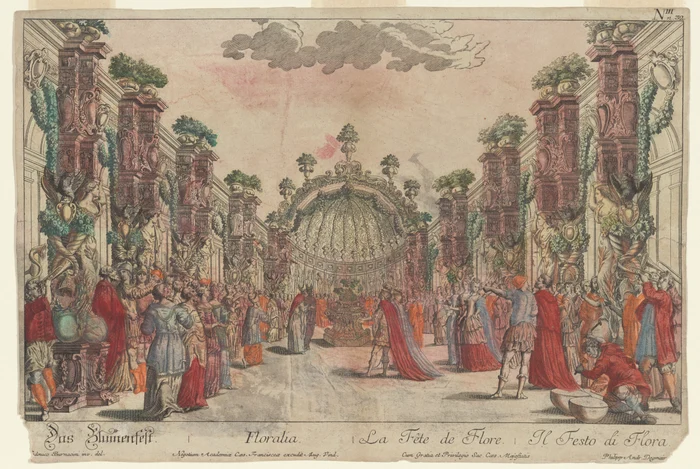
Photo Getty Images
The six days of holiday
The cult of flora has received several changes over time. If it was initially confused with Venus, but just as adored, as time goes by, the florals became immoral. The cult of the flora was substituted by “the cult of a courtesy, which left its entire wealth with a condition only, so that every year it would be celebrated.” Who could be the courtesan? In Greece, Aphrodita-Venus was the most beautiful of Curtisane “, and in Rome” Acca Larentia and Flora had to have been famous Curtisane “.
The Floralia feast held six days: from April 23, the anniversary day of the goddess, until May 3. The world was dressed in white clothes and came to attend and participate in events from the most unique: rabbit and goat hunting or floral games. “On this occasion, floral games were given in the circus. The games differ from all the others through their obscenity. Characteristic of these games, which were celebrated at night in light, it was the fact that the people could claim that the women on the stage would descend and play in bare skin.“Over time, the feast encompassed all the provinces, and the cult of flora was replaced by that of Venice, leaving more or less traces in Christianity, concludes the historian.
On the graceful Roman nymph we are also found in our popular fairy tales and songs, under the name of Ileana Cosânzeana, or Calomfir, “Emperor of Flowers”. In an older version of Ilena Cosânzene's fairy tale, there is a “baby, starting to cry half a year after birth, her mother promised her wife to Linulin's face, called Lina Ruulina, who inverts the fields, the flowers bloom.” In a song on the Transylvanian lands, the flora became a “Chicory gangs, Flower Fairy, Flower of Dawn, loved by the Holy Sun.”