Wind of changes in Europe. Norway smiles at the EU, Switzerland to NATO

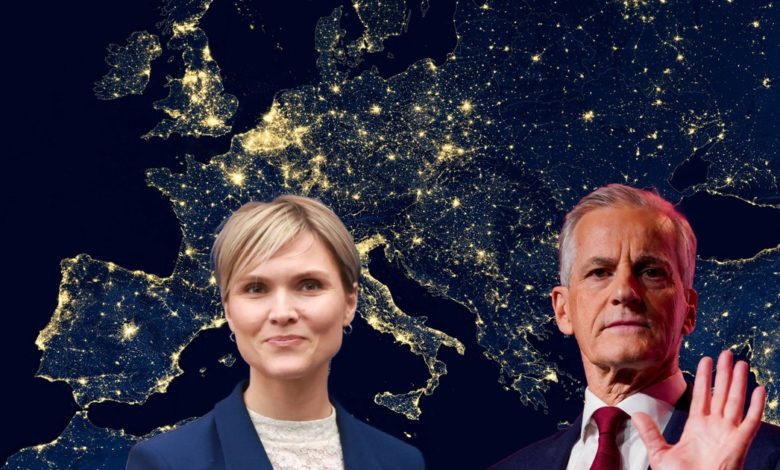
“Europe needs Norway, and Norway needs Europe,” said Norway Prime Minister Jonas Gahr Store this week during a meeting with the European Executive Authority. He suggested that his country, which is not a member of the European Union, wants to be seen as a partner – not an outsider – in Europe, especially in defense issues and decisions regarding the future of transatlantic trade.
Although Norway withdrew its candidacy to join the Union after referendums in 1972 and 1994, it is deeply integrated with the common European market, as well as with the Schengen zone. And although the polls still show that most of the Norwegians do not want to join the EU, the geopolitical situation – in particular the inconsistent character of the US government and the weakening Appetite of the United States to defend their partners in the alliance, as well as Russia's actions in Ukraine – prompts more and more of them to re -consider this matter.
At the end of last year – on the 30th anniversary of the day on which the Norwegians voted in favor of not arriving at the EU – researchers from Sentio Research Norge recorded the lowest level of reluctance in history to join the Union. In the survey of about 47 percent Norwegians said that their country should not join the EU. About 35 percent It would be in favor and the rest was undecided in this matter. In this situation, the Norwegian political representation is increasingly talking about stronger relationships with the EU.
The union can, defense for sure
At the last meeting, the chairwoman of the European Commission Ursula von der Leyen assured the Norwegian prime minister that his country remained within the uniform market even in the light of Trump's duties – finally the US president imposed lower duties on Norway than the entire European Union. While EU countries “got” 20 percent, Norwegians only 15 percent. The store for its part has declared Norway support for the EU task supervision group (monitoring platform possible to redirect goods as a result of American duties) and confirmed the involvement of his government in eliminating the long -awaited EU regulations, which must be adopted as a member of the European Economic Area (EEA).
However, in January this year it was the adoption of some EU directives that led to the collapse of the government in Norway, as a result of which the Eurosceptic agrarian Party of the Center left, and the Centrolevot Work Party of the Prime Minister Store ruled by itself. Trygve Slagsvold Vedum, leader of the Center party and the then Minister of Finance, rejected directives on pure energy, increasing the use of renewable energy and promoting the construction of a more energy -saving infrastructure.
After twenty -two years of delays, Oslo has also recently agreed to adopt EU regulations on genetically modified organisms [GMO]. Norway has long wanted to be able to impose more severe bans on the marketing of food and genetically modified feeds than EU regulations allow. The loss of support of the Eurosceptic agrarian party can to some extent solve the Store's hands and allow more cooperation with the EU.
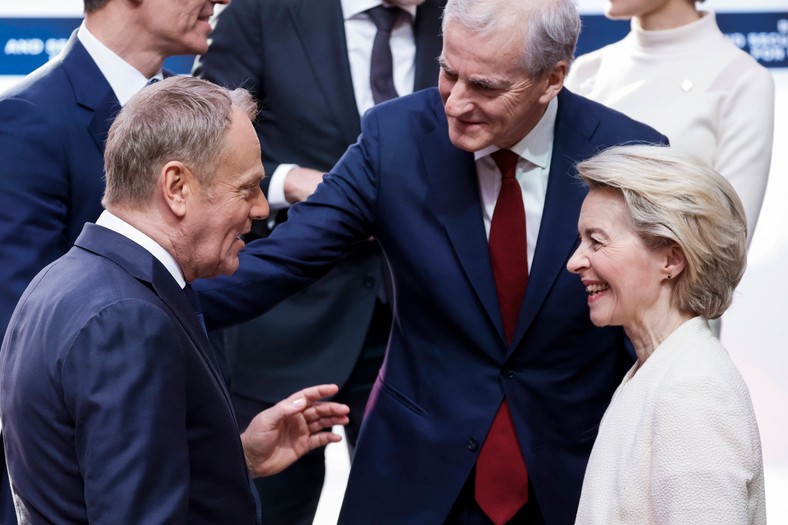
Polish Prime Minister Donald Tusk (L), Norway Prime Minister Jonas Gahr Store (Ś) and chairwoman of the EC Ursula von der Leyen (P) during the peak of the “Coalition of Volunteers” at the Elyseed Palace in Paris, France, 27 March 2025.
Even the leader of the main opposition party, conservatives, Erna Solberg, recently expressed support for the next referendum on joining the EU. Solberg was the prime minister of Norway in 2012-2021 and recently stated that she was “convinced that Norway would be a better country if we were members of the EU.” Despite the conservative position, their likely coalition partner, the populist party of progress, remains definitely opposite. Norway is in the face of parliamentary elections on September 8, and in front of them the Norwegian political scene changes with the return of the longtime general secretary of NATO Jens Stoltenberg to domestic policy. He was previously a prime minister, and now he became the Minister of Finance on behalf of the Labor Party. The latter currently dominates in pre -election polls.
A debate about whether Norway joins the Union in context growing hazard of security from Russia. The Norwegians are afraid that the Kremlin may gradually increase its interest in the Svalbard archipelago (especially in relation to the statements of Donald Trump about the intention to take over Denmark Greenland). Norway is a member of NATO and monitors the Russian North Atlantic fleet. The legal status of Spitsbergen ensures sovereignty, but also allows Russian settlement.
The government of Donald Trump is reluctant to support allies within the North Atlantic Pact, which is why European countries have worked hard in recent months to create a common defensive group (unofficially called the “coalition of volunteers”, which, in addition to most EU countries, includes Great Britain, Türkiye and Canada), which is not lacking in Norway. However, this is not yet a priority even for the leader of the Labor Party and the Prime Minister Store. “In turbulent times I would prefer to keep the country's unity,” said the prime minister, referring to the fact that his society is still divided into the EU membership.
Iceland thinks about the EU, Switzerland about NATO
By the way, another Scandinavian country, Iceland, announces a referendum on EU membership in the next few years. The current row of Iceland announced this week that he wants to carry out a plebiscite until 2027. Prime Minister Kristrun Frostadottir also said that she would establish a group of experts, which will look at the advantages and defects of maintaining the Icelandic Crown compared to the adoption of the euro.
According to the latest polls, the chances of becoming a full member state with the second attempt (the government finished the first in 2015 without success) are large.
According to Bild, currently almost two -thirds of Icelanders are in favor of a referendum: 45 percent. The island's inhabitants are currently in favor of joining the EU, 35 percent. It is against and 20 percent is neutral. Iceland is already part of the EEA and Schengen zone and has good experience with it.
The head of the Iceland government admits that the debate [dotycząca członkostwa w UE] It currently applies not only to the advantages of the Union itself, but also Washington's threats towards Greenland. Iceland also belonged to Denmark once until it announced independence in 1944.
However, Frostadottir hopes that the US's interest in Greenland and the threat to Europe by Russia's aggression will soon step down. “I don't want to conduct our accession to the EU based on fear,” she said.
Traditionally neutral In recent months, Switzerland has decided to take bold steps to strengthen defense cooperation with European countries. Switzerland joined the anti -Russian sanctions, and the head of the local army did not rule out that Swiss soldiers could one day take part in the peace mission in Ukraine. Half of the Swiss wants closer cooperation with NATO.
In February 2025, the government proposed alleviating the restrictions on weapon exports – it wants to stimulate the national arms industry. Switzerland does not allow arms export if the target country is involved in internal or international conflict or if it seriously violates human rights. Therefore, this country cannot send their weapons to Ukraine. For this reason, the export of weapons has fallen rapidly in recent years. The government proposal therefore assumes the possibility of an exception to licensing the export of war materials – it would be possible if it was necessary to protect foreign policy or country security interests.