The “Roller Coaster” meeting on Wall Street ended with two declining major indices, after Trump remained firm on customs duties. “A cure for the disease”

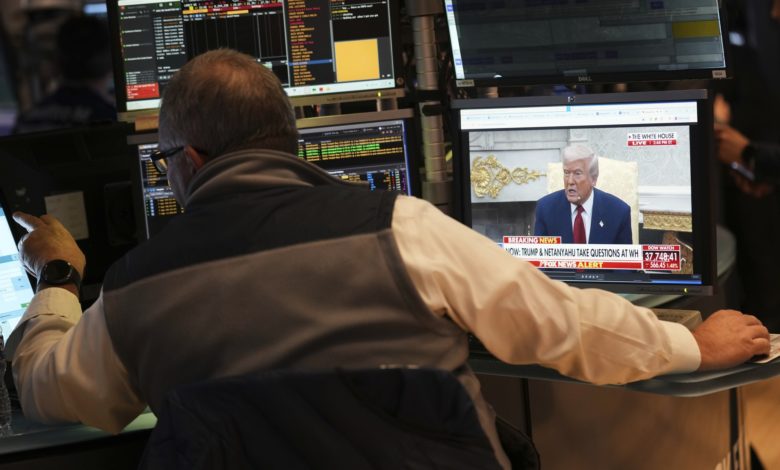
The S&P 500 and Dow indications of the Wall Street Stock Exchange down on Monday, after a “Roller Coaster” type session, investors being worried about economic slowing and inflation, while US President Donald Trump has strengthened his position on customs tariffs, warning that he could increase China.
The actions on Wall Street were strongly affected by Trump's radical tariffs, announced last week at the end of Wednesdays, all imports to the US and by much higher taxes on some important commercial partners.
On Monday, the volume of transactions on Wall Street has shot down several records in the US, for the second consecutive meeting. At the beginning of the trading session, all three main US indices have reached the lowest levels of the last 12 months. During the morning, they increased strongly for a short time, following information on customs tariffs, so that they would decrease again, after the press article with this information was denied.
Also, during the session, the CBOE Volatility Index (VIX) index, the “fear” indicator on Wall Street, has exceeded 60 points, reaching the highest level in August 2024. After limiting the winnings, he ended the day at 46.98 points, the largest closure in the last five years.
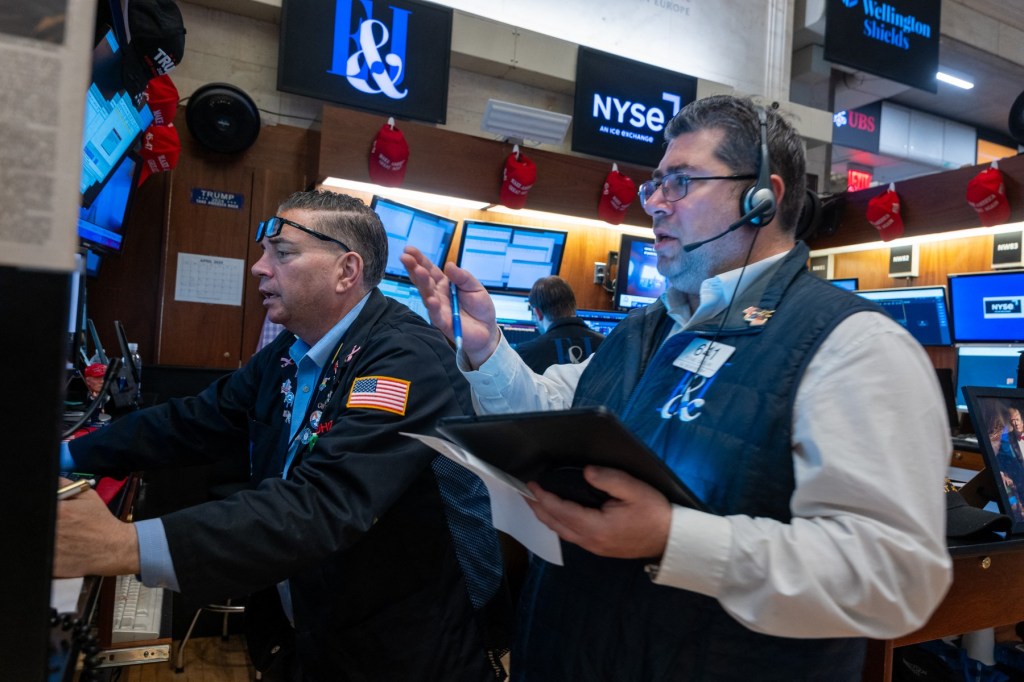 The “barometer of fear” has grown strongly on Wall Street. “Crazy” trading session on the American Stock Exchange, which has dropped again after an announcement of the White House
“Crazy” oscillations
“The basic market problem is that the approach to the Administration on commercial imbalances is to try a cure that is worse than the disease,” said Rick Meckler, a partner at Cherry Lane Investments, a New Jersey investment office.
“It is clear that investors favor either a break or a different approach to how to do so. It is very revealing that, of the many supporters of Trump in the investment and business community, it seems that there is no one to support the (American) administration approach,” Meckler added.
The Dow Jones Industrial Average (DJI) index decreased by 349.26 points, or 0.91%, to 37,965.60 points, the S&P 500 (SPX) index lost 11.83 points, or 0.23%, reaching 5.062.25 points, while NASDAQ Composite (Ixic) won 15.48 climbing to the value of 15,603.26 points.
In the first two days that followed Trump's tariff announcements last week, the S&P 500 reference index decreased by 10.5% and lost about $ 5,000 billion worth the market, this evolution marking the two -day loss of this index since March 2020.
On Friday, the Blue-Chip Dow confirmed that it is in a correction, or more than 10% under its record in December last year, while the NASDAQ index confirmed that it is in a “Bear Market” territory, defined as a decrease of 20% or more below Record closure.
On Monday morning, the S&P 500 index had dropped by 20% below its record level. The index increased for over 3%for a short time, after a press article stated that Trump takes into account a 90 -day break on imposing customs tariffs. The white house officials quickly denied the veracity of the information in the article, which threw the market back on “red”.
Meckler said that the “crazy” oscillations of the market registered on Monday left investors “little worried that if the facts begin to change, they could see a very fast growth of this market.”
“This leads to this forward and backward movement of increases that are actually sold and decreases in the market in which people (…) try to find a place to buy,” he explained.
The index of the SPLRCR real estate market lost 2.4%, this being the highest percentage decline in the 11 major industrial indices that constitute S&P. The Index of Communication Services (SPLRCL) was the largest winner, ending by 1%. The technological index SPLRCT, with an additional 0.3%, was the only other sector that recorded an advance.
Regarding the individual actions, the largest corrections within AS&P registered their Apple shares, down 3.7%, and Tesla, which went down by 2.6%. The biggest impulses came from Nvidia, up by over 3%, and Amazon.com, which won 2.5%.
This week several discourses of the Federal Reserve Officials (FED) are expected and the publication of a series of economic indicators, including consumer prices, investors being very attentive to any sign of recession.
The decreasing securities (actions) exceeded the number of the growing ones with a ratio of 4.45 to 1 in NYSE (New York Stock Exchange), where there were 42 new maximums and 2036 new minimums.
On the Nasdaq Square, 1,447 shares increased and 3,070 decreased, as the decline securities exceeded the number of those who climbed with a ratio of 2.12 to 1.
S&P 500 did not show any new maximum of the last 52 weeks, but it registered 168 new minimums, while Nasdaq Composite recorded 10 new maximums and 999 new minimums.
On American scholarships, 29.13 billion actions were traded, far exceeding 17.13 billion of the last 20 sessions.
The volume on Friday, of about 26.79 billion actions, had exceeded the previous maximum, of 24.48 billion traded actions, registered on January 27, 2021.