Putin's “brilliant” idea of Putin. This is how Russia wants to challenge the West


Putin's solution? Common SZOW bonds and new institutions that will compete with the International Monetary Fund (IMF) and the World Bank. The problem is not ambition, but lack of trust.
On the eve of meetings with the Chinese leader XI Jinping, Prime Minister of India Narendra Modim and other SZOW leaders in the Chinese seaside city of Tiencin Putin stated that the block should broadcast joint bonds and build own financial infrastructuresuch as a common payment system for trade settlements.
The new financial order would provide “equal and non -discriminatory access to its tools for all countries and would reflect the actual position of the Member States in the global economy,” said Putin.
The proposal sounds tempting. Who would not want to free himself from the dollar, avoid Washington's sanctions and get rid of outdated institutions created after World War II?
Emerging countries rightly demand more influence in the Bretton Woods, IMF and World Bank institutions, which were created in 1944 to manage post -war reconstruction and promotion global financial stability.
Washington often gives way to too slowly. The dollar domination gives the United States a powerful geopolitical leverwhich they freely use through sanctions.
On paper, proposals to create parallel institutions promise sovereignty and multiply glory. In fact, they are a pious wish: institutional credibility cannot be introduced by a decree.
The pillar of world finances
The IMF and the World Bank may have their drawbacks, but they are pillars of world finance for a reason. Ten years of institutional memory, technocratic processes and published standards give them legitimacy, which investors can actually rely.
They are often criticized, sometimes rightly, for imposing savings, consolidating Western preferences or too slow action. However, their management is at least transparentand the conditions, although they arouse reluctance, are in line with the rules that can be understood.
Take, for example, the experiences of my country, Ireland, during the rescue program in 2010–2013: Yes, the MFW funds were painful, but the conditions were clear. The published data meant that the process was accountable, which gave both national stakeholders and international investors certainty about the result.
The solution is not to create a parallel world of institutions operating in the shade, whose credibility only exists on paper. The solution is to strive for larger reforms, transparency and representation within structures that already enjoy trust.
Russian realities
Let's consider Russia's achievements. Apart from the Central Bank, an institution that, even according to critics, showed true professionalism, economic and legal management in this country is full of political interference, opacity and selective law enforcement.
Russia is not the only one. In most countries, the weakness of the rule of law makes the idea of combining trust funds is almost funny.
Trust is the real currency of the system. This is the only thing that is clearly lacking in the Shanghai Cooperation Organization, BRICS and most Russian institutions. Without him, all conversations about building bonds remain only conversations.
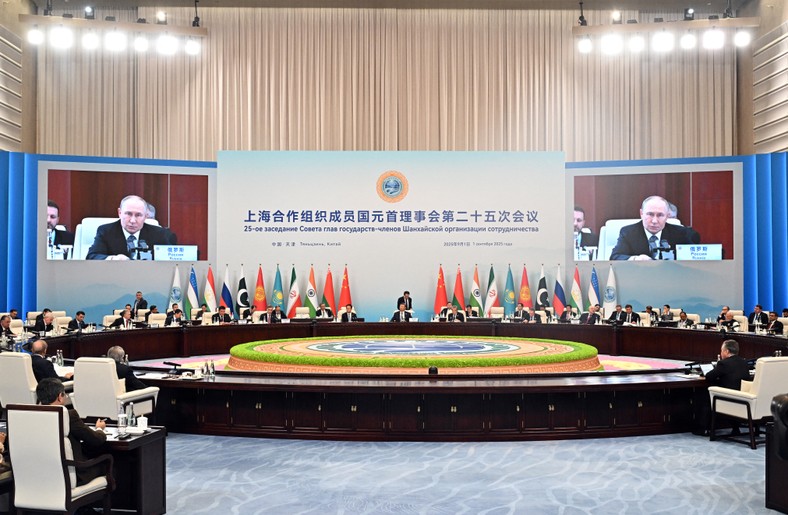
Vladimir Putin during the summit of the Shanghai Cooperation Organization, Tiencin, September 1, 2025.
It may sound visionate, but would investors risk buying bonds issued by mosaic, szow countries with contradictory credit ratings, divergent monetary policies and low transparency? Even if China took the risk, “SZOW bonds” would look like a Chinese instrument dressed in borrowed clothes.
There is also a practical issue of consistency. SZOW is a collection of competition, as well as a series of partnerships: India and China look at each other with distrust across the border, members from Central Asia jealously guard their sovereignty, and Turkey plays two fronts – one foot remaining in NATO.
The agreement of the credible framework of joint loans requires deep trust, harmonized supervision and legal security. None of these things currently exist within the block of flats.
Oil from Russia
However, when the IMF enters during the crisis, investors at least know what to expect. Conditions may be difficult, but the rules are clear, the data is verified and the management board is in front of the Member States. SZOW or BRICS instruments do not offer such predictability.
While Putin gave a speech about the financial revolution, real negotiations took place elsewhere and concerned oil and gas pipelines.
Russia is the second largest oil exporter in the world, and its two largest clients are China and India. Both countries demand significant discounts since the sanctions are applied through the West. The new Washington duties on the import of India, which do not apply to China, changed the situation.
Beijing can calmly wait and put be ups down, while Delhi has all the reasons to negotiate in a more decisive way due to the last duty imposed by Trump's administration. This was probably a message when Modi and Putin got into the limousine of the Russian president on the margins of the meeting. It was not about lofty visions of multipolaity, but about cold arithmetic about how cheap oil will be for India.
Then there was a surprise in Shanghai: a message about progress in the case of the long -discussed pipeline Siberia 2, for the first time proposed in the middle of the first decade of the 21st century as an Altai pipeline.
After years of stagnation in conversations, the project returns, and Moscow desperately tries to redirect gas, which once pumped to Europe. If this pipeline is ever built, it will be much more important for Russia's financial results than any fantasies about SZOW bonds.
However, the first pipeline is a warning: China secured a 30-year agreement worth $ 400 billion. (PLN 1.4 trillion) at prices lower than those paid by Europe, showing how much Beijing has the advantage.
Weak substitute
Beijing's advantage has only increased since the invasion of Ukraine, because China has become a key partner of Russia in celebrating Western sanctions. Beijing buys goods at reduced prices and provides financing, which European markets currently avoid.
Putin's great gestures in Tiencin will be assessed not on the basis of bonds, but on the basis of barrels and concessions. This emphasizes the simple truth: despite all conversations about joint debt and financial emancipation, The real influence in szow is due to energy.
Oil and gas maintain a Russian economy on the surface, and energy diplomacy drives the balance of power in the block. Great plans for alternative financial orders go to the headlines, but they are barrels sold at a reduced price or pipelines promised China actually finance the war in Ukraine.
Of course, Putin is right. The IMF and the World Bank remain developed by the economy, and the dollar supremacy gives Washington an incomparable arsenal of sanctions. Emerging economies are right, demanding a stronger voice. However, the solution is the reform of existing institutions, not creating weak substitutes that are unable to gain investors' trust.
Passwords about “neocolonialism” can meet with applause in Tiencin. However, finances are ruthless. Bonds without buyers are worthless. Institutions without credibility are only a facade.
If Putin really wants to challenge the dominance of the West, he should start with the protection of the independence of the authority, which enjoys respect in Moscow – a Russian central bank – instead of challenging it with the help of politics.
Szow can ultimately transform in a forum of economic importance greater than symbolic. For now, however, his great declarations will remain only declarations. Bonds without buyers are just empty promises.
Until then, Szow will still be better to handle messages than loans.