The consultations of the president Nicușor Dan with the magistrates, “a process of mediation”. What experts say about the referendum for magistrates


President Nicușor Dan summoned the magistrates to consultations on the functioning of the justice system, announcing at the same time an initiative not foreseen by the law, which analysts do not give much chance to.
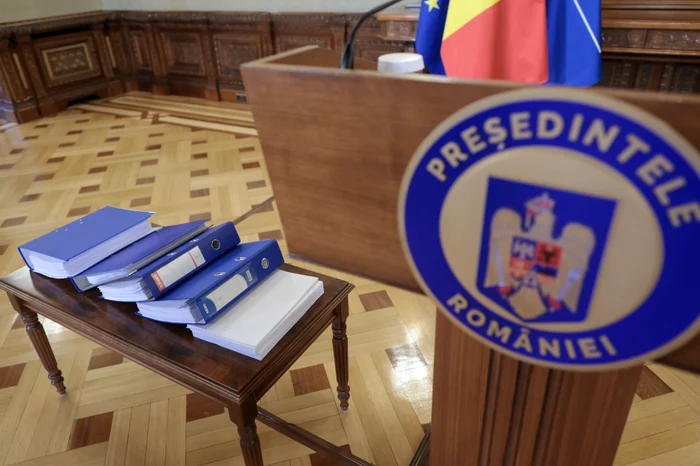
PHOTO Inquam / George Călin
The consultations of President Nicușor Dan, held on Monday, December 22, at the Cotroceni Palace, fall within the powers of the head of state, but experts emphasize that they must be followed by other “steps of an institutional nature”:
“It is about the mediation procedure that the president sets in motion. The president contacts those who wanted to come to these meetings. I understand that some of them are the representatives of the associations of prosecutors, respectively judges. We will see what the next steps will be. They must be steps of an institutional nature to allow the situation to be unblocked. (…) The problems in justice are very delicate. Because there is not one truth and several truths. There is the perspective that they have presented to the participants of the consultation and there is, as I understand it, the Judicial Inspection which mentioned that some of the issues reported and discussed in the public opinion were investigated by them. As long as the Judicial Inspection and the CSM will be controlled by a group of magistrates, it is very difficult for these two truths to harmonize”, explained Ioan Stanomir, professor of constitutional law at the Faculty of Political Sciences of the University of Bucharest, for Adevărul.
A referendum for magistrates, “impossible”
The head of state also announced the preparation of a “referendum” in January, for the consultation of the magistrates regarding the following question: “Does the Superior Council of Magistrates act in the public interest or does it act in the interest of a group within the judicial system?”, an approach that attracted criticism in the public space, in the context in which the head of state emphasized that the unfavorable results should lead to the departure of the entire CSM team.
“What the president proposes is very difficult to do, if not impossible. There are two aspects. First of all, the national referendum concerns all citizens, referendums cannot be held for social categories. There are local referendums, but those do not concern the president. They concern the local communities. And regarding the revocation of CSM members, if we look carefully at the law, we find that it depends on the vote of the magistrates and the intervention of the Judicial Inspection. And it is completely different situation. And they cannot be revoked en masse, they can only be revoked individually”says professor Ioan Stanomir.
Why the initiative would have no result
“Regarding the referendum, no, it is not possible to hold a referendum. The Constitution of Romania provides that the president, after consulting the Parliament, can call on the people to express their will, through a vote, on an issue of national interest. That's all. That's all it says in the Constitution. In the law is the Referendum Law, which tells us that local referendums can be organized, on administrative units, on communes, on counties. But the referendum has not yet been invented”. points former CCR president Augustin Zegrean.
Moreover, this referendum would not even have any result, he points out: “They can be revoked, but not all at once. Disciplinary issues are provided for in the law, the procedure is provided for in the law and it is very complicated and can take a year, maybe even more, because, in the end, any decision that is made can be appealed to the High Court of Cassation and Justice.”
On the other hand, at the Victoria Palace, regarding the prime minister's initiative to form a working group that will analyze the justice laws, the former president of the CCR emphasizes that if the head of the Government “he made a working group without magistrates, and it's not good at all.”
A competition between Palaces
Professor of political and legal sciences Radu Carp explains that the initiatives of Prime Minister Ilie Bolojan and President Nicușor Dan indicate “a competition” between the two palaces, this one having the potential to give “an unexpected boost to radical political forces”:
“If we look carefully, we see that there has been this competition in recent weeks. It starts, I think, from the projections that the two leaders make on their political future. Nicușor Dan knows very well that he will not be compared with Klauș Iohannis, in the short term, but with Bolojan's performances while he was interim president. Bolojan knows very clearly that he cannot go further with the reform, if he does not have the support of the President of Romania. On the other hand party, he is the one who leads the current coalition”, says professor Radu Carp, indicating that “this is the architecture of the political regime”, “there was always a president-prime minister competition because of the presidential system.”
However, the process initiated in Cotroceni has the potential to stop the one at the Victoria Palace, he added: “That's how I look at him. It would be an approach that has as its final objective the stopping of the Government's approach. Because the Government will set up this working group and follow the normal procedures. And certain problems will be identified and legislative solutions will come up”.
The threat from Parliament
The consultation meetings convened at the Victoria Palace and the referendum among the magistrates announced by the head of state are not the only steps taken so far. The president also asked the magistrates to write to him to present the problems they are facing. A report of the observations submitted so far by the magistrates indicates “an accumulation of structural vulnerabilities of the justice system which, in the absence of corrections, are claimed to have led to and have the ability to accentuate the erosion of the internal independence of magistrates (especially in the case of judges), the quality of the judicial act and public trust”.
In parallel, the Judicial Inspection published another report, right during the discussions in Cotroceni, in which it states that many of the facts that have sparked controversy in the public space in recent weeks, with the broadcast of the Recorder-Captured Justice documentary, have already been verified.
In the context of the initiatives announced by the head of state, he also faces threats of dismissal from Parliament. Both the Senate group, PACE-Întâi Romania, and AUR, announced their intention to start the procedures for the suspension and then the dismissal of the President of Romania. So, in the Parliament, the gathering of signatures is called for the dismissal of the president. The approach can be started with the signatures of more than 154 parliamentarians, but approval is needed in plenary. To pass the vote of the Parliament, a majority is needed. There are 464 parliamentarians in total, that is, the initiative needs 233 votes.