XI Jinping asked for a stricter regulation of “religious affairs” and a “guidance” of Tibetan Buddhism in a rare visit to Tibet

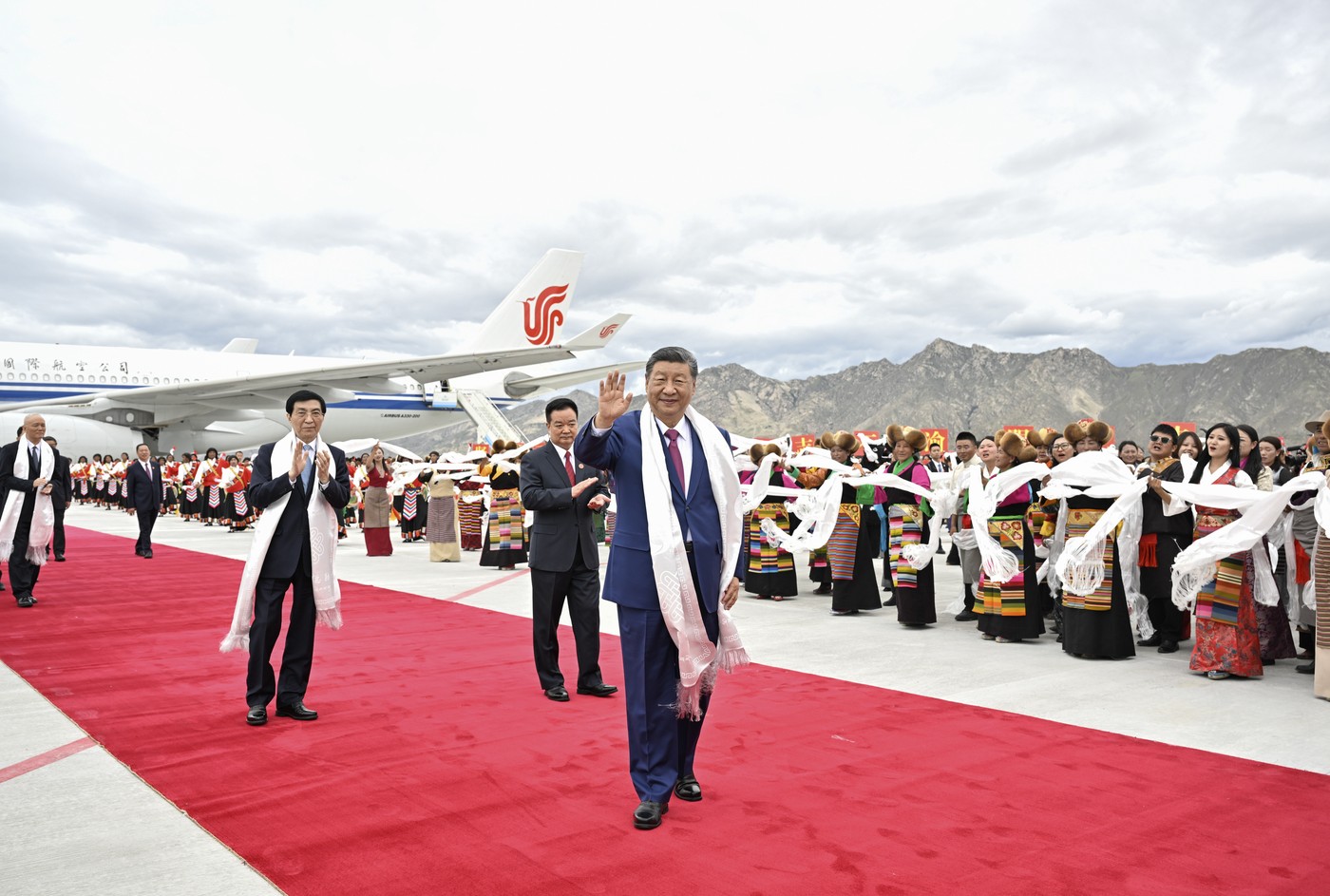
President XI Jinping urged a unit in a rare visit to Tibet, appearing in front of 20,000 people to mark 60 years since the creation of the autonomous region, writes BBC.
In his second presidential visit in the strictly controlled region, XI praised the local government for “his commitment to fight against separatism”-a reference to Tibetan resistance to Beijing, for decades.
The visit to Lhasa, who is at an altitude that could pose 72-year-old health problems, suggests the desire to strengthen his authority on the region.
The comments published by XI have not mentioned the Dalai Lama, the Tibetan spiritual leader who has lived in exile in India since he fled in 1959.
“In order to govern, stabilize and develop Tibet, the first thing is to maintain political stability, social stability, ethnicity and religious harmony,” said XI, according to an official summary of his speech.
The visit of Xi on Wednesday takes place just two months after the Dalai Lama announced that his office, not China, will choose his successor. However, the leaders of China claim that only they have the power to manage this decision.
China has long argued that Tibetans are free to practice its religion, but this faith is also the source of a centuries -old identity, which human rights groups say Beijing is slowly eroding.
When the BBC visited a Tibetan monastery in the province of Sichuan in June, the monks claimed that the Tibetans are denied human rights and that the Chinese Communist Party (PCC) continues to “oppose and persecute them.”
Beijing states that the standard of living of the people of Tibet has improved considerably under its leadership and denies the suppression of human rights and freedom of expression.
The party founded what it calls the Tibet Autonomous Region in 1965, six years after a failed revolt against Chinese domination.
The surprise visit of the Chinese president was the main news in all newspapers and state TV bulletins on Thursday, where Xi's tour in the Tibetan capital, Lhasa, was presented as a holiday.
The photographs published on the first pages of the newspapers showed him by the Tibetan dancers and by the crowds who were acclaimed.
During his meeting on Wednesday with the local authorities, attended by High leaders of the CCC, the Chinese president encouraged the bilateral economic, cultural and staff exchanges to and from Tibet, as well as the popularization of a common national language and characters.
XI also emphasized the PCC vision for Tibet and highlighted what it considers to be the four major tasks of the region: ensuring stability, facilitating the development, protecting the environment and strengthening border, said the Chinese state press.
PCC policies have included new laws that regulate the education of Tibetan children, who now have to attend Chinese state schools and learn mandarin.
XI also asked for a stricter regulation of “religious affairs” and a need for “guidance of Tibetan Buddhism to adapt to socialist society”.
The visit also takes place one month after the PCC has begun the construction in the region of what will be the largest dam in the world. The dam – also known as the Motuo hydroelectric power plant – is located on the Yarlung Tsangpo river, which flows through the Tibetan plateau.
When it will be completed, it will exceed the three decks as the largest in the world and could generate three times more energy.
Beijing states that the project, whose cost is estimated at 1.2 trillion Yuan ($ 167 billion; 125 billion pounds), will prioritize ecological protection and will stimulate local prosperity.
But experts and officials have expressed concern that the new dam would allow China to control or deviate the cross-border course of Yarlung Tsangpo, which flows south in the states of Arunachal Pradesh and Assam from India, as well as in Bangladesh, where they flow into the rivers of Siang, Brahmaputra and Jamuna.