
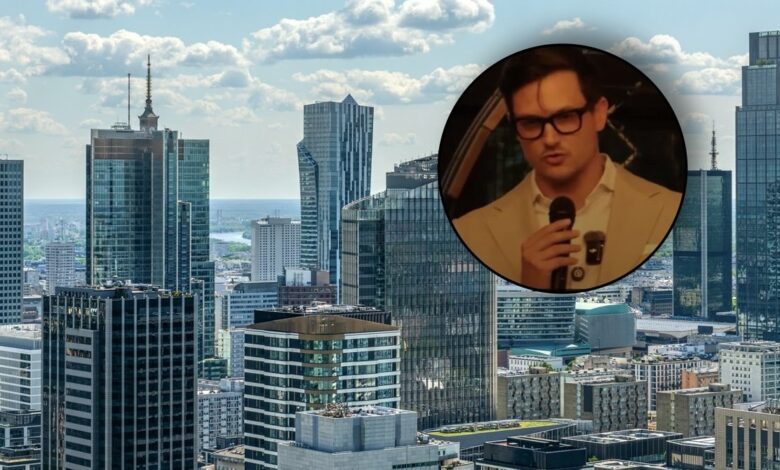
Last year, approximately 4,941 Germans relocated to Poland, while just over 1,700 returned to Germany. Among those who made the move is Kevin Wörner, a 33-year-old businessman who traded Frankfurt for Warsaw. He was captivated by the city’s rapid development, cost of living, and the proactive attitude of its residents. “In Germany, people complain; in Poland, they take action,” he stated in an interview with focus.de.
Wörner now operates a 120 square meter office in the heart of the capital, employing about 20 staff members, half of whom are on full-time contracts while the others work as freelancers. Initially, he relied solely on remote collaborators, but has since embraced a more substantial team presence in the office, valuing the atmosphere and the city’s skyline view.
From Frankfurt to Warsaw via China
Wörner, who studied management, previously worked at Roland Berger and lived in China for three years. During his time in Shanghai, he began to perceive the slower pace of life in Germany, especially in Frankfurt, where he grew up.
After spending a year as a digital nomad in locations like Miami, Bali, and Zurich, he developed social media channels for various industries. His initial perception of Poland was vastly different from his current experiences. Although his mother is Polish, he visited the country only a handful of times as a child, forming memories of family gatherings and the nature of Mazuria but associating Poland with grayness, neglect, and its communist past.
Wörner recalls stereotypes among his schoolmates, including jokes about car thefts, with most of his family having previously emigrated to the United States.
Warsaw Transformed His View of Poland
His longer trips to Poland began about two years ago, sparked by articles on the dynamic development of Eastern Europe and encouraged by his former partner, which led to more extended stays in Warsaw.
From his first visit, Wörner was impressed by the city’s modernity, contactless payment options, new skyscrapers, and the energy of its inhabitants. He believes optimism and a faith in the future are more palpable in Warsaw than in Berlin, Frankfurt, or Munich, where discussions often revolve around what is not working in the country.
He also contrasts Warsaw’s cleanliness to Frankfurt’s train station and shares his experiences with Deutsche Bahn.
Safety in Warsaw: Personal Experiences
While Wörner views safety positively, he emphasizes his personal experiences. He feels comfortable traversing the train station without fear of attack, although he admits that at 1.95 meters tall, muscular, and having trained in martial arts for a decade, he possesses an advantage.
He recounts everyday situations, such as having left his phone at a café and his motorcycle with the keys in the ignition—both items remained untouched.
However, he notes that simply comparing crime statistics between Poland and Germany can be misleading due to differences in how offenses are classified. For violent crimes, both countries report similar figures.
Cost of Living in Poland: A Changing Landscape
Cost of living is another advantage Wörner cites for Poland, although he acknowledges that the situation is evolving rapidly. Initially, the difference was more significant, but he observes that prices are rising, and property costs are becoming comparable to those in Germany. Presently, he pays about 10% less for office rent in Warsaw, yet believes overall living expenses, especially dining out, are noticeably lower.
He also points to the wide array of options available for health-conscious individuals.
As a business owner, Wörner comments on the popularity of B2B collaborations, resembling self-employment, as many choose this route due to lower contributions. Nonetheless, he notes the challenge of rising living costs, stating that wage growth is not keeping pace with increasing expenses.
For him, the current scenario remains beneficial as an employer.
Germans Discover Warsaw: Friends Following Suit
Wörner grew up bilingual, but his Polish proficiency waned over time due to lack of practice. He has since regained a solid command of the language, often mistaken for someone from Silesia due to his slight accent.
He believes that non-Polish speakers can still build careers in Poland if they are proficient in English, highlighting numerous international events, startup meetups, and opportunities for networking.
Recently, he founded a community for German entrepreneurs over 40, which has already attracted 30-40 members who meet monthly.
Warsaw has enchanted several of Wörner’s friends, with three deciding to relocate after visiting him in recent months.
Planning a Decade in Poland
Wörner has moved out of his Airbnb and now rents an apartment in a modern complex in central Warsaw that offers amenities like a reception and gym.
He still travels to Germany every few weeks to visit family, friends, and clients but has no plans to return permanently. He expresses his intention to remain in Poland for the next ten years, asserting that while Germany was once his home, he would not want to live there again.


