June 11, 1934
A meeting of Chelyuskin heroes took place in Birobidzhan. The newspaper “Birobidzhan Star” (12+) covered this large-scale event for the region:
“…Since one o'clock in the morning, numerous ranks of workers were waiting for the train. They joked, laughed and waited. But there was no train… Two. Three hours. And no one leaves the station. Waiting. Waiting. The first morning stripes of dawn appeared in the east. And people are waiting. And now – the semaphore is open! An express train showered with electric bulbs rushed across the plain like a fiery meteor. An orchestra struck up. Excited people poured out exclamations, greetings in different languages.”
Clippings from the newspaper “Birobidzhan Star”. Photo: Photo: Regional Library
The head of the expedition, Ilya Leonidovich Baevsky, in his response, spoke about the excitement with which the Chelyuskinites met the message on the way about the creation of a new autonomous region:
“This is a huge victory for Lenin’s national policy.” “I,” recalls Comrade. Baevsky, I remember how we financed Birobidzhan at the All-Union State Planning Commission and supplied it with cars. This was 2.5 years ago. Then your comrades came to us. I thought about visiting Birobidzhan before, but, as you can see, I was delayed in the Arctic due to unforeseen circumstances.
The crowd is electric. The crowd expresses its joy with applause and cheers. And after a few minutes a soft conversation begins between the Chelyuskinites and the workers of Birobidzhan.
The carriages begin to slowly sail away from the station. The crowd watches them for a long time. Greetings, smiles and more greetings. And one can feel in the voices the great joy and great pride of the working people in their Chelyuskin heroes. One can also feel in the voices of the working people of Birobidzhan what we call revolutionary patriotism.
And the workers of Birobidzhan saw off the heroes of the Arctic for a long time with excited shouts and glances. The train leaves for Moscow.”
June 11, 1935
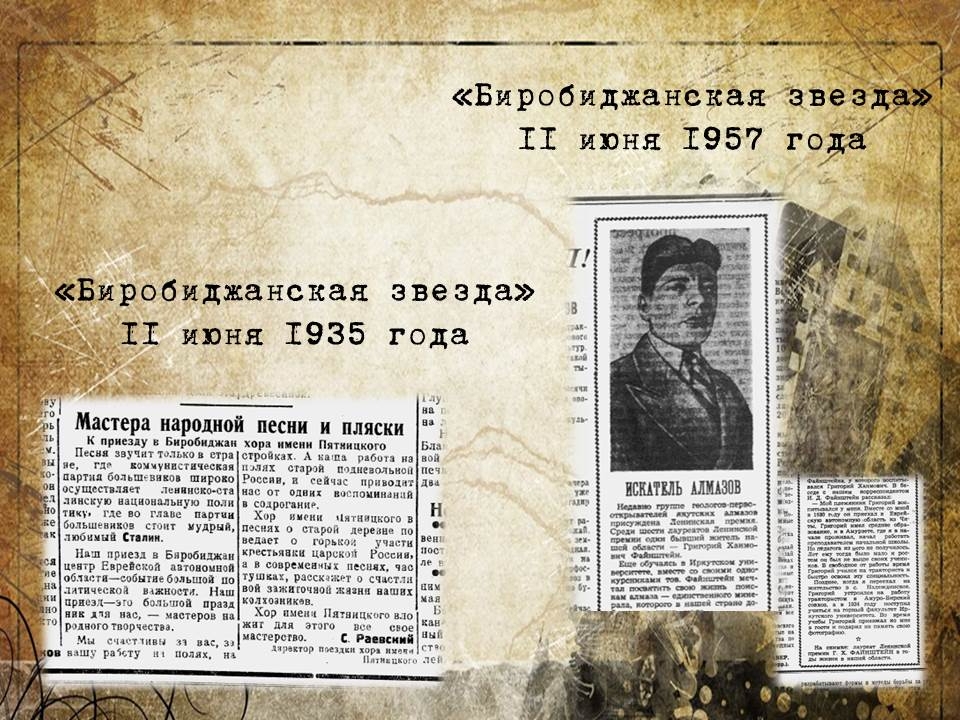
Clippings from the newspaper “Birobidzhan Star”. Photo: Photo: Regional Library
The newspaper “Birobidzhan Star” on June 11, 1935 reports the arrival of the Pyatnitsky choir to Birobidzhan. The director of the choir trip, S. Raevsky, said:
“Our arrival in the center of the Jewish Autonomous Region is an event of great political importance. Our arrival is a great holiday for us, masters of folk art. We are happy for you, for your work in the fields, on construction sites. The Pyatnitsky Choir will show in songs about the old village, tell about the bitter fate of the peasant women of Tsarist Russia, and in modern songs and ditties will tell about the happy, prosperous life of our collective farmers. The Pyatnitsky Choir will put all their skills into this.”
June 11, 1957
The newspaper “Birobidzhanskaya Zvezda” wrote on June 11, 1957 that a group of geologists who discovered Yakut diamonds had been awarded the Lenin Prize. Among the six Lenin Prize laureates, there is one former resident of our region – Grigory Khaimovich Fainstein.
While still studying at Irkutsk University, Grigory dreamed of devoting his life to searching for diamonds. But only after the end of the war was the Tunguska Diamond Expedition created. Grigory Fainstein was appointed head of one of three search groups. The participants of the Tunguska expedition decided, due to the savings achieved, to carry out additional exploration in the Vilyui River basin. The Vilyui party was led by Grigory Khaimovich, and the search was crowned with success, the first Vilyui diamond was found.
Grigory Khaimovich came to the Jewish Autonomous Region in 1930 from Chita. Gregory had a secondary education, and began working as a primary school teacher in Amurzet.
“But he did not turn out to be a teacher. He was young at the time and taller than his students. In his free time, Grigory studied to be a tractor driver and quickly mastered this specialty. Later, Grigory got a job as a tractor driver at the Amuro-Birsky state farm, and in 1934 he entered the mining department of Irkutsk University to study.”
June 11, 1965
The border outpost of the village of Leninskoye was named after Pyotr Petrovich Kagykin. At the entrance to the outpost there is a bust of the Hero. Kagykin’s bed has been preserved in one of the barracks, and there is also a corner in his memory at the outpost. Every day the name of the Hero is heard.
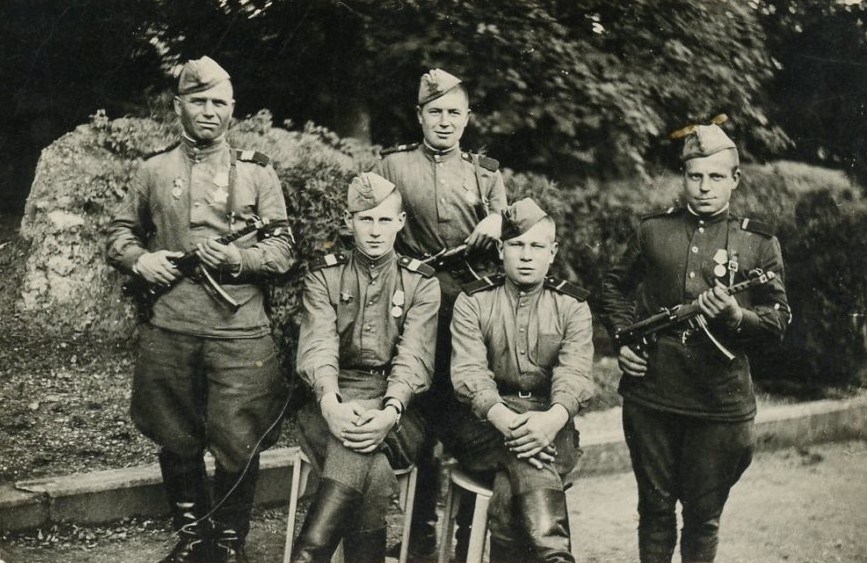
Peter Kagykin. Photo: Photo: State Archive of the Jewish Autonomous Region
One of the streets in the village. Leninskoye and the adjacent lane are named after Pyotr Kagykin. It was on this street that the centenary of the Hero’s birth was celebrated.
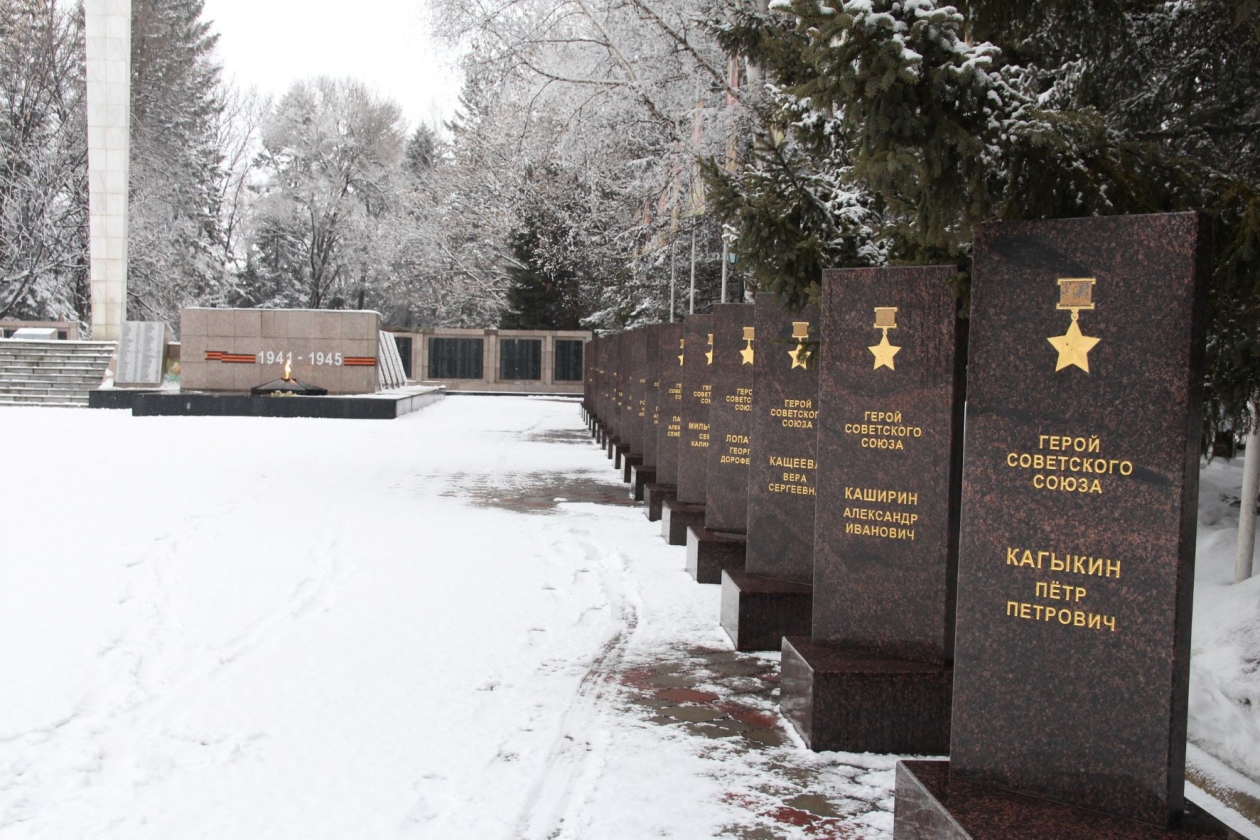
Victory Square. Photo: Photo: Regional Library
The memory of Pyotr Kagykin, whose last name is embossed in gold on the granite slab of the Alley of Heroes in Birobidzhan, is preserved not only in our region, where he lived for eight years. On the recently restored memorial, which is located on Glory Square in Khabarovsk, among the four Far Eastern border guards – Heroes of the Soviet Union – there is the name Kagykin. He is also included in the lists of Heroes of the Altai Territory, as well as the city of Novokuznetsk, Kemerovo Region.
June 11, 2002
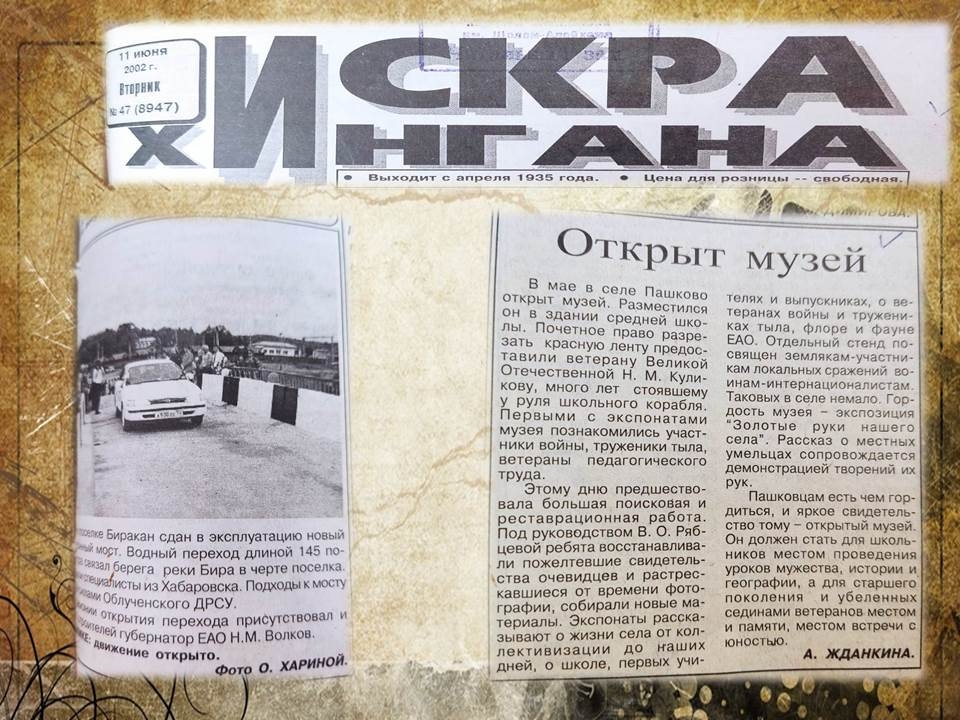
Clippings from the newspaper “Birobidzhan Star”. Photo: Photo: Regional Library
The Obluchensky district newspaper “Iskra Khingan” (12+) wrote on its pages on June 11, 2002 that a new reinforced concrete bridge had been put into operation in the village of Birakan. A water crossing 145 linear meters long connected the banks of the Bira River within the village.
The newspaper contains information that a museum has been opened in the village of Pashkovo, Obluchensky district, which is located in the building of a secondary school. The opening of the museum was preceded by extensive search and restoration work. Under the leadership of V.O. Ryabtseva’s guys restored yellowed eyewitness accounts and photographs cracked by time, and collected new materials.
The museum exhibits tell about the life of the village from collectivization to the present day, about the school, the first teachers and graduates, about war veterans and home front workers, the flora and fauna of the Jewish Autonomous Region. A separate stand is dedicated to fellow countrymen who participated in local battles and internationalist warriors. The pride of the museum is the exhibition “The Golden Hands of Our Village” – this is a story about local craftsmen, which is accompanied by a demonstration of their creations.