
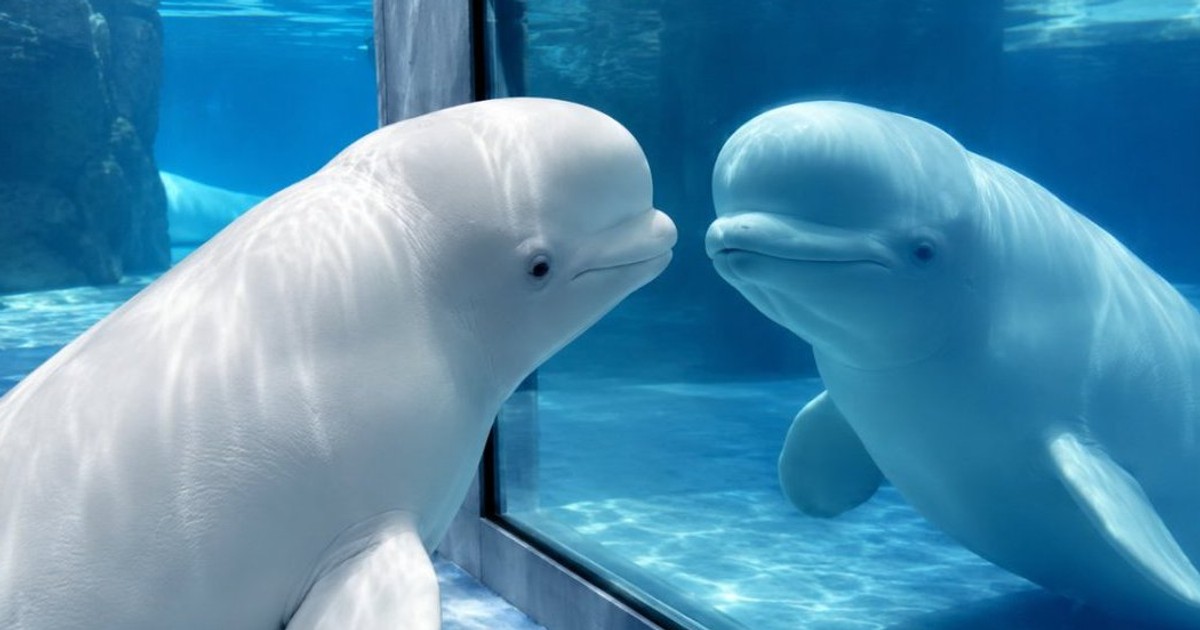
The study concerns one of the most interesting issues in contemporary animal cognitive science – the ability to recognize oneself in the mirror (Mirror Self-Recognition, MSR). This skill is widely recognized as advanced self-awareness indicator and for many years it was considered a uniquely human trait. So far, positive results have only been obtained in a small number of species, including chimpanzees, bonobos, orangutans, gorillas, Asian elephants, magpies and bottlenose dolphins.
The aim of the study published in the prestigious PLOS One magazine was to check whether Arctic beluga whales (Delphinapterus leucas) exhibit the ability to recognize one's own reflection in a mirrorrecognized as one of behavioral indicators of self-awareness. The authors wanted to determine whether beluga whales go through the typical stages observed in species passing the mirror test: from social reactions, through testing the relationship between their own movement and reflection, to self-directed behavior and a positive result of the marker test.
Method
The study was conducted on four female beluga whales at the New York Aquarium. The animals were exposed to:
- a real mirror
- transparent control surface
The group included three adults and one 7-year-old female, Maris, born in the aquarium. The animals had no direct contact with mirrors before, although they could observe their own reflections in the pool windows. The experiment consisted of two stages.
In the first phase, scientists placed a large mirror or a transparent inspection plate next to the pool glass. They then analyzed the whales' behavior. In classic MSR studies, animals typically go through several stages:
- initially they treat the reflection like another animal
- then they do unusual ones movements checking the relationship between one's own behavior and the image in the mirror (so-called contingency testing)
- then they start use a mirror to observe your own body
Results
Of the four two beluga whales (mother Natasha and her daughter Maris) they spent much more time at the mirror than at the control surface and exhibited behaviors typical of self-recognition, such as:
- unusual movements testing the relationship between one's own movement and reflection
- looking at different parts of your own body
- spinning, playing with air bubbles and objects in front of the mirror
7-year-old Maris performs barrel rolls in response to a mirror placed in the pool, in which she recognized her reflection
|
Alexander Mildener, Diana Buchman, Sonia Ragir, Diana Reiss / PLOS One
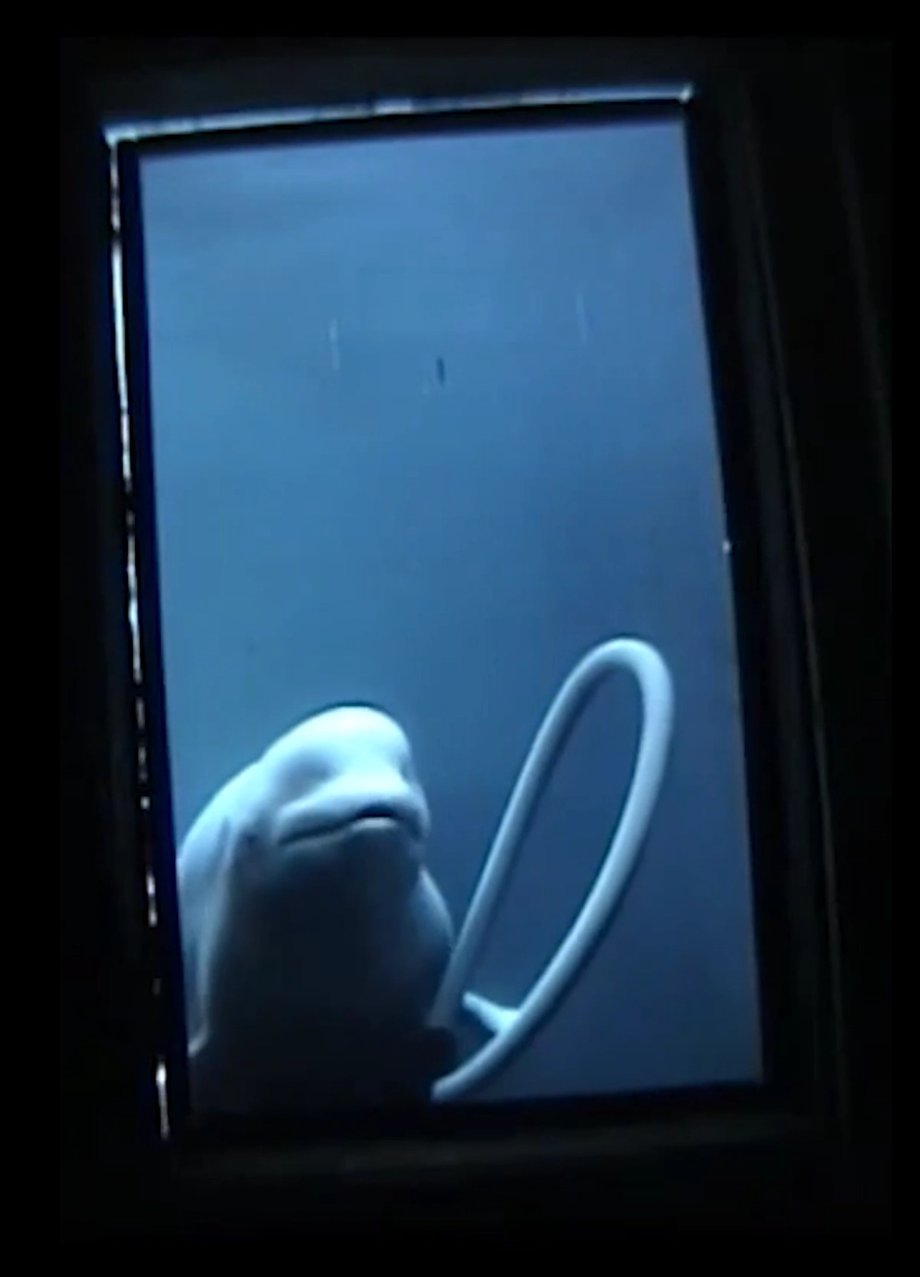
Natasha plays with a toy in front of the mirror
|
Alexander Mildener, Diana Buchman, Sonia Ragir, Diana Reiss / PLOS One
Tag test
The second stage of the study was performed only on Natasha and Maris, because only they showed signs of recognizing their own reflection. This stage included the so-called marker test – a mark was placed on a part of the body that was invisible without a mirror and it was checked whether the animal used a mirror to view it. If an individual uses a mirror to view a sign, this is considered one of the strongest pieces of evidence of visual self-awareness.
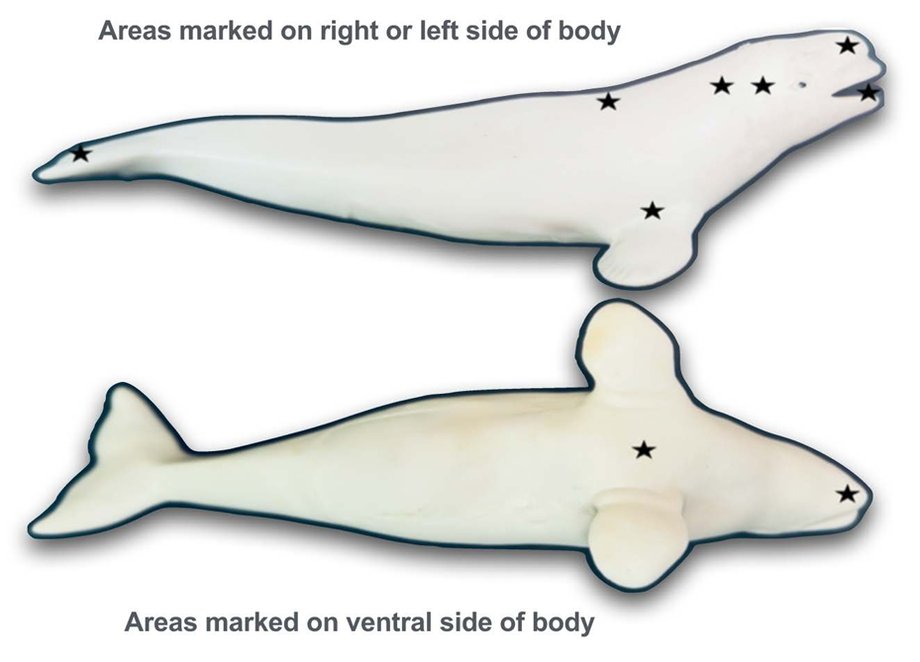
Mirror test – places of markers visible only in the reflection of the mirror
|
Alexander Mildener, Diana Buchman, Sonia Ragir, Diana Reiss / PLOS One
Both visible markings and the so-called “shame marks” – apparent markings invisible to the animal that served as a control for the effect of touch itself during marking.
Results
The most convincing results were obtained with Natasha. In the third mark test, the female was marked behind the right ear opening – a place that is not visible without a mirror. After marking She repeatedly positioned herself to observe the marked part of the body in the mirror. She spent significantly more time in front of the mirror than before the markingand about 85% of the time spent at the mirror after marking was devoted to exposing the marked area. Additionally, she performed a number of unusual self-directed behaviors that did not appear in other sessions. The authors recognized this one result for meeting the criteria for passing the mirror test.
Young Maris has not formally passed any sign test. Despite this, she displayed a rich repertoire of self-directed behaviors similar to those observed in adult Natasha. According to the authors, this may suggest a partially developed ability to recognize oneself, although the lack of a clear test result does not allow for equally strong conclusions.
Conclusions
In the discussion, the authors emphasize that the ability to recognize oneself in a mirror does not have to be identical in all species. Animals that lack limbs that enable touching markings—such as whales and dolphins—may demonstrate self-awareness primarily through self-directed behaviors. For this reason alone the sign test may not always be the only or best evaluation criterion, especially in the case of animals that often use senses other than vision.
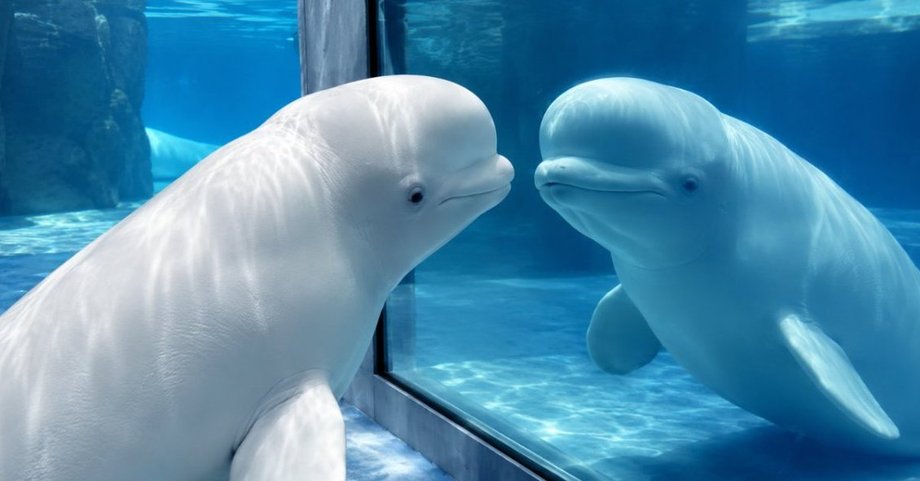
Belarusians pass the mirror test – proof that they have self-awareness
|
DALL-E / x@CurioSphereX
The study has great evolutionary significance. The results suggest that self-awareness may be more widespread among cetaceans than previously thought. The authors associate it with large brain sizetheir complex social life, developed communication, the ability to learn vocally and documented ability to imitate the behavior of other individuals. These results reinforce the idea that advanced forms of self-awareness have evolved independently in several distant groups of animals and are not exclusively the domain of humans and primates.
Still Norway, Iceland and Japan allow commercial whale huntingand the USA (Alaska), Canada, Russia (Siberia) and Denmark (Greenland) still allow traditional slaughter of whales and dolphins.
As a consolation, there's a video of a cat that has just gained self-awareness.


