NASA is testing the “silent” supersonic plane this month, with the promise of a new era in commercial aviation

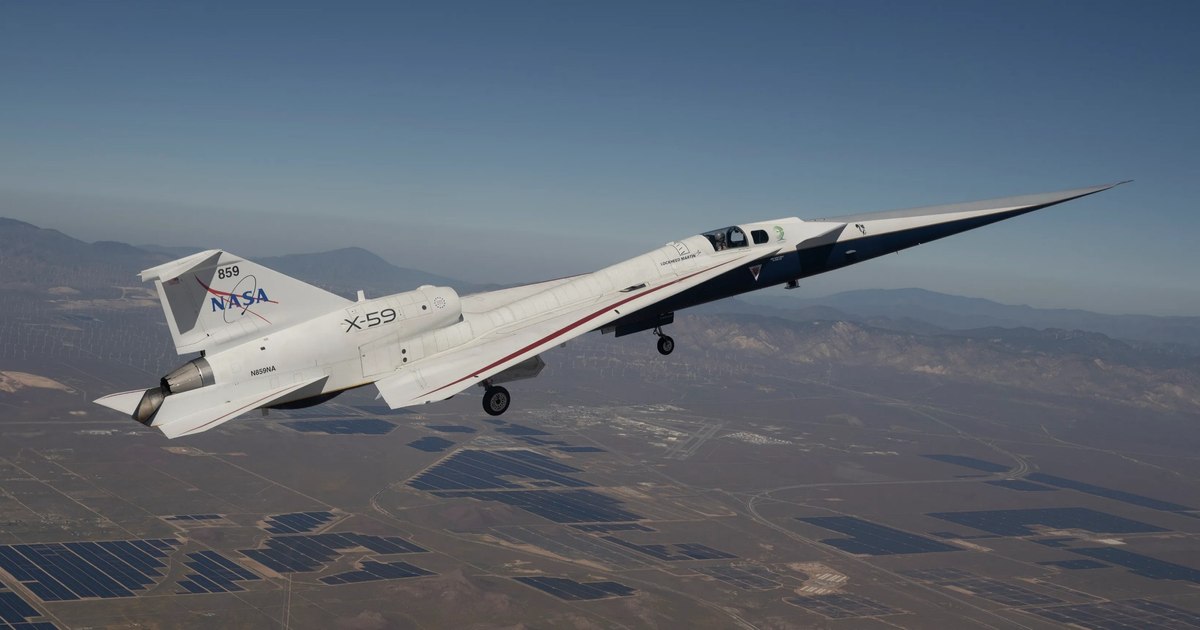
The United States is on the brink of a technological and legislative revolution that could reopen the skies to commercial supersonic flights, more than half a century after they were banned over the American continent. This month, NASA's X-59 experimental aircraft is set to fly beyond the sound barrier for the first time, a watershed moment for a program that aims to permanently eliminate the biggest impediment to ultrafast aviation: the sonic boom.
NASA's supersonic plane, X-59/PHOTO:X
“We are moving towards the test point of the mission conditions for which the X-59 was designed,” the US space agency announced. The objective is ambitious but calculated: to demonstrate a technology capable of reducing the deafening noise of exceeding the speed of sound to a mere “thump”, perceptible on the ground without causing damage or discomfort.
A radical geometry against the laws of physics
The X-59 is not just a new high-speed plane, but a flying laboratory with an elongated, almost unrealistic geometry. This extreme aerodynamic silhouette was specifically designed to prevent the shock waves from merging into a traditional sonic boom, which in 1973 led the US authorities (FAA) to ban civilian supersonic flights over land due to the destructive and disruptive impact on the population and buildings.
After a first test flight in October 2025 and 14 more calibration missions since early spring this year, the device is ready for the ultimate test. According to NASA's planning, the X-59 will reach a speed of Mach 1.4 (about 1,489 km/h) at an altitude of 16.7 kilometers.
“What follows is the first time this unique aircraft will fly supersonic,” explains Cathy Bahm, NASA's Low Boom Flight Demonstrator project manager. “Completing the first flight under mission conditions is particularly significant – it's when we begin to validate the aircraft in the environment it was created for.”
XVS technology: piloting in a cockpit without a windscreen
Aeronautical performance also required avant-garde engineering solutions. Due to the extremely long and sharp nose, the designers had to completely abandon the classic front windshield, because the pilot would not have visibility of the trajectory.
In place of the traditional glass, NASA implemented the eXternal Vision System (XVS): a suite of high-resolution cameras captures real-time images from the front of the device. The data is processed and projected onto an augmented reality screen placed directly in front of the pilot. The result provides a perfect digital panoramic perspective, from which the massive nose of the plane is completely removed visually so as not to block the horizon.
In recent weeks, the program has ticked off major milestones. The X-59 has already reached a speed of Mach 0.95 (1,009 km/h), successfully completed its first two flights on the same day, and tested the landing gear retract in flight, giving engineers confidence that the complex systems are fully stable and ready for the critical phase of the program.
From the experimental phase to commercial reality
This month's scheduled flight officially concludes “Phase 1” of the program, dedicated to aeronautical safety and low-speed performance. Later in the second part of the year, NASA will launch “Phase 2”, the crucial stage in which the aircraft will fly over communities in the United States to measure, with the help of ground sensors and feedback from the population, the effectiveness of the “Quiet Supersonic” technology.
The data collected will be handed over to global regulators to rewrite the rules of international civil aviation, paving the way for a new generation of airliners.
Unlike the era of the famous Concorde – a technological triumph but a commercial failure due to flight restrictions and massive costs – the new supersonic wave relies on economic sustainability and social acceptance. In addition to NASA, private companies such as Boom Supersonic (Colorado) are already developing similar projects. Last year, Boom achieved its first successful supersonic flight with a civilian demonstrator over US territory, signaling that the market is ready for a change.
The potential benefits go far beyond luxury tourism or transoceanic business travel. Halving global flight time could revolutionize emergency medical transport, disaster rescue missions and global logistics.