The former industrial county that relies on energy. Huge investments for 2,500 MW, at Mintia, Retezat and Paroșeni

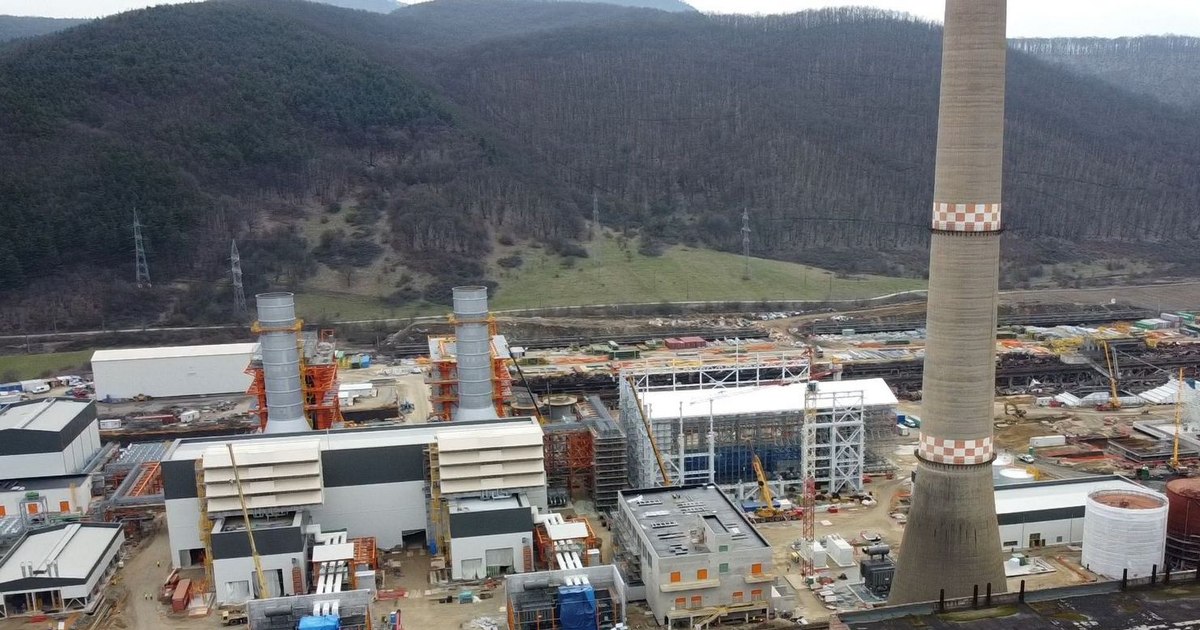
Hunedoara could once again become one of the great energy centers of Romania, through the investments announced in Mintia, Retezat and Paroșeni. The new projects aim at re-technologically upgrading the Mintia thermal power plant, modernizing the Retezat hydropower plant and the Paroșeni thermal power plant after abandoning coal.
Mindia thermal power plant. Photo: Daniel Guță. TRUTH
The former industrial county of Hunedoara relies on investments in energy, favored by the energy infrastructure created in recent decades, to mainly support local industry.
In the past, one of the most industrialized counties in Romania, Hunedoara counted, at the beginning of the 90s, almost 100,000 employees in heavy industry.
Most of them worked in the coal mines in Valea Jiului, in the steel plant in Hunedoara, in the “Victoria” metallurgical plant in Călan, in the mechanical plants in the Orăștiei area and in the mining centers in the Poiana Ruscă and Metaliferi Mountains. Around this industry, in the second part of the 20th century, energy production developed, designed to ensure part of the needs of the national energy system and the operation of resource-consuming industrial centers.
In the 1950s, the Paroșeni thermal power plant was built, and in the 1960s, the construction of the Mintia thermal power plant followed, both based on the coal extracted from the Văii Jiului mines. In the 70s, the Râul Mare – Retezat hydropower development began, one of Romania's largest hydropower plants, continued in the 80s and 90s by the flurry of hydropower plants downstream, built on the Râul Mare and Strei. In the 1990s, the installed power of Hunedoara's power plants totaled over 2,000 MW, most of which was covered by the Mintia Thermal Power Plant, with over 1,285 MW, and the Retezat hydropower plant, with 335 MW.
Heavy industry has gone into deep decline since the 1980s, and most of the local mines and factories have ceased operations in the past three decades. Investments in energy slowed down after 1990, although they continued in the Streiului and Răului Mare valleys where several hydroelectric plants were built.
After the closure of the Mintia thermal power plant and the reduction of activity in Paroșeni, energy production in Hunedoara has decreased until 2024, to just over 700 MW, mainly from hydropower plants. The energy infrastructure of the county has been preserved, and the new investments announced could return Hunedoara to the first places in Romania in terms of energy production. In the coming years, if the modernization of the Mintia and Paroșeni thermal power plants and the modernization of the Retezat hydropower plant are successful, Hunedoara could add production capacities of almost 2,500 MW to the National Energy Systems.
The Mintia thermal power plant, completed in 2026
On site since 2024, after being acquired by Mass Group Holding in 2022, the Mintia Thermal Power Plant is being transformed from a former coal-based power plant into a modern energy complex with an installed capacity of over 1.7 GW, based on natural gas and state-of-the-art equipment supplied by Siemens. The private investment exceeds 1.2 billion euros and was made after the old thermal power plant on Mureș was stopped for good in 2021, and later the Romanian state sold it, through the judicial liquidator, for more than 91 million euros.
The new thermal power plant built on the bank of Mureș, near the municipality of Deva, was designed to use natural gas and is equipped with two gas turbines, one steam turbine and three Siemens SGen5-3000W generators.
“This project is very important for the stability of the energy sector in Romania, it is important for the local community and for employment opportunities. We already have around 950 workers, and very soon we will reach 1,000. We hope to go into production with the first gas turbine by June this year, and with the second, around August. Everything depends on the support of the authorities, including Transgaz and Transelectrica. Our target is to have combined cycle by in October of this year”, recently informed Shadi Abulkhair, director of Mass Global Energy.
At the same time, the components of the plant will be prepared for the transition to the new energy production technologies, based on hydrogen. Completion of the works is expected in 2026, and with it, Mintia will become the largest gas-fired power plant in the European Union, on a single site.
According to a recent press release from the Romanian Government, Mass Global Energy Rom has announced its intention to develop in Romania a new investment in BESS (Battery Energy Storage System) electricity storage capacities, worth approximately one billion euros.
The Retezat Hydropower Plant, in the process of being re-engineered
Another important power plant in Hunedoara will also be modernized. Hidroelectrica signed, on Thursday, the contract for the refurbishment of the Râul Mare – Retezat Hydroelectric Power Plant, a strategic project for the modernization and efficiency of the company's production capacities, worth 188.4 million euros, excluding VAT.
The energy colossus from Retezat is undergoing modernization after four decades. Huge investment at the Râul Mare hydropower plant
Although the plant has an installed capacity of 335 MW since commissioning, it has operated, for technical reasons, at approximately 200 MW, the restrictions being generated by the limitations of the existing equipment.
“Through the re-engineering project, approximately 135 MW more available in real terms will be recovered and integrated into operation, which will contribute significantly to the increase in production capacity, to the improvement of the system services provided by SEN and to the consolidation of Romania's energy security. The investment aims to prepare the plant for a new operational life cycle, by replacing the main electromechanical equipment and implementing modern technological solutions”. the company informed.
The Râul Mare – Retezat hydroelectric power station was inaugurated in the spring of 1986, after more than a decade of works, and remains one of the largest underground constructions of this type in Romania. It has a water fall of 582.5 meters and an equivalent volume of a 15-story building. Inside it are two Francis turbines, which add up to an installed power of 335 MW.
Due to deficiencies and wear and tear, the two turbines could not operate at full capacity. However, the hydroelectric plant in Retezat remained in the top of the hydroelectric plants, together with Portile de Fier I, Lotru and Portile de Fier II.
Image 1/15:
Lake Gura Apelor from Retezat Photo Daniel Guță THE TRUTH (50) JPG
The works on the Râul Mare – Retezat hydropower development began in January 1975. The plans aimed to build the Gura Apelor dam in Retezat, located at over 1,000 meters above sea level, the Gura Apelor reservoir and the downstream Retezat and Clopotiva hydropower plants, located in the Râului Mare valley. More than 12,000 people were involved in the project, from engineers specialized in the construction of dams and hydropower installations, to workers, young brigadiers, soldiers and even students who came to school camps.
More than nine million cubic meters of rock were used in the construction of the dam, and the Gura Apelor lake has a maximum area of approximately 420 hectares, a depth of more than 160 meters and a capacity of 210 million cubic meters of water.
The water is led through a concrete underground tunnel, over 18 kilometers long, to the Retezat power station, one of the main producers of electricity in Romania. Another secondary gallery, 30 kilometers long, captures the waters of the northern streams of the Retezat. Work on the dam continued until 1999, when it reached its final grade of 1,078.50 mdM. The maximum filling level of the lake, the final elevation, was reached by controlled filling only in August 2021, for a few days, during a period when its filling and retention capacity was checked.
The new Mintia thermal power plant, built in three years. The 1.7 GW investment brings almost 1,000 jobs
The Paroșeni thermal power plant, refurbished after 2030
Inaugurated in 1956, the Paroșeni Thermal Power Plant was the main energy producer in Valea Jiului, the mining region in the south of Hunedoara county, known for the richest coal deposits in Romania.
Its first three generators, each with a capacity of 50 MW, were installed in the period 1956–1959, and by 1964 the second stage of construction of the power station was completed, consisting of a block of 150 MW, which doubled its energy capacity. In 2009, the three 50 MW generators, commissioned in the 1950s, were scrapped due to their outlived life. In recent years, the power plant in Paroșeni operated with a single energy group of 176 MW.
The Paroșeni thermal power plant, inaugurated in 1956 Photo: Daniel Guță. TRUTH
With the closure of the last four coal mines in the Jiului Valley, the Paroșeni Thermal Power Plant is also approaching the end of its coal-fired activity. According to officials from the Ministry of Energy, December 2030 will be the last month in which it will be possible to burn coal from the Jiului Valley. However, the authorities have announced a project aimed at continuing the production of electricity in the Jiului Valley after 2030, by building a gas group with carbon dioxide capture in Paroșeni.
“For the Paroșeni Thermal Power Plant, according to the decarbonization program, December 2030 is the last month in which it will be able to burn coal from the Jiului Valley. We have a project approved by the Romanian Government to install a gas turbine, which can reach up to 500 MW, and I hope that, after carrying out a feasibility study, it can be implemented even by 2030”recently informed former Secretary of State Casian Nițulescu.