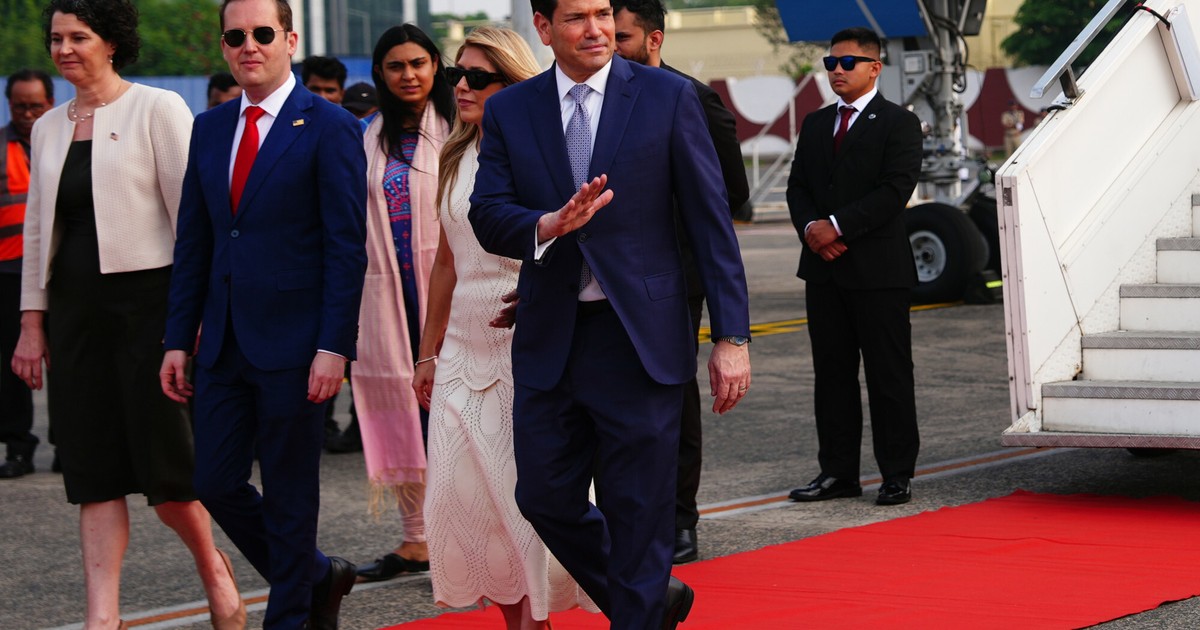
US Secretary of State Marco Rubio arrived in India on Saturday on a mission to strengthen a partnership strained by President Donald Trump's tariffs and to bring Washington closer again to New Delhi's rivals Pakistan and China.
After arriving in Kolkata, Rubio, a Catholic, visited the headquarters of the humanitarian organization and religious community founded by Mother Teresa. On the same day, he is scheduled to meet Prime Minister Narendra Modi in New Delhi and then take part in celebrations organized by the American embassy.
Read also: India will overtake the US in coal mining. Gevra will be the largest mine in the world
Rubio in India on a mission to repair relationships
According to the State Department, Rubio's talks in India will focus on cooperation in the areas of trade, energy and defense. The four-day trip – which is his first visit to the South Asian country – will also include Agra and Jaipur.
Successive US presidents – including Trump during his first term – have for years tried to strengthen relations with historically non-aligned India in order to make it a counterweight to the growing influence of Russia and China in the Indo-Pacific region. But those efforts appeared to falter last year when Trump imposed some of the highest tariffs on India in U.S. history.
Tariffs and trade remain a major source of tension
Many of these tariffs were later removed as part of an interim agreement, but the two countries have yet to finalize a comprehensive trade agreement.
New Delhi sought Trump's visit to India in conjunction with the summit of the Quad group, which includes the US, India, Japan and Australia. However, analysts point out that these plans fell apart in the face of trade tensions and other events – including the US and Israel's war with Iran.
New geopolitical context: Pakistan and Iran
Meanwhile, the United States has grown closer to Pakistan, India's rival and neighbor. Islamabad became a key partner in talks to end the war, which introduced additional tensions in US-India relations.
The energy crisis caused by the armed conflict has also weakened Washington's efforts to make India independent from Russian oil.
Energy and Russian oil in the background of the dispute
Rubio said on Thursday that the United States is already in talks to increase its share of energy supplies to India.
“We want to sell them as much energy as they want to buy,” he noted. “There is still a lot to be done in relations with India. It is a great ally and partner with whom we implement many valuable initiatives.”
Uncertainty around the trade deal
According to Basant Sanghera, a former State Department expert on South Asia, now with consulting firm The Asia Group, Trump's visit to Beijing this month has heightened concerns in India about relations with the US.
As Sanghera emphasized, Trump's approach “caused a real wave of concern” in India in the context of relations with Washington, “however, relations have begun to stabilize and both sides are seeking to accelerate cooperation where their interests overlap.”
The Biden administration has paid special attention to India as a key strategic partner and honored Modi during a state visit in 2023. Trump also hosted the Indian prime minister at the White House at the beginning of his second term, before he imposed high tariffs that disrupted relations.
US ambassador Sergio Gor, described by Michael Kugelman from the Atlantic Council think tank as the “India whisperer”, arrived in New Delhi in January and has been trying to rebuild relations since then. Gor is a close Trump associate and former White House adviser.
In February, the two countries agreed on the framework of an interim trade agreement that would reduce tariffs on Indian goods from the painful level of 50%. to 18 percent, with half of the previous rates related to purchases of Russian oil by India.
However, negotiations to finalize the agreement slowed down after the US Supreme Court repealed the tariffs introduced by Trump at the end of February.
As a result, the actual tariff rate on Indian goods has dropped to 10%, but New Delhi is still reviewing its options as the Trump administration conducts investigations under unfair trade practices laws. They are widely expected to lead to the reinstatement of most previous fees.
Cautious optimism despite difficulties
A person familiar with the negotiations said the United States is disappointed with what it sees as India's delay in action and its belief that it can negotiate favorable terms without major concessions. Such an atmosphere – he estimates – may hamper Rubio's efforts to stabilize relations.
“I don't expect Secretary Rubio to be able to significantly reverse this negative trend,” said Richard Rossow of the Center for Strategic and International Studies think tank.
“The absence of a trade agreement – more than three months after the announcement of the 'interim agreement' – casts a shadow over other areas of cooperation.” – he added.