One of the most humiliating episodes in Romanian history. The day the country was reduced to the status of a true colony

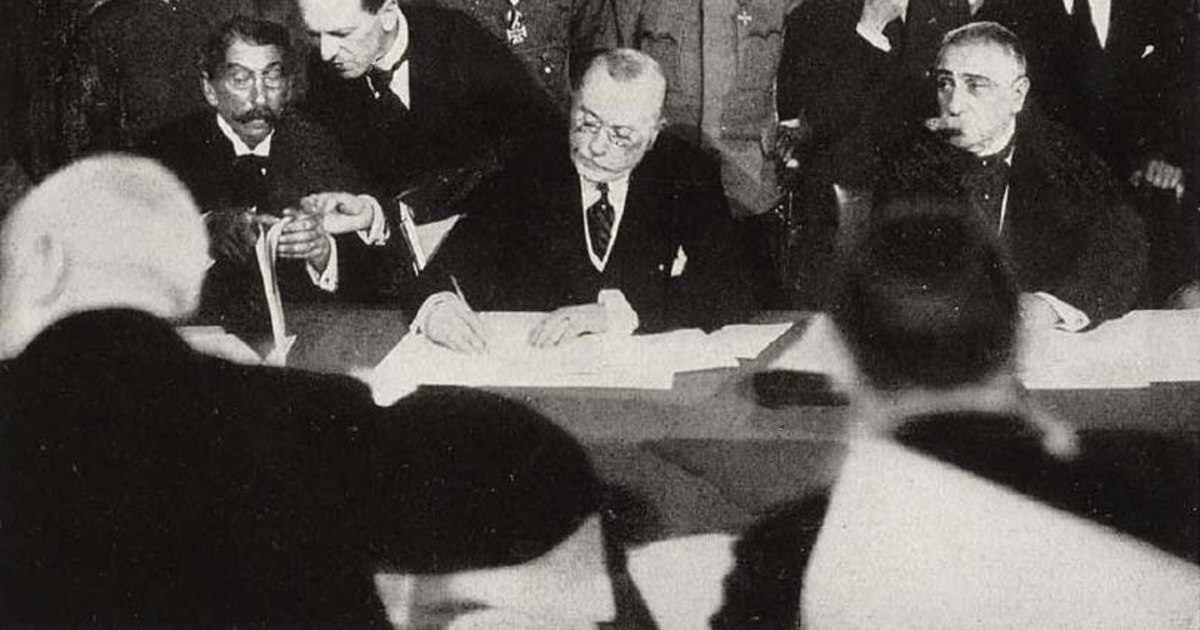
On May 7, 1918, one of the most humiliating treaties in Romanian history was signed at the Cotroceni Palace. It was about the peace treaty with the Central Powers, by which the country was put in an extremely vulnerable position, being forced to accept territorial losses, major economic concessions and conditions that seriously affected its sovereignty in relation to Germany and Austria-Hungary.
Signing of the Buftea-Bucuresti Treaty PHOTO wikipedia
At the beginning of 1918, Romania was in a dramatic situation. After the disastrous campaign of 1916 and the occupation of Bucharest by the Central Powers, the Romanian authorities had retreated to Iasi, and the front had hardly stabilized in Moldova. Practically, Moldova was the only part of the country left under the control of the Romanian state, an overcrowded territory, where there were troops, refugees and a population affected by famine and epidemics.
The victories achieved by the Romanian army in the summer of 1917, in Mărăști, Mărășești and Oituz, still brought a ray of hope. The equipment provided by the French military mission led by Henri Mathias Berthelot, the supplies received and the thorough reorganization of the troops transformed the Romanian army into a force capable of resisting German offensives and even conducting effective counterattacks.
In March 1918, however, came the decisive blow, which destroyed Romania's hopes of continuing the war under favorable conditions. Bolshevik Russia signed the Treaty of Brest-Litovsk with the Central Powers on March 3, 1918, thus exiting the First World War. For Romania, this meant almost total isolation and the loss of the last important ally in the region. Without the possibility of receiving military or logistical support from the Entente, the Romanian leadership was forced to accept peace negotiations with Germany and Austria-Hungary, which would lead to the signing of one of the most difficult treaties in the country's modern history.
Romania, cornered. The king appeals to the German man
After the retreat to Moldavia, in the winter of 1916–1917, Romania's only secure land link with the Entente remained through Russia. Equipment, ammunition and supplies sent by France and Great Britain crossed Russian territory by rail to reach the front in Moldova.
Supply, however, was difficult from the start. Although there were agreements for a steady flow of military materials and munitions, the shipments were often delayed, incomplete, or affected by the internal disorganization of the Russian Empire. However, an important part of the supplies managed to reach the Romanian front. Including the modern equipment used for the reorganization of the Romanian army in 1917, with the support of the French Military Mission led by Henri Mathias Berthelot, was transported on this route.
The situation changed radically after the February Russian Revolution. Although the new Russian leadership initially continued participation in the war, the events of the fall of 1917 completely changed the context. Following the October Revolution, the Bolsheviks led by Vladimir Lenin and Leon Trotsky took power and announced their intention to withdraw Russia from the conflict.
Soon after, the new regime issued the “Decree on Peace”, and in December 1917 Russia signed the Armistice of Brest-Litovsk with the Central Powers. Fighting on the Eastern Front temporarily ceased, paving the way for peace negotiations with Germany, Austria-Hungary, Bulgaria and the Ottoman Empire.
On March 3, 1918, the decisive blow came. Through the Treaty of Brest-Litovsk, Russia accepted extremely harsh territorial conditions, relinquishing control over Poland, the Baltic States, Ukraine, Finland, and some territories in the Caucasus. For Romania, Russia's withdrawal from the war meant the collapse of the last strategic support in the east. The victories at Mărăști, Mărășești and Oituz, which seemed to offer a respite and a chance for recovery, could no longer compensate for the new military and political reality, which had become completely unfavorable.
The historian Florin Constantiniu observes in the volume “An honest history of the Romanian people” that, after the seizure of power by the Bolsheviks, Vladimir Lenin's announcement regarding Russia's exit from the war made it almost impossible for the Romanian resistance to continue. The mixed Romanian-Russian device on the front and the strategic position of Moldova, surrounded by territories controlled by the Central Powers, put the Romanian state in a situation with no way out.
Under these conditions, on March 18, 1918, Ferdinand I appealed to Alexandru Marghiloman, leader of the Conservative Party and a politician known for his favorable orientation towards an agreement with Germany. Marghiloman, who had built solid relations with both German representatives and Austro-Hungarian officials, was considered the most suitable man to conduct the peace negotiations in the dramatic conditions in which the country found itself.
By royal decree, he was appointed prime minister, and on March 19, 1918, the government led by Alexandru Marghiloman was sworn in before King Ferdinand I.
“It was then believed that a government chaired by Alexandru Marghiloman, remaining in Bucharest under occupation and well seen in Vienna and Berlin, could obtain better peace conditions. The conservative leader, convinced of the German victory, believed that he could ensure a better situation for Romania by cooperating with Germany and by clearly dissociating himself from Brătianu's policy”is shown in “A sincere history of the Romanian people”.
Marshal Alexandru Averescu, the hero of Mărăști and Oituz. The repression of the 1907 Uprising is also linked to his name
However, through this “cooperation” with Germany, the Romanian delegation sent to the peace negotiations ended up accepting almost all the conditions imposed by the Central Powers. In reality, the options were extremely limited. Romania was faced with a dramatic choice: continuing the fight in almost impossible conditions or accepting a peace dictated by the adversaries. To many contemporaries, even military capitulation would have seemed less humiliating than the terms that would be imposed at the negotiating table.
Romania, humiliated and subjected to total robbery
Peace negotiations began in Buftea, near Bucharest. Along with Alexandru Marghiloman, the Romanian delegation included Constantin C. Arion, Alexandru Papiniu and Mihail N. Burghele. The negotiations took place on four main components: political, military, legal and economic.
Despite the relations Marghiloman had with German and Austro-Hungarian officials, the Romanian delegation failed to obtain significant concessions. On the contrary, the conditions imposed were extremely harsh. The peace treaty was signed on May 7, 1918, at the Cotroceni Palace, by Alexandru Marghiloman, from Romania, together with the representatives of Austria-Hungary, Bulgaria and the Ottoman Empire.
The treaty contained 31 articles, many of them with serious implications for the Romanian state. By the territorial provisions, Romania was obliged to cede the Quadrilateral to Bulgaria, and the rest of Dobrogea came under the control of the Central Powers. In addition, the border with Austria-Hungary was to be modified in favor of Romania, which lost important strategic positions in the Carpathian area, including regions around the massifs of the Parâng, Cozia, Negoiu, Caraiman, Ceahlău and Rarău Mountains. According to historical estimates, these changes affected over 700,000 inhabitants.
From a military point of view, the country was forced to drastically reduce its defense capacity, the army being limited to only a few divisions. The economic clauses were, however, the most pressing. Romania was obliged to deliver agricultural products and resources to Germany under disadvantageous conditions, losing control over an important part of domestic production. At the same time, German interests obtained privileged access to agricultural land, transport and, above all, to the Romanian oil industry.
Economic control also extended over the Danube, where Germany gained major influence over navigation, while Austria-Hungary consolidated its position in the Romanian naval infrastructure. For many historians, this treaty represented one of the heaviest political, territorial and economic blows suffered by Romania in the modern era.
The impressive story of the child who died for Romania. How a 12-year-old girl managed to contribute to the most important victory of the First World War
“A Shameful Surrender”
The peace of Buftea-Bucuresti was perceived by a large part of the Romanian public opinion as a deep national humiliation. Ion C. Grădișteanu, politician and former minister, described it as “a shameful capitulation”. For his part, Take Ionescu, one of the leaders of the Conservative-Democratic Party, demanded the annulment of the treaty and the continuation of the war alongside the Entente, considering that such a peace was more difficult to accept than the continuation of the fight, even under the conditions of a possible government in exile. This position was shared by many Romanians, both from the country and from communities abroad.
Constantin Argetoianu noted in the volume “Amintiri” that many had initially hoped that Alexandru Marghiloman would obtain less harsh terms, but during the negotiations it became clear that the Central Powers aimed to impose a dictated peace, without real concessions. Even Ferdinand I refused to officially promulgate the treaty, despite pressure from the government. At the same time, Romanians abroad sent memoranda and petitions to Western governments, trying to keep the Romanian cause in the attention of the allies.
However, in the context of military and diplomatic isolation, the signing of the treaty became inevitable. The situation changed radically a few months later, when Germany and its allies were defeated in the First World War. This outcome allowed Romania to return to the Entente side and participate in the international negotiations after the war. An important role in restoring the country's external image was played by Romanian diplomacy and Queen Maria, who contributed to supporting Romanian interests in the following years.
Many contemporaries, however, blamed the disaster of 1918 on the state's poor preparation before entering the war, administrative dysfunctions and internal political conflicts. In his memoirs, Constantin Argetoianu formulated some of the harshest criticisms of the government led by Ion IC Brătianu, accusing the lack of military and administrative training that contributed to the dramatic situation in which Romania had reached in 1918.