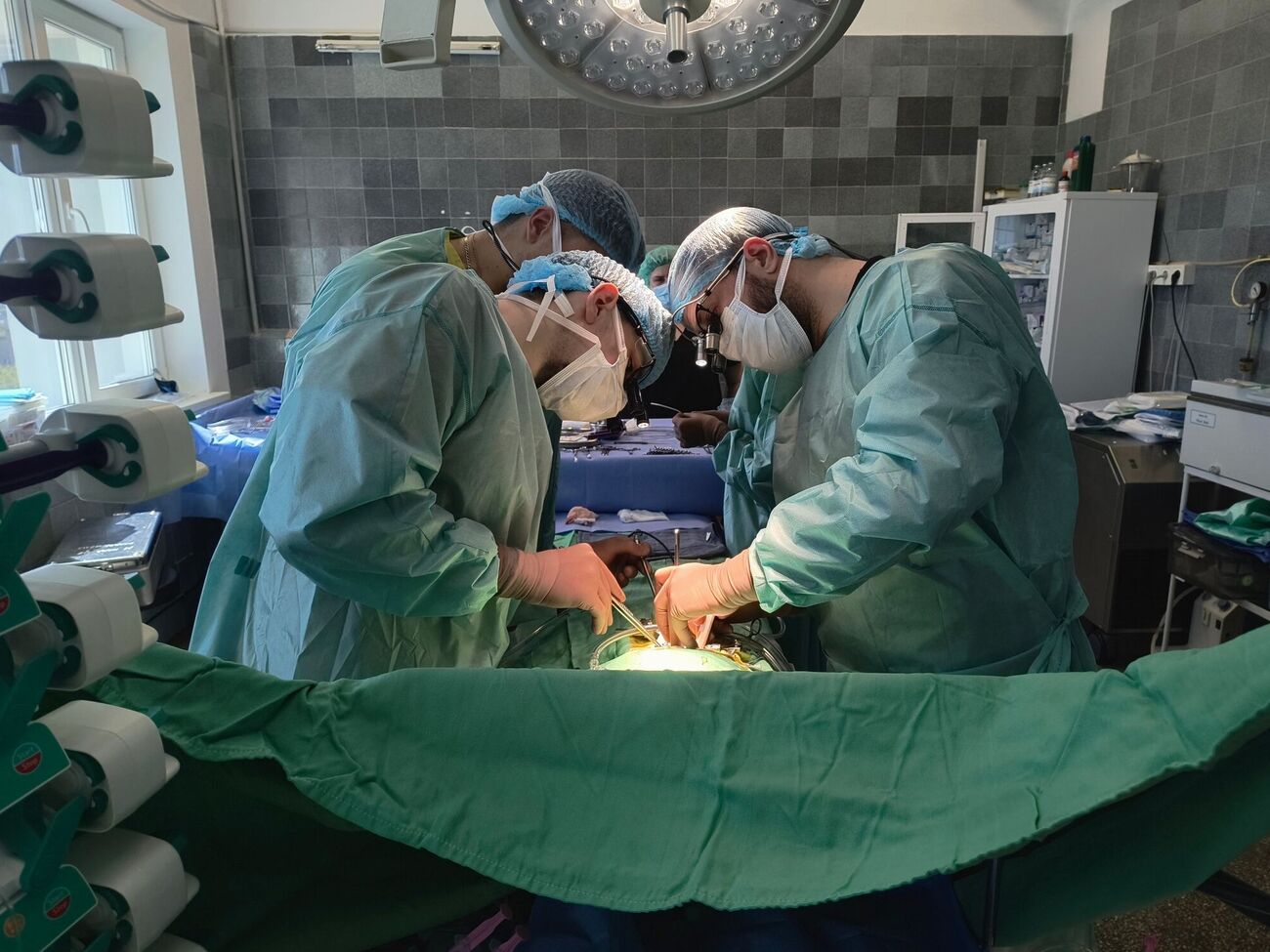
In Lviv, at the St. Nicholas Children's Hospital, a complex heart operation was performed on a three-month-old boy, Nazar: the intervention was performed using a minimally invasive method, which reduces the risk of blood loss and allows the child to avoid sternum deformation in the future. The press service of the medical institution reported this on May 7.
“The boy was born with a diseased heart – one working ventricle instead of two. In a healthy organ, the left ventricle pumps arterial blood, enriched with oxygen and nourishes the whole body. And the right one transports already “waste” venous blood to the lungs in order to “cleanse” it of carbon dioxide. In Nazarchik, all the blood – both arterial and venous – was mixed in the only working ventricle and spread throughout the body. Therefore, the baby from his first sigh suffered from hypoxia and shortness of breath,” the doctors said.
The newborn baby was immediately taken to Lvov (his mother, a migrant from Kherson, lived in Khmelnitsky).
The baby was admitted to St. Nicholas Hospital at the age of one day, says Sofia Golik, a cardiologist at the medical institution.
Doctors monitored the baby for three months, but over time the saturation indicator (oxygen level in the blood) became critical – and the decision was made to operate on Glenn.
“The task of cardiac surgeons is to separate the flows of venous and arterial blood so that they do not mix. It is necessary to disconnect one of the two main veins from the heart and connect it directly to the pulmonary artery. Thus, the heart will no longer pump as much venous blood, but will carry more oxygen throughout the body. This is a complex intervention. In Ukraine, it is performed only through an open approach, that is, with a large incision in the sternum,” the hospital explained.
Cardiac surgeons performed the operation through a 4 cm incision under the armpit instead of the traditional one in the middle of the chest.
“This significantly reduces tissue trauma, blood loss and the need for donor blood. And most importantly, it allows the baby to avoid sternum deformities and visible scars in the future. We took a risk because this technique, although more difficult for a doctor, is much better and safer for the child. This is our way of pushing medicine further, beyond the limits of the possible,” said the head of the department, Alexander Yachnik.
Two weeks have passed since the operation. Little Nazar, who was out of breath and exhausted before the operation, is feeling better, says his mother Olga Kizyun.
“He began to breathe normally, began to eat. Previously, he drank a bottle of milk four times with breaks. But now he eats all 120 g at a time and does not turn blue,” she rejoices.
The hospital says that when their little patient begins to walk confidently, he will undergo another operation (Fontan).