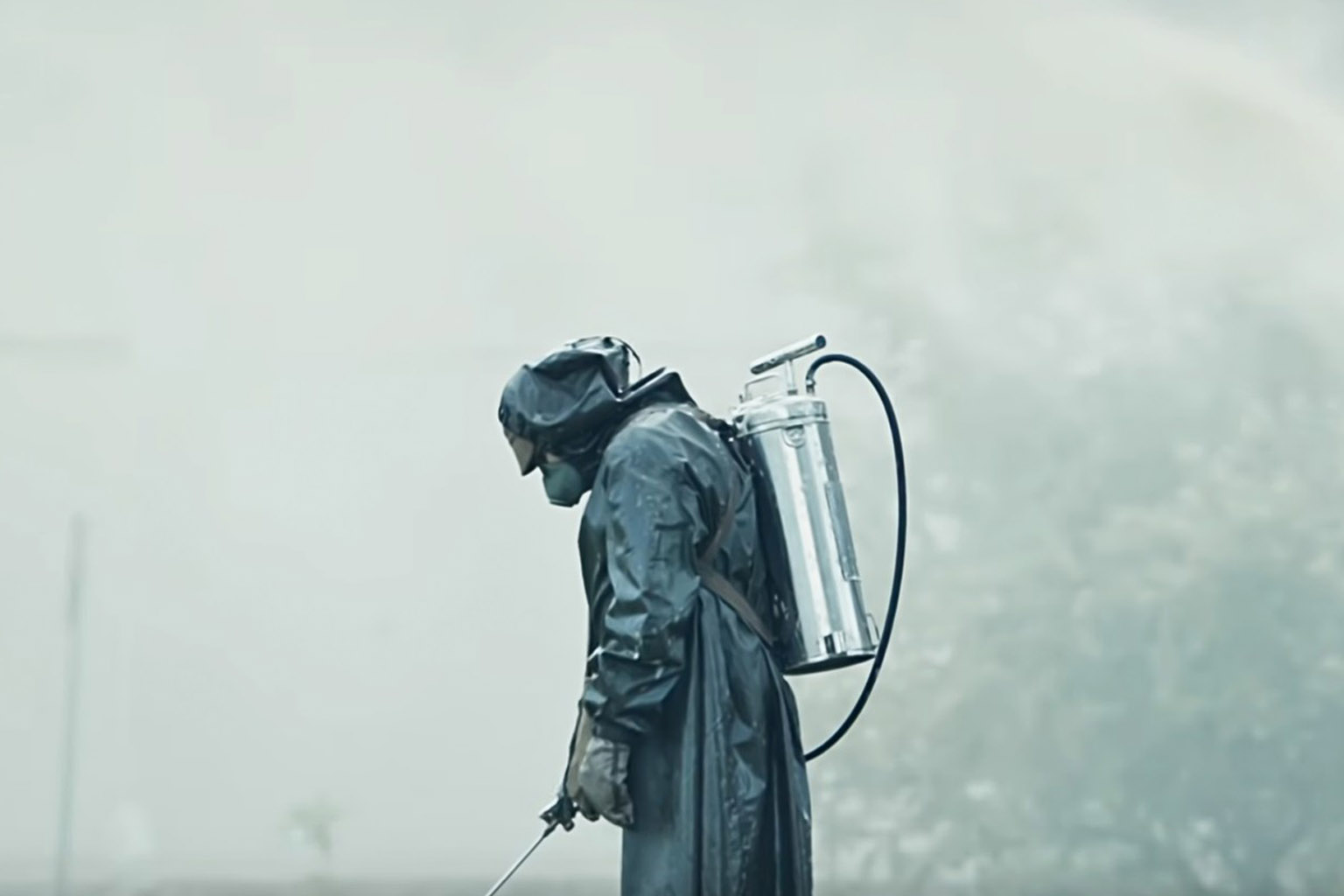
This Sunday, April 26, it will be exactly 40 years since the Chernobyl nuclear accident, and, as usually happens around such commemorations, interest in film productions dedicated to the catastrophe will very likely increase suddenly. And one of the best series ever made about Chernobyl, if not the best, can be seen at home, streaming, on HBO Max. Netflix has a movie on the subject, but it leaves a lot to be desired.
What new could be said about the series “Chernobyl” that has not already been said after the huge success enjoyed by the 5-episode miniseries produced by HBO after its release in 2019? The truth is that not very many, although I would like to mention that two of his actors were nominated for the Oscar Award this year.
And Jessie Buckley, who in “Chernobyl” plays Lyudmila – the pregnant wife of firefighter Vasili Ignatenko, was also awarded the Oscar for best actress in a leading role at last month's gala. The recognition came thanks to her performance in last year's Hamnet, in which she played William Shakespeare's wife as she copes with the painful loss of their only son. The role also earned her her first career Golden Globe and BAFTA Award.
As for Stellan Skarsgård, he lost the Oscar for Best Actor in a Supporting Role to Sean Penn, but his performance in the drama “Sentimental Value” earned him his second Golden Globe of his career. The first was precisely for the series “Chernobyl”, in which the veteran actor from Sweden played Boris Šerbina, the official of the Soviet government tasked with assessing the situation at the nuclear power plant and then limiting the repercussions of the disaster.
However, the two were only part of the cast of the HBO series, alongside actors such as Jarred Harris (who played Valeri Legasov), Emily Watson (Uliana Homiuk), Paul Ritter (Anatoli Diatlov) or Barry Keoghan, another actor later nominated for an Oscar.
For Ritter, the acclaimed British actor who died in 2021 due to a brain tumor, the role of the deputy chief engineer of the Chernobyl power plant in the HBO series would also be one of the last in his career. “3.6 roentgen, not great, not terrible,” his character's line when informed of the radiation level in the control room, became an internet sensation and spawned countless memes.
The HBO series “Chernobyl” is based on the book by a Nobel Prize laureate
However, it was the way in which Diatlov and the other two top plant officials – director Viktor Briuhanov and chief engineer Nikolai Fomin – were portrayed in the documentary that was criticized by some survivors after its release.
For example, Oleksii Breus, one of the engineers who entered the reactor 4 control room a few hours after the nuclear accident, told the BBC in 2019:
“The operators feared him (Dyatlov). When he was present at the reactor, he created tension for everyone. But no matter how strict he was, he remained a top professional.”
The engineer speculated that Diatlov may have become the show's main anti-hero because, “at first, that was the perception of him among the plant's employees, his subordinates, and top management.” “Subsequently, that perception changed,” Breus pointed out.
Other criticisms have been directed at the way the “Chernobyl” series presented some of the effects of radiation and the power relations within the Soviet state. As the Russian-American journalist Maria Gessen noted in a review of the series published by The New Yorker magazine:
“Resignation was the defining condition of Soviet life. But resignation is a depressing spectacle and not telegenic. So the authors of the 'Chernobyl' series imagine confrontation where confrontation was unthinkable.” She particularly criticized the fictional character of Uliana Homiuk, arguing that she was a Hollywood archetype and that such a defiant scientist would never have lasted in the Soviet system.
In this chapter, the American filmmaker Craig Mazin, the creator of the series, allowed himself certain creative freedoms. In fact, the very sequence at the end of the last episode shows that Homiuk's character is meant to embody those few researchers who dared to speak against the official version of events and “were subjected to denunciation, arrest and imprisonment.”
In others, however, such as the objections of some of the plant operators regarding the appearance of Diatlov, part of the contradictions come from the fact that Mazin based his miniseries on “Prayer for Chernobyl,” the 1997 non-fiction book by Belarusian journalist and writer Svetlana Alexievici.
Alexievici, the 2015 laureate of the Nobel Prize for Literature, wrote that book after a decade in which she interviewed more than 500 eyewitnesses of the events, including firefighters, liquidators, politicians, ordinary citizens of Prîpeat and other people. Obviously, some people perceived things differently.
Netflix has a “Chernobyl” movie, inspired in part by the success of the HBO series
Those who want to see a production about the Chernobyl nuclear accident on Netflix this weekend might notice in the streaming platform's catalog a film called “Chernobyl, 1986.” The feature film itself has an interesting history. It's a production based on an older idea by Ukrainian filmmaker Alexander Rodnianski.
Rodnianski is one of Ukraine's most successful film directors and producers, with a Golden Globe Award for Leviathan, his 2014 dark comedy about one man's fight against corruption in Russia, a César Award for the 2017 drama Loveless, and 4 of his films receiving Academy Award nominations for Best Foreign Language Film.
He was 24 years old at the time of the Chernobyl accident and said that it was an ambition of his to make a film about the disaster at some point. The script for “Chernobyl, 1986” (released in the US and other countries under the title “Chernobyl, Abyss”) came to his table in 2015, and he later went with it to the Russian actor Danila Kozlovski, who at the time was filming the popular series “Vikings” (in which he played Prince Oleg of Novgorod).
The two decided to make the film together only after seeing the success of the HBO series. But they wanted to do something different and focused on the human stories of the disaster, with Kozlovski directing and starring in the film that was eventually released on Netflix in 2021. Rodnianski was the producer and the feature film with a cast of mostly Russian actors was partially financed by the Russian state.
It was help the Ukrainian filmmaker was likely to regret, given that a Moscow court sentenced him in October 2024 to eight and a half years in prison for his repeated comments against Russia's invasion of his native country. The conviction came two years after Russia declared him a “foreign agent”.
The problem with his Netflix movie is that it's probably one of the weakest of his career. The characters have a hard time convincing, some lines seem far-fetched and some of the sequences leave the impression that they are unnecessarily long and become boring. Rodnianski really did what he set out to do: he told the story from the perspective of the rescuers called to the nuclear power plant.
But by doing this in a movie, not a series, it left out other things like the story of the actual disaster as it unfolded at the nuclear plant, or the authorities' frantic attempts to cover up what happened. The end result was a 5.2 film out of over 12,000 ratings posted on IMDb.
It's light years away from HBO's “Chernobyl,” which has a 9.1/10 rating out of a whopping million-plus viewer ratings.