Astronauts who have flown around the Moon are returning to Earth. The most dangerous moments of the Artemis II mission are yet to come

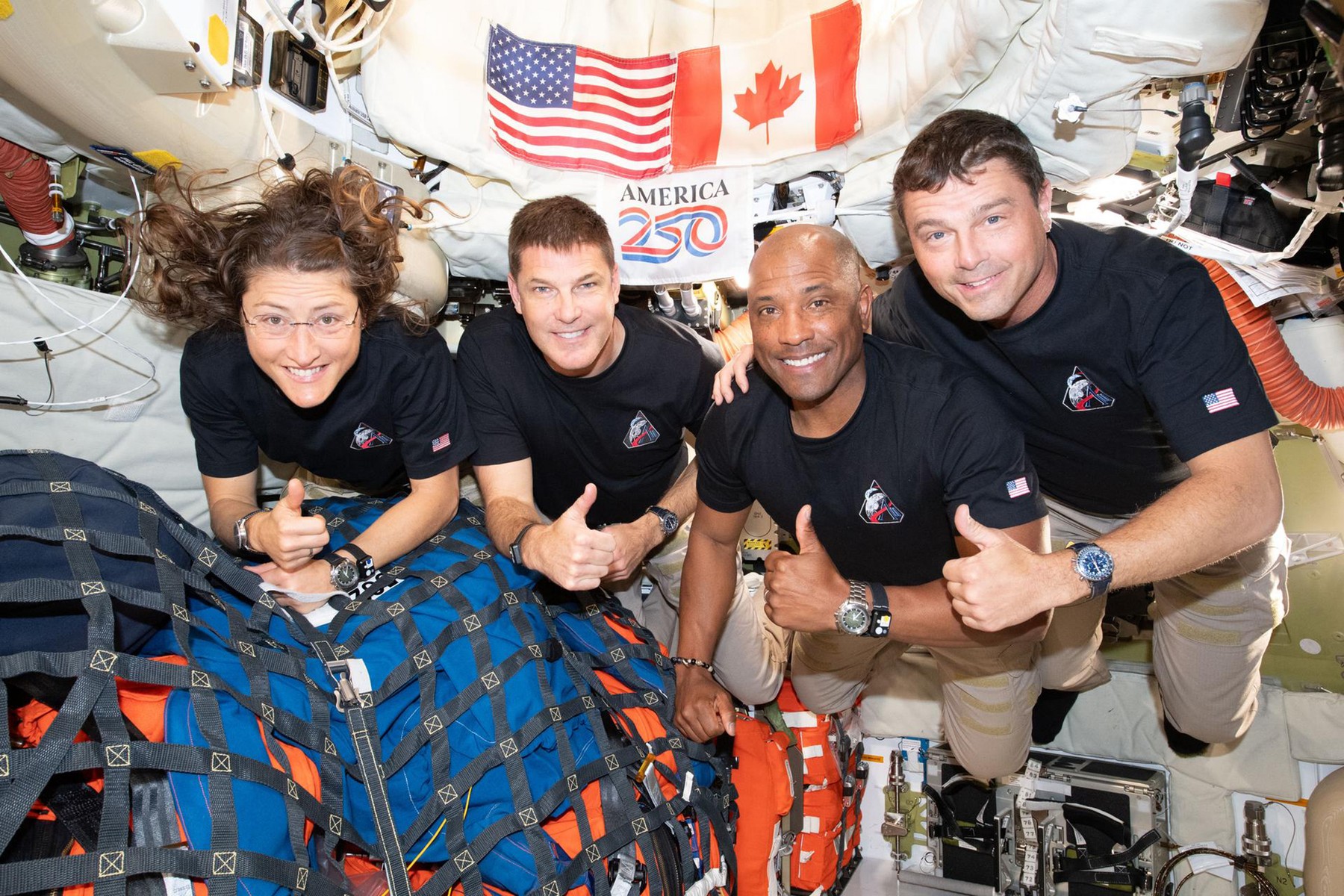
The four astronauts who flew around the moon as part of NASA's Artemis II mission are close to home, but one of the most dangerous and stressful parts of the mission awaits them, reports NBC News.
NASA astronauts Reid Wiseman, Christina Koch and Victor Glover, as well as Canadian astronaut Jeremy Hansen, are to return to Earth on Friday evening (overnight in Romania), after 10 days spent in space, writes News.ro.
Their Orion capsule is scheduled to begin entering the atmosphere around 7:53 p.m. EDT (02:53 Saturday, Romania time), in a literally blazing journey expected to last less than 15 minutes. If everything goes well, the mission will end with a landing in the Pacific Ocean at 20:07 (03:07 Romanian time), off the coast of San Diego.
“There are 13 minutes where everything has to go perfectly,” Jeff Radigan, flight director of NASA's Artemis II mission, said at a news conference Thursday.
Re-entry is always one of the riskiest parts of spaceflight, as vehicles can be exposed to temperatures of around 5,000 degrees Fahrenheit (2,760 degrees Celsius) as they travel through the atmosphere. But this is especially true for Artemis II, because the Orion spacecraft's heat shield — the essential bottom layer of thermal protection that protects astronauts from extreme temperatures — has known design flaws.
This is the first time the Orion capsule has carried a human crew.
What happened on the Artemis I mission
After the 2022 Artemis I mission — an uncrewed test flight of the Space Launch System rocket and Orion capsule — NASA discovered unexpected damage to the spacecraft's heat shield, NBC News recalls.
NASA's Orion spacecraft was recovered at the end of the Artemis I test flight and taken to the Kennedy Space Center in Florida, where the heat shield was removed and inspected.
An agency investigation later found that some of the heat shield material cracked during re-entry, “causing pieces of carbonized material to break off in several places.” The investigation determined that gases did not properly vent from the outer heat shield material, allowing pressure to build up, which caused the observed failures.
Because of these issues, NASA will modify the heat shield design for future Artemis flights. The Orion spacecraft used for these missions will have a more permeable outer layer. But for Artemis II, the capsule had already been built and assembled when NASA learned of the damage suffered during the Artemis I mission.
What a solution NASA found
So instead of rebuilding the heat shield, NASA designed a modified capsule reentry trajectory to minimize the risk to the astronauts.
Normally, before beginning its final descent, the Orion spacecraft must enter the atmosphere, then re-emerge at its edge—like a rock skipping on the surface of water—to reduce thermal stress and G-force (a measure of acceleration relative to Earth's gravity) on the capsule.
But Amit Kshatriya, NASA's deputy administrator, said this time the “jump” will be short, and the capsule will descend faster and at a steeper angle to minimize exposure to the most extreme temperatures.
“Every system we've tested in the last nine days — life support, navigation, propulsion, communications — all depend on the last few minutes of flight,” Kshatriya said at Thursday's briefing.
He added that NASA has “high confidence” in the spacecraft's heat shield on the modified trajectory.
Significant risks
However, there are significant risks and four lives are at stake.
Charlie Camarda, a former NASA astronaut, has publicly expressed concern about the heat shield and said NASA should not have launched the Artemis II mission with the existing design.
“History shows that accidents happen when organizations convince themselves that they understand problems that they don't. This problem shows the same patterns that have preceded past catastrophes,” he wrote in an open letter to NASA Administrator Jared Isaacman in January.
However, Isaacman said in the same month that he has “full confidence” in the Orion spacecraft's heat shield.
And astronaut Reid Wiseman, commander of the Artemis II mission, said he was satisfied with the plan. “If we stay on the new re-entry trajectory planned by NASA, then this heat shield will be safe for flight,” he said during a pre-flight media event in July.
The reentry plan requires Orion to stay on a highly precise trajectory, said Jeff Radigan, the Artemis II mission's flight director. Mission controllers have spent the last day and a half keeping the Orion spacecraft on course, performing the propulsion maneuvers necessary to maintain its trajectory.
“Let's stop hiding behind our fingers,” Radigan said. “We have to get that angle right. Otherwise, we're not going to have a successful reentry,” warned the mission's flight director.
Forces almost 4 times greater than gravitational attraction
During atmospheric reentry, Orion is expected to reach an estimated top speed of nearly 24,000 mph (38,624 km/h). Astronauts will be exposed to G-forces equivalent to approximately 3.9 times the normal gravitational pull of Earth.
As the capsule sinks through the atmosphere, communications are expected to be disrupted as plasma builds up around the spacecraft and causes interference. The disruption is expected to last about six minutes, flight director Rick Henfling said at a news conference Wednesday.
“Once that six-minute blackout is over, Orion will be about 150,000 feet (about 45 km), so it's still going to fall pretty quickly,” he said.
ditching
At an altitude of about 6,000 feet (about 1.8 km), the capsule will open its three main parachutes, which will help it reduce its speed to about 20 miles per hour (32 km/h) before plunging into the ocean.
The US Navy will assist recovery efforts in the Pacific. Once the landing zone is deemed safe, NASA's plan is to extract Koch from the capsule first, then Glover, followed by Hansen and then Wiseman.
At Thursday's briefing, Kshatriya praised the crew and said it was time for flight directors, engineers and recovery teams to bring them home.
“The crew did their job,” he said. “Now we have to do it ourselves,” he added.