Mobile internet disruptions began in Moscow on March 5, and two weeks later, the outages are still ongoing. According to Kremlin spokesman Dmitry Peskov, the lack of communication is due to the fact that “the Ukrainian regime is using increasingly sophisticated attack methods, and therefore more technologically advanced countermeasures are necessary to ensure the safety of citizens.” The correspondent of Novaya Gazeta took a walk around the city center and looked at how the inhabitants of Moscow live.
A year ago, on Victory Day in Moscow, the Internet was turned off in the city center and near all the most important memorial sites: communication did not work on Poklonnaya Gora, Tverskaya Street, or Novaya Tretyakovka. The Moscow authorities' test of strength was successful, and a year later the Internet completely disappeared in the center of the capital and adjacent districts. Back then, the breaks lasted less than a day. In March this year, it was easier to count the days when the Internet in the capital operated without restrictions.
When traveling towards the center on the Sokolnicheska metro line, I regularly measure the internet speed using a special application. When entering the “Park Kultury” station (Chamowniki district), the application stops working and asks for an Internet connection. Telegram does not want to work even with VPN, the weather is not displayed in Google. But the music in my headphones is still playing: all Yandex services are on the so-called white lists that operate when mobile Internet is cut off.
For the first time in my life, I try to connect to the Wi-Fi of the Moscow Metro, but it turns out that it is not that easy. First, they do not redirect me to the website to connect to the network for a long time, they display ads, and then I have to wait a few minutes for an SMS with an authorization code. Without having time to connect, I get out of the carriage.
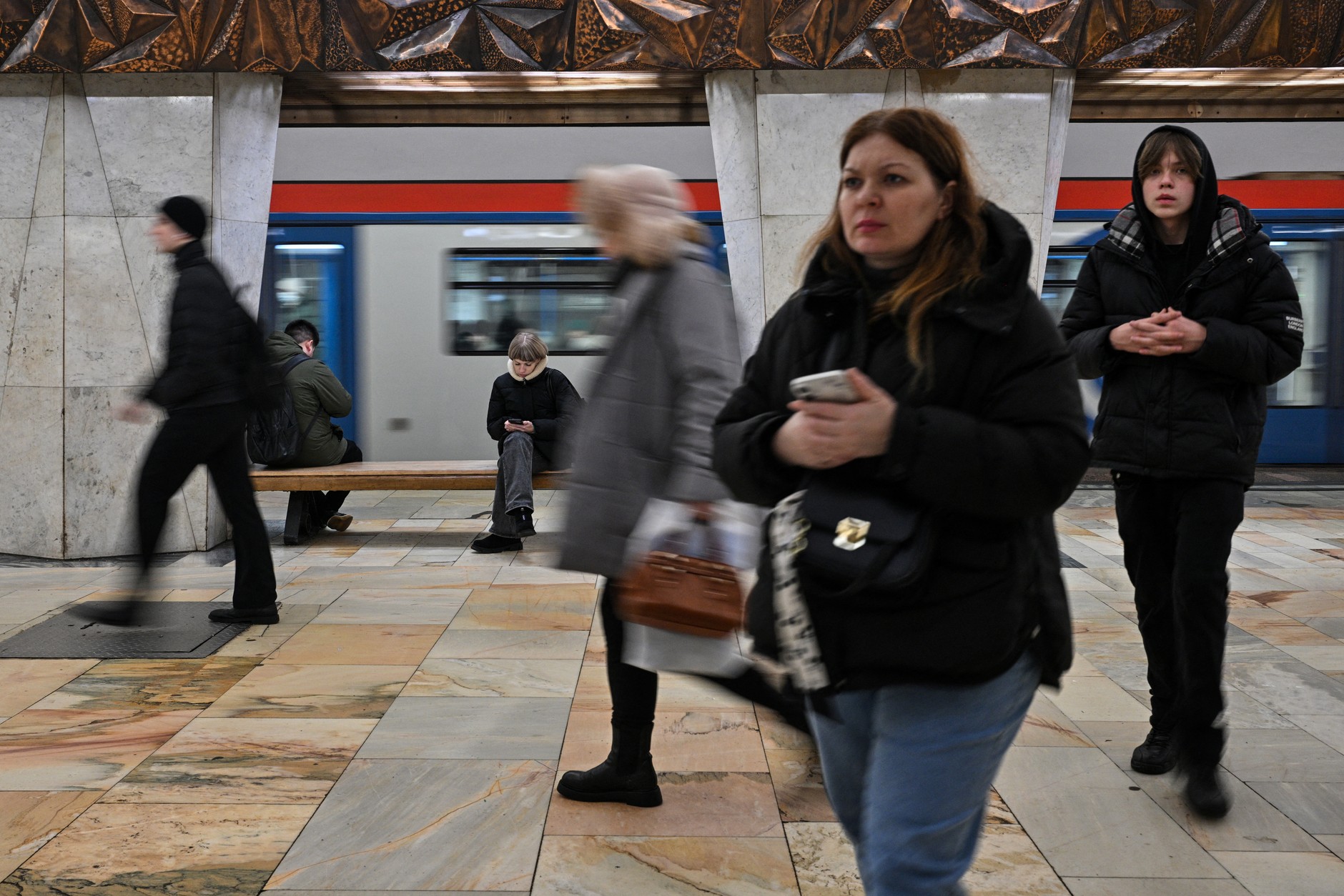
Moscow residents at a metro station, February 12, 2026.HECTOR RETAMAL/AFP / AFP
According to the press office of the largest bookstore chain “Chitai-gorod”, from March 6 to 10 sales of paper maps in Moscow increased by almost 50%.. To check whether the sellers themselves have felt this increase, I go to the bookstore in the neighboring shopping center. I ask the only saleswoman to show me the shelf with maps, I explain that in the last few days in the city center my online maps hardly work. The woman advises me to find a “good proxy server” and leads me to atlases. While I'm browsing through the items on the shelf, I ask if she's bothered by interruptions in internet access.
“We grit our teeth and live,” replies the saleswoman. — I'm 40 years old, do you think I've had a phone in my hands since I was born? Life was good! We met somehow, we went for walks!
– Yes, and I've had it almost since birth – I admit in response.
— Yes, that's why young people are so helpless.
– Do they even buy these paper maps from you?
– They are buying them now, when everyone is left without the Internet. Now even adult men are like helpless children: “Aah, help, give us a map!”
Spare SIM card
In the shopping center, you can see small queues at the offices of mobile operators. I approach the Tele2 counter. One of the customers asks whether the Internet will work if he buys a new SIM card and chooses the most expensive package.
– At the moment, the Internet in the center does not work with any operator – explains a tired employee. — You have to take a few metro stops away from here. Only whitelists work, such as state services, Sberbank and so on.
The customer thinks about it and finally decides on a new SIM card – he says that he will try to alternate it with the current one if internet outages continue.
“Maybe at least one SIM card will work,” the man says hopefully, handing over his passport to sign the contract.
At the MTS operator's office, the queue is even longer. Two salon employees draw up new contracts – young people predominate among the customers. The girl in the queue says that she is a student at a nearby university and has been using an unlimited tariff from another operator for many years.
The article continues below the video
However, its tariff is expensive, the Internet in the center stopped working altogether, and the operator refuses to recalculate the bill.
There is Wi-Fi at the university, which saves her while studying, but the connections don't work anyway, the girl complains.
– We have better internet than other operators – says the manager confusedly and not very confidently to one of the customers. – The only thing that can be said is that it will most likely work on a 3G network, but it's still better than many others. And our connections should work. You know, for some people, the Internet on our SIM cards works fully. But truth be told, for some it doesn't work at all. However, it is more likely to work.
Due to telephone connectivity problems in Moscow last week, the demand for landline telephony increased, which had been steadily declining for many years. And deputy from the United Russia party Igor Antropenko proposed starting the installation of telephone booths in large citiesincluding internet access, so that Russians can stay connected.
Whitelists
According to Mobile Research Group principal analyst Eldar Murtazin, in regions where shutdowns have become regular, whitelists – sites and applications that should function even under shutdown conditions – operate in different ways. – There are internet outages during which whitelists are operational [w całości]and there are also cases where only specific resources are listed on whitelists, the expert said in an interview with RTVI. — I mean, even in the whitelist there is a certain gradation. There are also outages when only voice calls work and nothing else works, including what is on the whitelist, he added.
It's true: Yandex Music, for example, played in my headphones the entire walk. Online store websites also loaded, but I still couldn't order anything because I needed a banking application and it didn't work without mobile Internet.
Yevgeniya, a resident of Moscow, also encountered problems with the operation of whitelisted applications and spoke to Novaya Gazeta. The girl said that it was in her district of Moskvorezheye-Saburovo in the south of the capital the Internet turns off especially often near state institutions: schools, hospitals, clinics. According to her, even whitelisted applications stop working there.
A few days ago, Evgeniya went to the doctor, forgetting to write down the exact time of the visit and the office number – she was hoping that out of habit she would check them in the clinic, in an application that is on the white list, but she failed to open it.
— I came to the clinic and the Internet simply didn't work, says Yevgeniya. — I couldn't check the details of my visit, such as the doctor's office or his name. The only thing left is the old method of printing cards on the terminals at the entrance.
Some Moscow residents buy special VPN services that are supposed to “bypass whitelists”: such networks mask the user's traffic as allowed, so you can use the Internet during its partial shutdown, when only whitelists work.
— Last Thursday I was supposed to meet a friend downtown, my friend tells me. — I was about 20 minutes late and I couldn't tell her because the internet disappeared as soon as I left the house. She lost sight of me and left, assuming that I wouldn't make it.
Then the girl installed a special VPN service that bypasses whitelists – according to her, even blocked Telegram works through it.
I’m Ashley Davis as an editor, I’m committed to upholding the highest standards of integrity and accuracy in every piece we publish. My work is driven by curiosity, a passion for truth, and a belief that journalism plays a crucial role in shaping public discourse. I strive to tell stories that not only inform but also inspire action and conversation.