The fever of new stadiums covers Romania. Investments that take the place of arenas built in communism

Romania entered the fever of new stadiums, even if such projects are not without controversies. Investments in the reconstruction of stadiums start from tens of millions of euros and promise modern infrastructure, even in cities where the passion for football died out after communism.
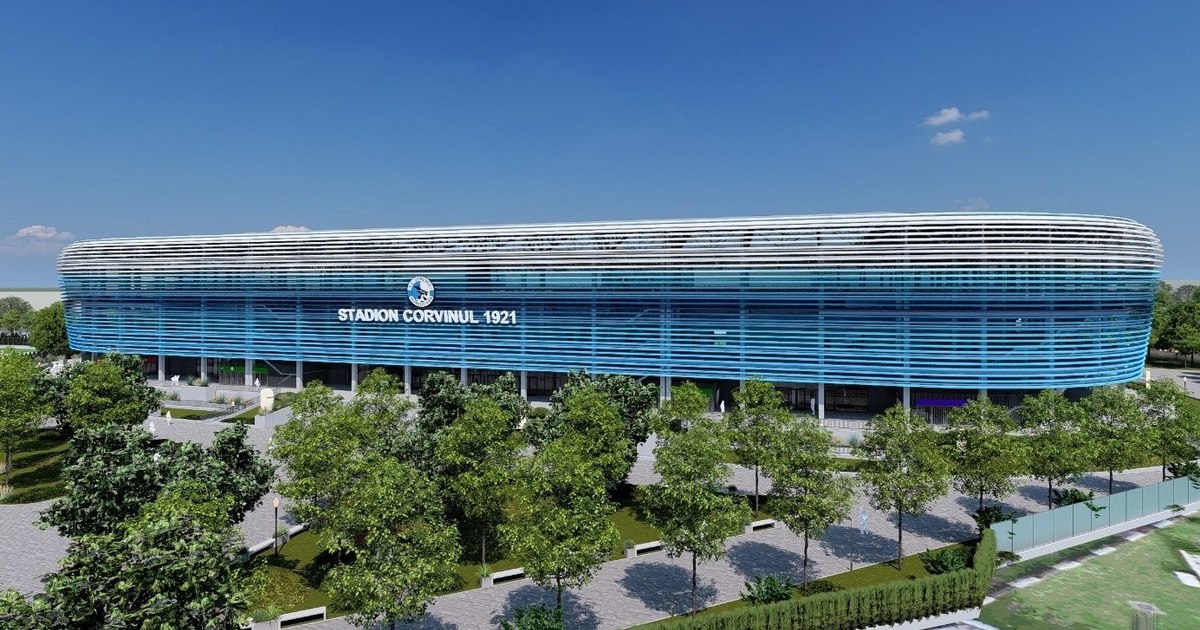
The stadium designed in Hunedoara. Source: Hunedoara City Hall
At least ten major stadium construction projects are underway in Romania, and their costs start from several tens of millions of euros.
While many locals look forward to their completion, the investments have often sparked controversy. First of all, the high costs and the inability of the Romanian Government to finance them in the current economic conditions, even in the situations where the execution contracts were signed, were complained about.
Other Romanians declared themselves dissatisfied with the projects because they aimed to demolish the old local arenas, to which they were sentimentally attached or which they considered still viable, decades after their inauguration, provided they were modernized.
In addition to the costs, the efficiency of the projects and the attachment to the old arenas, the capacity of the new stadiums and its adequacy to the needs of the community has also caused controversy, given that the clubs for which they were built have not had notable sporting performances, and the number of supporters who use them is often small.
More and more new stadiums
The National Arena in Bucharest, the largest stadium in Romania, was inaugurated in 2011 and built with a budget of approximately 235 million euros, becoming the first stadium in the country approved to the UEFA elite standard.
The investment paved the way for other major sports infrastructure projects carried out in the last decade, including the Cluj Arena (2011), the Ilie Oană Stadium in Ploiesti (2011), the Anghel Iordănescu Stadium in Voluntari (2012), the Giurgiu stadium (2014), the Ovidiu stadium (2015), the Ion Oblemenco Stadium in Craiova (2017), the Mioveni stadium (modernized in 2018), the stadium in Târgu Jiu (2019) and the Francisc von Neuman Stadium in Arad (2020).
Investments continued after 2020 with several new arenas built especially through the National Investment Company, including the Steaua Stadium (2021, over 31,000 seats), the Arc de Triumf Stadium (2021), the Sepsi OSK stadium in Sfântu Gheorghe (2021), the Rapid-Giulesti Stadium (2022), the Municipal Stadium in Sibiu (2022) and the Eugen Popescu Stadium in Târgoviște (2023), to which are added several sports bases and smaller arenas built in the same period.
Currently, several projects are in the execution or design phases, most of them run through the National Investment Company.
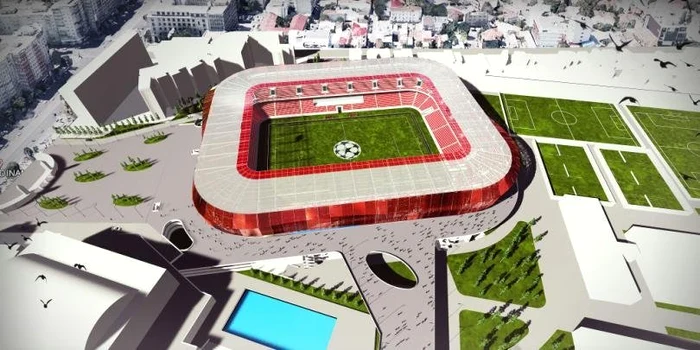
Dinamo stadium. Project outline. Facebook Dinamo
Among the most important are the reconstruction of the Dinamo Stadium in Bucharest, the Gheorghe Hagi Stadium in Constanța, the new stadium of the Corvinul Hunedoara team and the new arena in Timișoara, which will replace the former “Dan Păltinișanu” stadium. Other works concern new stadiums in Târgoviște, Pitesti and Timișoara, Brașov, Oradea, Alexandria, Slatina, Giurgiu and Bistrița.
What costs will the new stadiums have?
According to the list presented by the National Investment Company (CNI), the costs of the new stadiums under construction, contracting or public procurement procedure reach hundreds of millions of lei for each objective, and their capacity varies between approximately 5,000 and over 30,000 seats.
The most expensive project is the new stadium in Timișoara (32,150 seats), estimated at 836.94 million lei, followed by Arena Dinamo Bucharest (25,059 seats), valued at 854.57 million lei, the stadium in Constanța (18,190 seats), estimated at 490.93 million lei, and the sports complex in Oradea (16,291 seats), with a value of 472.91 million lei, CNI shows.
Other important investments are the stadium in Slatina (10,670 seats), estimated at 397.13 million lei, the Nicolae Dobrin stadium in Pitesti (15,200 seats), valued at 372.85 million lei, as well as the stadium in Bistrița (12,388 seats), with a value of 318.36 million lei.
The list also includes the stadium in Târgoviște (12,012 seats), contracted at 271.42 million lei, the Corvinul stadium in Hunedoara (10,100 seats), estimated at 209.96 million lei, the Tineretului stadium in Brașov (9,716 seats), valued at 164.43 million lei, as well as the municipal stadium in Alexandria (5,496 seats), contracted at 66.96 million lei.
Romania's first big stadium
The first large stadium in Romania, the “23 August” Stadium in the capital, was built in just four months, in 1953, and had a capacity of over 80,000 seats. The complex originally named the “23 August” Culture and Sports Park was inaugurated on August 4, 1953, on the occasion of the World Festival of Youth and Students for Peace, organized in Bucharest. Tens of thousands of people were mobilized for the construction of the sports complex and other buildings that were to be inaugurated on the occasion of the international festival.
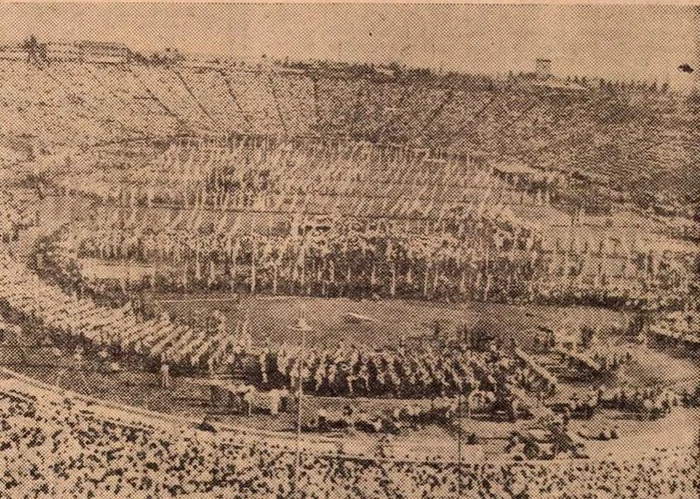
The August 23 Stadium, at its inauguration in 1953. Photo: Scânteia
“The stadium was built in record time, working day and night, by battalions of the General Directorate of the Labor Service (DGSM) and the Ministry of the Armed Forces (MFA), workers and citizens of the Capital, obliged by the so-called voluntary work to contribute. The work was facilitated by the existence of a natural pit, in which the stadium was built”a 1954 United States Central Intelligence Agency (CIA) document showed.
The stadium that welcomed Khrushchev and Lucescu, at the end of the road. The last whistle before the big demolition
The national press mentioned that thousands of people worked on the construction of the stadium and the park: workers, officials, soldiers, young women, housewives, students, elderly people.
“At the inauguration of the Festival, we got to know the country's biggest stadium. To be honest, we French would like the Colombes stadium (the biggest stadium in France, with a capacity of 50,000 seats) to be like it. The “23 August” stadium was built especially for the Festival. Its vast tribunes can hold well over 80,000 spectators. The stadium is excellently arranged for athletics competitions, its huge grassy crater has, between the huge access stairs, an endless row of wooden benches mounted on concrete bleachers. Thanks to the angle of inclination of the stands, visibility is perfect from any point of the stadium”noted, in 1953, the French publication L'Equipe, quoted by the Romanian press.
The stadium was demolished in the 2000s to make way for the National Arena
Most stadiums, built in the 60s and 70s
The former “1 Mai” stadium in Timișoara, later named Dan Păltinișanu, was inaugurated ten years later, on May 1, 1963. It had 30,000 numbered seats and another 10,000 for the spectators who remained standing, in the outer aisles of the stands.
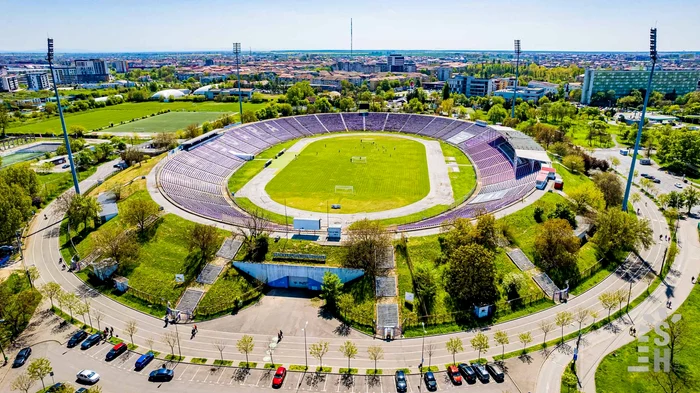
Dan Paltinișanu Stadium, before the start of demolition. Photo: Alfred Simonis.
“It impresses with its scale, elegance and the constructive solutions adopted. It is located in the south-eastern part of the city of Timişoara, in the immediate vicinity of some main arteries. Spectators' access to the stands is through 16 external stairs and 36 internal stairs. Around the football field there is a 400 m athletics track, with eight lanes (eight in a straight line). In the semicircles at the ends of the football field are arranged sectors for jumps and hoops for throws, and in front of the stands are the moose tracks for jumps”, informs the press of the time.
The former stadium in Timișoara is also being demolished.
In the 60s and 70s, most of the large stadiums outside the Capital were built. Most had over 20,000 seats and were made in Craiova, Bacău, Hunedoara (video), Brașov, Sibiu, Timișoara, Cluj-Napoca, Drobeta-Turnu Severin, Buzău, Ploiesti, Târgu Mureș, Suceava, Botoșani and even Medgidia, the last one with 30,000 seats.
Lauded during the communist era for their architecture and capacity, many arenas have been allowed to deteriorate over time. After 1990, attendances fell sharply from the communist era, when in many cities football matches were among the few ways for locals to relax, and clubs supported by big business went into decline with them.
How the cities of Romania were filled with stadiums. The end of the great arenas of communism, built by “patriotic labor”
Why stadiums built from scratch are preferred
Stadiums of 20,000 seats have arrived almost empty for matches, and the number of hosted events has decreased by as much. In many of them, renovation investment was minimal, often consisting of replacing old fixtures and utilities, fitting out interior spaces, and installing plastic seats in small areas instead of “classic” benches.
Although they do not have major structural deficiencies and could continue to be used, more and more old arenas are considered “outdated”.
According to specialists, modern standards for stadiums have changed in recent decades, and many constructions made in the 60s and 70s no longer meet the requirements regarding the safety and comfort of spectators, access for people with disabilities, as well as those related to electrical and sanitary installations, parking or commercial and media facilities. At the same time, a new stadium generally offers the advantage of not being limited by outdated configurations and can facilitate functions and activities that can enhance the economic viability of the project.
“Stadium design must take into account the need to create hospitable structures that offer comfort and safety at maximum levels. Football stadiums are increasingly seen as architectural monuments within the urban landscape that have a major impact on the surrounding communities and infrastructure.” shows the UEFA Guide to Quality Stadiums.
According to the UEFA guidelines, impressive stadiums can be built with relatively limited budgets, meaning that even smaller clubs have the opportunity to use bold designs. They must serve the whole community, being designed as family-friendly destinations, both for football matches and other events.
“Stadiums must be developed to maximize their commercial potential, integrating a diverse range of amenities and facilities. Stadium design must incorporate the latest technology to provide the best facilities to the football-loving public, who increasingly expect more from the stadium experience.” the UEFA Guide also shows.