Gold from the National Bank of Poland. A member of the central bank's management board explains what's going on

Artur Soboń points out that a possible decision to sell part of the gold from the central bank's reserves is consistent with its mandate. It is difficult to talk about financial stability, low inflation and a strong currency without state security – reminds a member of the NBP management board and gives Ukraine as an example, where inflation increased and the hryvnia collapsed.
Bartek Godusławski, Business Insider Polska: “Achieving a positive financial result is not the goal of the central bank, including the National Bank of Poland” – this is the official position. Is it already obsolete, since the National Bank of Poland is ready to sell gold to ensure extra profit to finance defense?
Artur Soboń, member of the NBP management board: It is very important to separate two things. Achieving a positive financial result is not and has never been the goal of the central bank – neither the National Bank of Poland nor any other central bank. The aim is to maintain price stability and protect the value of money. This is the primary goal that we pursue through monetary policy.
If a loss occurs while achieving this goal – and it may occur because fighting inflation costs money – it is a consequence of the central bank's actions, not an error. Such a loss is covered either from surpluses from previous years or from future profits. Ustawa przewiduje, że 5 proc. profit is used to cover losses.
What has the greatest impact on the financial result of the National Bank of Poland?
In Polish conditions, these are mainly two factors: the zloty exchange rate and the costs of open market operations. They determine whether we have a profit or an accounting loss.
It should be remembered that central banks apply specific accounting principles. To put it simply: if we have 1,000 dollars bought for PLN 3,900, and at the end of the year their value is PLN 3,600, we show a loss of PLN 300 in accounting – even though we still physically have the same dollars.
In the case of the National Bank of Poland, where reserves amount to hundreds of billions, such revaluations are on an appropriately large scale. But this is not a loss in the economic sense. This is the accounting result resulting from the adopted principles, which are the same throughout the European System of Central Banks.
The rest of the text below the photo
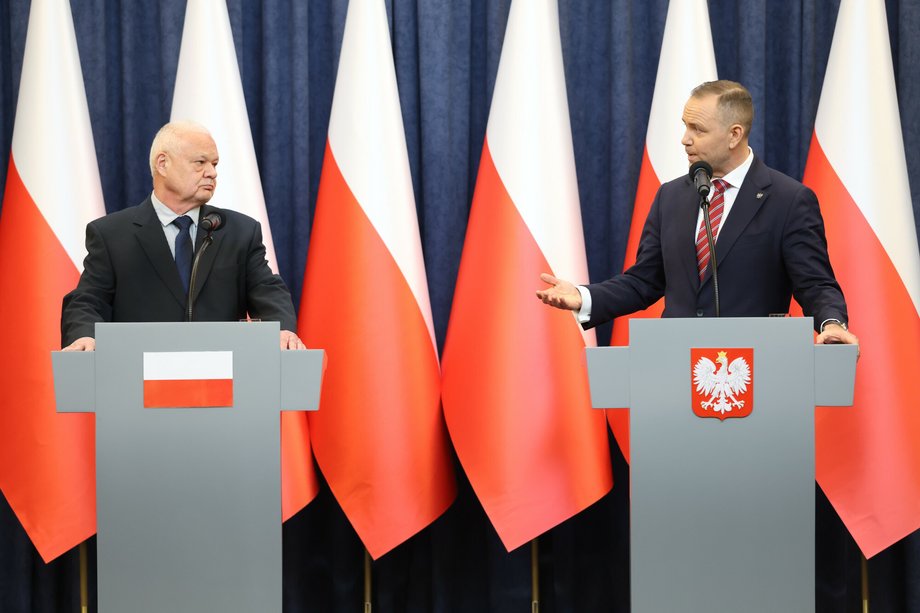
President Karol Nawrocki and NBP President Adam Glapiński announce how to finance defense using gold
|
Andrzej Iwanczuk/REPORTER / East News
How does the sale of gold relate to the central bank's mandate of price stability and currency value?
It not only fits the mandate – it can be said that in the current conditions it is fully consistent with it. Today, gold constitutes over 30 percent. our reserves, i.e. their value is approximately PLN 340 billion. This is the only asset that we have not actively traded so far.
Other assets – bonds, other instruments such as shares – generate income. Their profitability is approximately 3.5%. annually. We treated gold as a safe haven, an element of building the credibility and stability of the state, a kind of security buffer.
We did not plan to actively trade gold – rather to purchase it up to a certain level, which we estimate today at approximately 700 tons. Natomiast sytuacja rynkowa się zmieniła. We have a very high increase in gold prices, which – to be honest – no one predicted.
And this opens up the possibility of action?
In this situation, we can sell part of the gold in such a way as not to reduce the level of reserves, and at the same time generate income resulting from the difference between the purchase price and the market price at which we can sell it.
What we technically call unearned income becomes the real financial result at the moment of the transaction. And this is fully consistent with the rules applicable to central banks.
Will the liquidity of the gold market allow the NBP to make transactions worth tens of billions of zlotys?
The gold market is one of the most liquid markets in the world. Daily turnover reaches approximately USD 200 billion. This is not a market where large operations cannot be carried out.
The rest of the text below the entry
Gold gains amid uncertainty
However, you set a condition for selling gold – the money must be used for a specific purpose, i.e. financing defense. Isn't this violating the independence and apolitical nature of the central bank?
Rather, it is an expression of responsibility. Two issues are important in this context. First, safety. It is difficult to talk about financial stability, low inflation and a strong currency without state security. We will look at Ukraine. Since Russia's aggression in 2022, inflation there has remained high and the exchange rate has collapsed. Therefore, taking into account our location on the map of Europe and Russia's aggressive attitude towards its neighbors, today it is impossible to separate security issues from economic issues. And the central bank must take this into account.
Second, military spending has a relatively small inflationary impact – it does not generate strong demand pressure like other spending.
Does such an operation require the consent of the European Central Bank?
The management of foreign exchange reserves is the responsibility of the National Bank of Poland. We do not go beyond applicable regulations – neither national nor European.
Why such a rapid increase in reserves in recent years?
To jest naturalny proces. The Minister of Finance exchanges funds in euro from the EU for zlotys at the National Bank of Poland. In addition, there is money from KPO or potentially from programs such as SAFE. Each such inflow increases the reserves and at the same time requires us to take sterilization measures. The same will happen with SAFE.
Aren't you afraid that an operation such as the sale of gold will set a precedent and open Pandora's box, and politicians will always have in the back of their minds that they can come to the National Bank of Poland for extra money?
I understand these concerns. Therefore, it is particularly important that the profits from the increase in gold prices are used responsibly to increase the security of all Poles. In the face of the current geopolitical situation, this has an existential dimension. Redirecting these funds to current expenses would generate inflation risks.
Gold has its own specificity – its price increases during periods of uncertainty. Today we have such a moment.
And the exchange rate risk? Even if the NBP makes money on the sale of gold, it may have losses due to the strong zloty, which will consume the entire positive result.
Exchange rate risk always exists. But the average rate of our reserves changes every year, which limits this risk. The appreciation of the Polish zloty may reduce the financial effect, but it is unlikely to eliminate it.
Is the war in Iran a good time for such an operation?
From a security perspective, the moment is very serious. From a financial perspective, we have a unique market situation that provides a real opportunity to support the state without compromising the stability of the reserves.
If we were talking about Poland's economic situation a month ago, the picture would be very positive. Inflation is low and, in the interest of the central bank, the economy is accelerating and is expected to grow by approximately 4 percent this year. Is the war in the Middle East turning everything upside down?
It certainly forces adjustments to forecasts. Until recently, it seemed that inflation would stabilize within target and the economy would grow at a rate of approximately 4%.
In the short term, the war in Iran means higher inflation. However, a comprehensive assessment of the impact of this shock on the medium-term inflation outlook is difficult.
First of all, since the conflict lasted. The longer it lasts, the stronger its negative impact will be. Disruptions to raw material supplies are key, with up to one third of shipments passing through the Strait of Hormuz. Therefore, today we do not know how oil and gas prices will develop in the coming months, and this is crucial for the inflation outlook.
However, the scale of the impact of the shock on the commodity market on medium-term inflation prospects will depend on many factors, such as the situation on the labor market, developments in inflation expectations and the scale of transferring the increase in costs to core inflation.
For example, we see higher fuel prices at gas stations, but this does not necessarily lead to stronger wage pressure, but may result in lower spending on other consumer goods.
The National Bank of Poland recommends caution
How does the National Bank of Poland react? So we should expect the decision on further interest rate cuts to be suspended?
It is undoubtedly advisable to be careful and analyze the data and incoming information. The Monetary Policy Council will make decisions based on inflation projections and current information, and the July projection will undoubtedly include the impact of the war in Iran on the economy. As always, the NBP will provide the MPC members with up-to-date analyzes and forecasts.
Author: Bartek Godusławski, journalist of Business Insider Polska